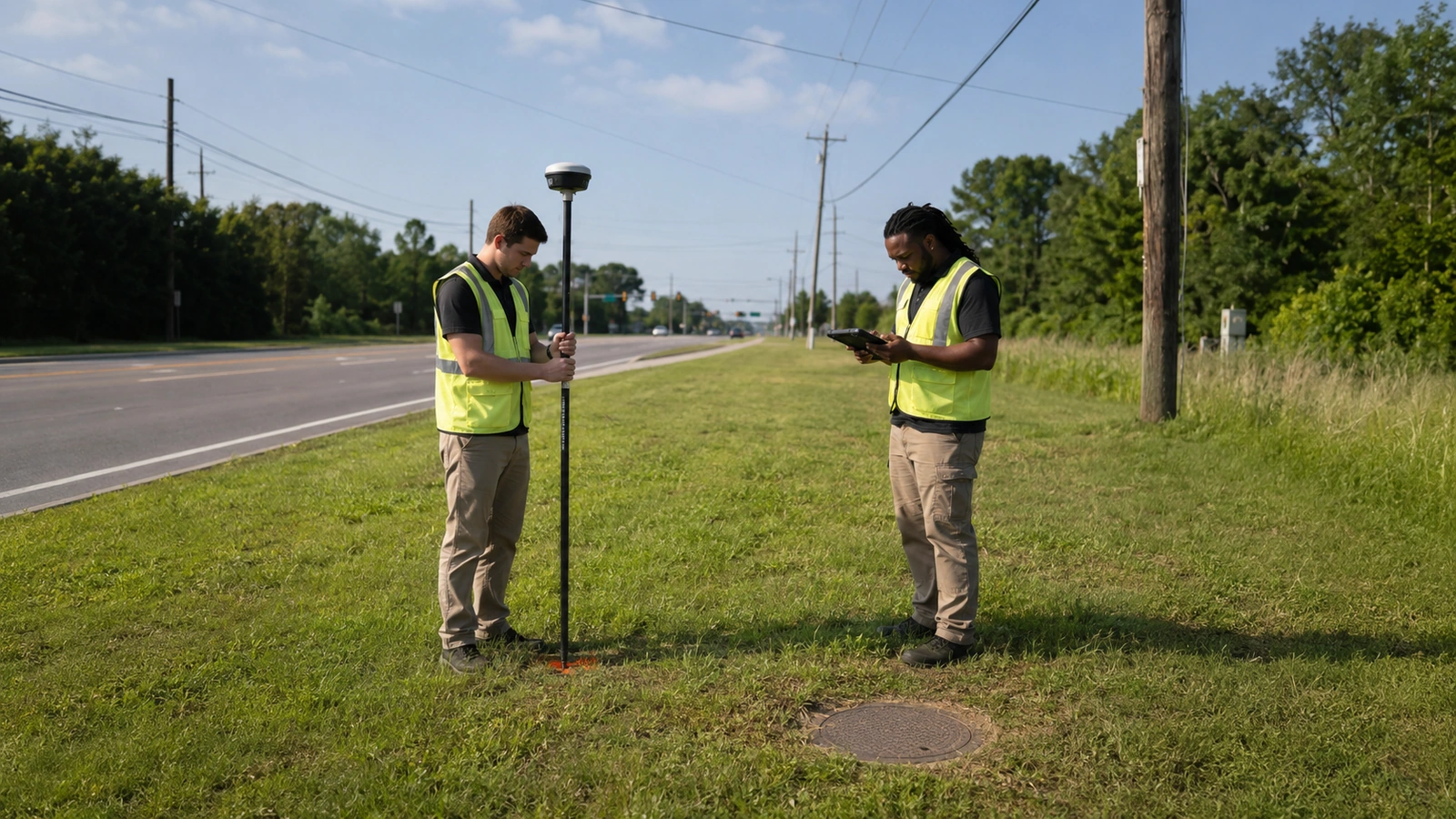
The outsourcing decision is usually framed as headcount. That misses the expensive part. A fiber route survey succeeds only when the collecting team understands the receiving design decision, follows the governing owner and safety requirements and returns evidence that survives QA. Capacity matters, but unowned interfaces create the repeat trip. Capacity alone is not proof.
In-house crews have context and direct access to operations. External teams can mobilize specialized capacity and carry a controlled workflow across a changing program. Either model can fail. An internal crew without a frozen schema produces inconsistent records, while an outsourced crew without engineering feedback produces a polished package that answers the wrong questions. Context still matters.
This comparison focuses on the operating conditions that tip the choice. We examine scope maturity, route dispersion, safety control, owner requirements, data acceptance, correction ownership and continuity after delivery. The verdict is segmented because a stable local maintenance survey and a multi-region deployment should not be procured the same way.
Fiber Route Survey Outsourcing Is a Control Decision
Fiber route survey outsourcing assigns field collection and its QA handoff to an external team under a defined scope, while the owner retains approval of criteria and acceptance. Compare the models across 4 gates: scope readiness, safe mobilization, engineering-data fitness and correction ownership. Outsource only when responsibility remains explicit at every gate.
A survey provider should not invent the engineering criteria it is hired to collect. The owner or engineer defines the route purpose, asset classes, required dimensions, photo evidence, coordinate expectations, owner forms, exception states and delivery format. The field team then proves that the workflow can collect those items safely and consistently. If the scope says survey existing utilities without defining the intended design output, neither model has a fair acceptance test.
In-house control is strongest when the same small team repeatedly surveys a familiar plant and can resolve questions with its own engineering or operations staff. Outsourcing becomes stronger when route volume is uneven, work spans separated areas or the owner needs capabilities it does not maintain continuously. The deciding issue is not whether external labor is available. It is whether the external workflow can preserve project-specific judgment without adding another unowned boundary.
Decisions the Owner Must Retain
The owner retains acceptance authority, source-of-truth decisions, access authorization and the right to change scope through a controlled revision. An outsourcing agreement can assign preparation and review tasks, but it should not blur who approves a route observation for design. We ask one plain question during setup: who can declare that an exception is acceptable? If the answer changes by email thread, the governance model is not ready for production.
External support also does not transfer every site risk to the provider. The contracting party still needs accurate access information, known owner constraints, applicable permits or permissions and escalation contacts. The provider controls its people and methods within the agreed scope. Both parties share a duty to stop work when field conditions exceed that basis. A procurement document cannot make unknown property rights or energized hazards disappear.
In-House Crew Versus Outsourced Survey Team
The practical comparison is about operating fit. In-house teams gain from local memory and direct communication, but they carry fixed capability and can be pulled into urgent operational work. Outsourced teams can provide variable capacity and documented production controls, but they need deliberate onboarding and timely owner decisions. A hybrid model can work when the owner keeps high-context exceptions while the external team handles repeatable route collection under one schema.
We use the table as a preview, not a universal scorecard. Each row needs evidence from the actual route program. A local crew may mobilize faster for one nearby segment, while an established external team may be faster across several regions. An owner can have excellent internal QA and weak capacity or abundant staff and no controlled data model. Judge the configured system, not the label on the org chart.
| Decision factor | In-house team | Outsourced team | Question that decides |
|---|---|---|---|
| Local context | Direct operating memory | Requires structured onboarding | Is local knowledge documented or held by individuals? |
| Capacity | Stable but finite | Can scale by agreed mobilization | Is workload steady or released in waves? |
| Methods | Owner controls directly | Contract and pilot control methods | Are acceptance criteria complete and testable? |
| QA path | Short communication chain | Needs named review and return interfaces | Who accepts and who corrects each defect? |
| Continuity | Supports recurring local work | Supports variable program delivery | What knowledge must remain after closeout? |
| Special access | May know owner relationships | May bring specialized field workflow | Which permissions and qualifications govern the route? |
Where an In-House Crew Wins
An in-house crew wins when work is continuous, geographically compact and tightly connected to maintenance decisions. The team can carry owner-specific naming and operating knowledge without translating it for each release. Questions can move directly to the responsible engineer. This model is especially strong for recurring updates where a brief site visit depends on knowing prior repairs, access contacts or internal records that would take longer to package than to use.
The weakness is priority conflict. Internal field staff are often the same people called for outages, customer issues or urgent plant work. Survey assignments then wait or restart between interruptions. Familiarity can also hide undocumented methods. If only one experienced employee knows which photo proves a cabinet condition, the process is fragile even though the team is internal. We recommend documenting the schema and review rules before measuring whether more capacity is needed.
Where Fiber Route Survey Outsourcing Wins
Outsourcing wins when the program releases work in waves, crosses multiple operating areas or needs a dedicated production queue that will not be displaced by routine operations. A capable partner can staff collection, supervisor QA, correction routing and delivery control as one workstream. That is materially different from buying isolated site visits. The owner still sets standards and accepts work, but the provider owns the daily mechanics of producing a reviewable package.
Our preferred integrated model has a candid limitation: onboarding takes real effort. We need source records, owner standards, route priorities, data dictionaries, access rules and sample deliverables before the pilot can prove fit. When a client wants crews in the field immediately but cannot identify the receiving schema, an external team may mobilize and still create delay downstream. We would rather pause setup than pretend field volume can repair an undefined handoff.
Procurement test: ask each bidder to show the exact path from one rejected field record through correction and engineering acceptance. A staffing chart without that path is not a delivery model.
Safety and Pole-Owner Rules Can Eliminate a Bid
Field survey is not harmless because it stops short of construction. Crews work near traffic, energized facilities, uneven ground, animals, vegetation and private-property boundaries. The OSHA telecommunications standard at 29 CFR 1910.268 covers telecommunications field installations and requires training in applicable precautions. It also requires traffic-control devices before work near vehicular or pedestrian traffic that may endanger employees. The scope must reflect the actual work condition.
That OSHA section also states that construction work falls under applicable standards in 29 CFR part 1926 rather than being covered as telecommunications field work under the same provision. Procurement should therefore separate observe-and-document tasks from construction activity. If the expected method involves climbing, opening facilities, excavation or another intrusive action, the required qualifications and controls may change. We do not let a broad survey label conceal the work method.
Traffic control should use the current authority and the agency's adopted requirements. FHWA identifies the MUTCD 11th Edition with Revision 1, dated December 2025, as the current official edition and Part 6 addresses temporary traffic control. That does not give one universal setup for every shoulder or local road. The field plan must apply the controlling agency rules and site conditions.
Pole-owner rules can govern who may survey and what information must be submitted. The current text of 47 CFR 1.1411 provides a 45-day survey period for covered ordinary pole-attachment applications after a complete application, with 60 days for mid-sized orders and 90 days for large orders. It defines mid-sized orders above the lesser of 300 poles or 0.5 percent of a utility's poles in a state. Applicability still depends on owner and jurisdiction.
The same rule permits affected attachers to be present during a utility field inspection and calls for commercially reasonable efforts to give at least 3 business days of advance notice. A survey vendor should understand whether it is collecting pre-application data for the new attacher, supporting the utility's survey or performing authorized self-help. Those are not interchangeable roles. The contract should name the role and required notices rather than merely citing pole survey.
An in-house crew can be the right answer when owner authorization is personal, established and difficult to transfer. An external team can be the right answer when it already meets the controlling qualification and notice process. We reject both shortcuts: assuming an employee badge grants access or assuming vendor experience with one utility transfers to another. Confirm the specific owner process before schedule commitments.
Build the Scope, Pilot and Acceptance Path
A strong scope defines the unit of work and the receiving decision. Route segments, poles, handholes, crossings, service locations or equipment sites each create different records. The scope identifies source data, expected geometry, attributes, measurements, photographs, owner forms, exceptions, safety limits, delivery format and review timing. It also states exclusions. A bidder cannot price or staff responsibly when the asset count and evidence standard remain open-ended.
What the Pilot Must Prove
The pilot must resemble production. Use a segment containing ordinary assets, an access issue, weak connectivity and at least one condition likely to trigger a return. Run the full assignment through collection, supervisor QA, engineering review, correction and export. We do not accept a platform demonstration as a pilot. The purpose is to expose how people handle ambiguity and whether the data model preserves the answer. Test the correction path early.
Pilot gate: approve production only after one difficult record survives collection, return, correction, acceptance and export with its stable ID and evidence intact.
Acceptance criteria separate completeness from fitness. A record can contain every required field and still fail because a measurement lacks method, an image shows the wrong asset or the relationship to an adjacent span is broken. We use device rules to catch format errors, supervisor QA to catch context errors and engineering review to judge intended use. For the evidence boundary, see our field survey data accuracy guidance.
Correction ownership needs a clock and a stopping rule, but those thresholds should be agreed in the contract rather than invented from a generic benchmark. Define who triages a return, what starts the response period, when a field revisit is authorized and how disputed acceptance is escalated. We recommend sampling accepted ordinary records while reviewing every safety, access and source-mismatch exception. A single average defect rate can hide a serious category.
The best partner evaluation follows interfaces. Our guide to choosing an OSP engineering partner helps test accountability beyond resumes. For aerial work, the strand mapping and plant assessment guide details connected route evidence. The fiber route field survey workflow we provide ties external collection to in-house engineering review instead of handing design an unqualified photo archive.
Cost comparisons should use the same scope and risk allocation. An internal payroll calculation that excludes vehicles, devices, supervision, travel, software, training, QA and repeat work is not comparable with an outsourced proposal that includes those items. The reverse is also true: a vendor day rate without mobilization, correction or delivery obligations is not a complete external cost. A defensible comparison identifies the same fielding scope variables on both sides without pretending one figure fits every route. Control must stay visible.
Choose the Survey Delivery Model by Operating Risk
Local owner with steady recurring work: keep an in-house crew when route volume is predictable, local context drives many decisions and the team has protected time plus documented QA. Do not outsource merely to avoid writing the data contract. The internal team needs that contract too. Invest first in repeatable evidence and a controlled review path.
Regional build with uneven releases: outsource when dedicated capacity, multi-area mobilization and a managed correction queue matter more than keeping every field role on payroll. Require a production-like pilot and named engineering acceptance. The Draftech delivery model is designed for owners who want field collection connected to accountable technical review, not a crew vendor operating beyond the receiving team.
Owner with sensitive access relationships: use a hybrid model. Keep owner-specific coordination and high-context exceptions in-house while assigning repeatable authorized collection to the external team. Define the transfer point by record type, not by informal judgment. The pole loading calculator may support an early planning discussion, but neither crew model should treat it as a substitute for measured inputs and formal analysis.
Outsourcing removes a capacity constraint only when scope, safety, owner authorization, QA and corrections operate as one system. Draftech connects those interfaces through an external field workstream with in-house engineering review. If you are comparing models, email info@draftech.com with one sample route, the intended design output and the owner requirements already known. We will tell you where the handoff is still undefined. Interfaces decide the result.
The verdict depends on operating shape. Stable local work with deep institutional context favors in-house delivery. Variable multi-area releases favor outsourcing. Sensitive owner relationships often favor a hybrid. None of the three works without acceptance authority and a controlled return path. Buy a field-to-engineering result, not an impressive number of people on the road. The selected model should be the one whose authorization, supervision, acceptance authority and correction path remain clear when the route becomes difficult and the schedule is under pressure.