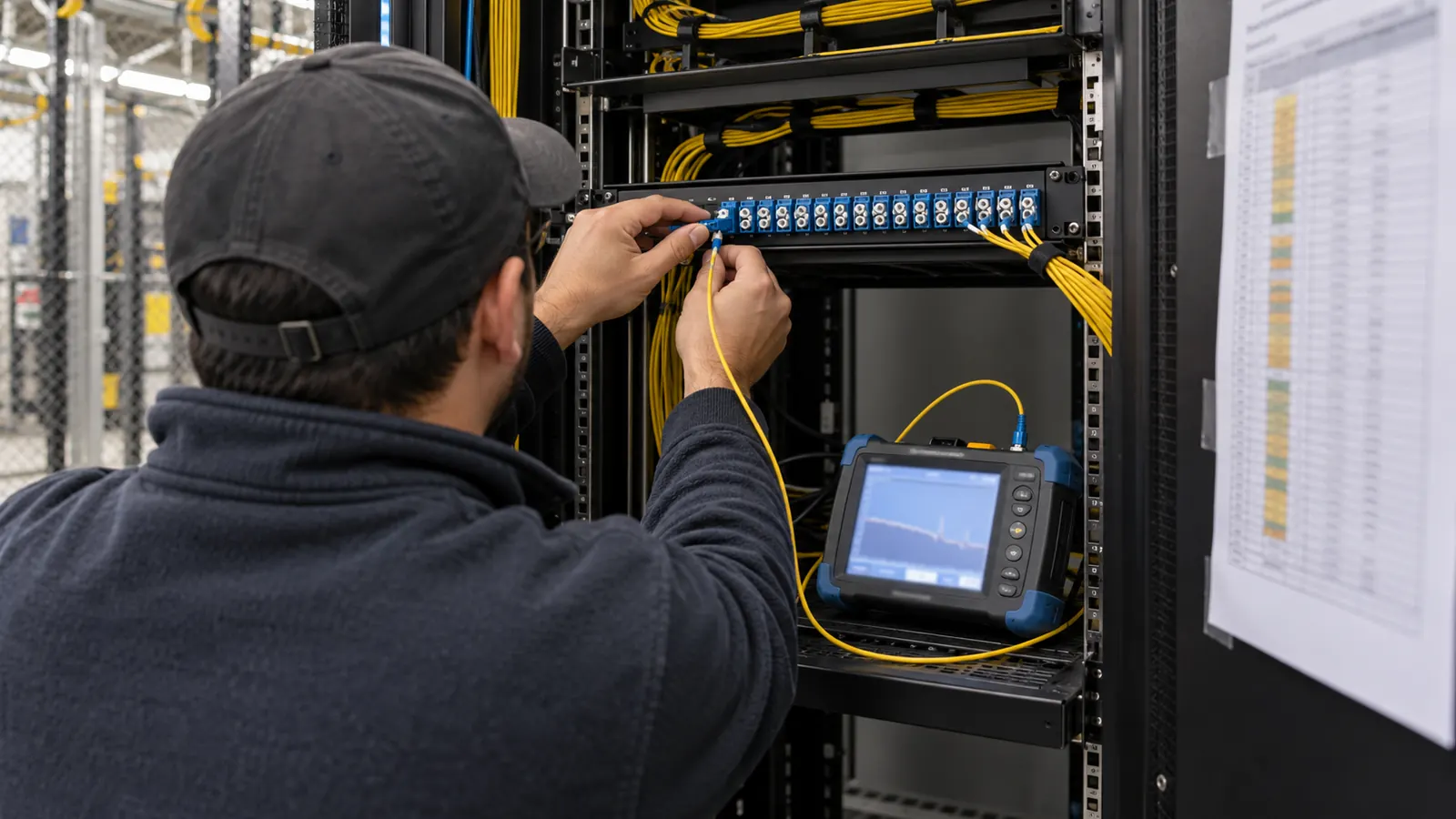
IRU meaning: a right to use specified infrastructure
An indefeasible right of use (IRU) is a long-term contractual right to use specified fibers, duct or capacity while the grantor retains ownership. For a route joining 2 endpoints, the practical iru meaning depends on the defined assets and contract: the grantor typically cannot revoke the right except for contract-named causes.
The agreement defines the right. The route determines whether that right serves the network. A carrier can obtain exclusive use of identified strands and still lack an approved building entrance, while an enterprise can secure capacity without controlling the cable that carries it. We start with those boundaries because the acronym alone settles neither question.
Indefeasible does not mean unconditional or permanent. The signed agreement governs termination events and the obligations that keep the right in force. We treat the term as a reason to examine the supporting schedules carefully, especially where the grantor depends on another party's infrastructure rights. Legal counsel determines enforceability. Our work establishes the physical facts counsel and the buyer need.
Identify the asset before comparing offers
A fiber IRU should point to identifiable strands between defined demarcations. A duct IRU concerns usable pathway space under its stated conditions. A capacity IRU concerns a defined transmission entitlement, which may depend on provider-operated equipment. We keep those descriptions separate when reviewing a route because permission to use one asset does not automatically include the others.
For a dark fiber route, we would reconcile the offered strand allocation with the cable and splice schedules before treating the connection as available. Each endpoint needs a handoff location that operations can find. A parcel boundary is insufficient. If the offer ends outside the building, the buyer still needs an entrance path and permission to reach the equipment room.
MCNC's publicly available Summary of its Master Agreement for Indefeasible Right to Use Fiber illustrates the distinction: identified customer fibers carry use rights, while access to designated splice points remains subject to protocols. That source describes one provider's arrangement. It demonstrates why we ask for the actual asset schedule rather than assuming every IRU includes unrestricted physical access.
Make the scope review useful to operations
The buyer should define its intended connection before asking engineering to evaluate an offer. We need to know whether the route will support carrier transport, a private enterprise network or a utility communications function. That operating purpose shapes the required handoff and restoration arrangements. It also determines who needs authority to approve a changed route after a failure.
Keep the commercial and technical reviews connected. When a contract schedule describes a continuous route but a drawing contains a gap at a third-party handhole, our review should identify the exact segment and the missing connection authority. The parties can then resolve a concrete exception instead of trading general assurances about access. Until it is resolved, the route remains conditional.
What the IRU agreement needs to identify
The route schedule is the engineering reference for the grant. We recommend checking it against current records before acceptance, then keeping the agreed version with the executed documents. A sales map can establish general intent, but it rarely contains the detail needed to locate a fault or decide whether a replacement path preserves the original service objective.
Fibers, route and term
Fiber allocation should remain traceable through every splice. We look for cable identifiers and the corresponding strand assignments, with changes in numbering explained where cables join. The route geometry should identify shared segments clearly. For duct rights, the equivalent review concerns the exact duct or subduct and the access points through which installation and maintenance can occur.
The term needs a defined start event. It might depend on acceptance or another contract condition; we do not assume that signing, construction completion and service activation mean the same thing. Those events can differ. The owner and counsel should also reconcile the use period with the underlying rights on which the grantor relies, including any conditions for renewal or replacement.
Maintenance, relocation and assignment
Maintenance language should establish who receives a fault report and who can authorize physical intervention. We ask how the parties will distinguish a failure in the granted fibers from a fault in customer equipment. Entry procedures matter. A restoration obligation is difficult to carry out when the responding crew cannot access the building or open the relevant enclosure.
Relocation provisions need an engineering counterpart. If the grantor may substitute fibers or change the route, the acceptance basis should address the optical performance and physical separation that the replacement must preserve. Assignment is another separate question: a buyer planning organizational changes needs counsel to review whether the right can transfer and what consent or notice applies.
The comparison below separates the rights question from the operating question. We use it to identify what must be established before evaluating route suitability; it does not determine the legal or accounting classification of any particular agreement.
| Arrangement | What the buyer receives | Operating boundary to verify | Route evidence to request |
|---|---|---|---|
| Fiber IRU | Long-term use of specified strands | Customer optics and grantor plant maintenance, as agreed | Strand schedule and accepted test records |
| Dark fiber lease | Use of unlit fibers under lease terms | Equipment responsibility and access permissions | Actual route and maintenance interface |
| Lit service or leased capacity | Defined transport service or capacity | Provider equipment and customer handoff | Service demarcations and diversity evidence |
| Owned build | Ownership of the specified constructed assets | Owner responsibility for plant operation | Rights, construction records and closeout package |
IRU meaning compared with a lease, lit service and ownership
The commercial label leaves important technical choices open. Dark fiber is unlit optical fiber that the user equips to carry traffic; our dark fiber route engineering guide explains the physical route behind that operating model. An IRU is one way to secure its use. A lease is another, and ownership is a different arrangement again.
IRU versus dark fiber lease
An IRU usually emphasizes durable use rights over a defined term, while a lease defines use through its own renewal and termination provisions. The documents control the distinction. We would compare the actual rights to specific fibers and the conditions for substitution before drawing conclusions from either label. Neither label establishes physical diversity or proves that the offered strands meet the optical design.
Both arrangements can leave the customer responsible for transmission equipment. That means our route review must connect the offered fiber characteristics to the proposed optics, and the buyer must identify who operates those optics after handoff. Equipment control can support future changes in capacity. It still depends on the available optical margin and the agreement's permitted uses.
Lit service and leased capacity
Leased capacity gives the buyer an agreed transport entitlement or service handoff rather than ownership of the underlying route. With a lit service, the provider operates the transmission equipment within the agreed service boundary. The buyer's engineering review therefore concentrates on the interface and performance commitments. We also ask what route information supports any claim of protected or diverse service.
Choose that model when the organization wants a provider to operate transport and can define an acceptable service boundary. Choose access to dark fibers when the organization needs control of the optical system and can sustain that operating responsibility. These are different workloads. Buying strand rights without an equipment operations plan leaves a significant part of the connection unresolved.
Owning a build
An owned build gives the owner title to the assets specified in the construction and transfer documents, with the associated responsibility for maintaining and operating them. Underlying land access can still depend on easements or permits. We distinguish ownership of cable from ownership of the corridor because a property boundary can constrain an otherwise suitable network design.
For a private fiber network, ownership may support direct control of extensions and spare capacity, subject to the route rights. An IRU can support the same network purpose through someone else's plant. Data center interconnect can likewise use owned fiber, granted strands or provider-operated transport. The application does not dictate the commercial form; the required control and available route evidence guide the choice.
Route design decides what the right delivers
A contractual fiber count must correspond to usable end-to-end paths. We start with the intended equipment architecture and reserve policy, then reconcile the required allocation through each cable segment. A large cable on a route map says little about which fibers the buyer can use. Continuity matters at every splice, including intermediate transitions that disappear on a high-level diagram.
Fiber count and spare duct
Reserved strands need an explicit purpose. A duplex optical link commonly uses a transmit fiber and a receive fiber, while other optical architectures can use fibers differently. We establish that design basis before recommending an allocation. Protection requirements must be considered separately. More strands in the same cable can provide capacity headroom without creating a separate physical path.
Spare duct also needs evidence. An unoccupied duct drawn in GIS may be obstructed or unavailable for the buyer's use, and a spare pathway may terminate before the critical crossing. We ask how continuity and access were established, then distinguish installed spare infrastructure from space that somebody merely proposes to reserve. The IRU schedule should match the available asset.
Expansion deserves its own review. If the current grant covers selected strands only, a future cable addition may require separate duct rights and a new installation approval. We would show that dependency beside the proposed expansion path rather than allowing the presence of unused conduit to imply an entitlement. Physical room and contractual permission are separate prerequisites for the addition.
Diversity through the full route
Two routes can converge at one entrance. Different providers can also share a conduit section or bridge attachment. We compare actual alignments through the buildings and critical crossings before accepting physical separation as a design input. The buyer must decide which common points are tolerable for the application, with those exceptions visible to the operations team that will depend on the connection.
For a facility where both paths enter the same room, the external route review cannot resolve every internal failure risk. Our data center fiber engineering services connect outside-plant decisions to the facility handoff so that entrance assumptions receive the same scrutiny as the corridor. The accepted boundary should explain where route separation ends and facility protection begins.
Review the replacement path: Require an engineering review when a permitted relocation changes a shared-risk point. A replacement can meet the original strand count and still put previously separated paths into a common duct.
Specify the actual G.652 fiber
ITU-T Recommendation G.652, Characteristics of a single-mode optical fibre and cable, edition 08/2024, was approved on August 29, 2024 and is listed by ITU as in force. It describes fiber and cable characteristics. The designation helps establish the optical design basis, but it does not certify the installed route or its compatibility with every transmission system.
Request the applicable fiber category and manufacturer data for each segment. We compare those records with the proposed equipment requirements and identify any transition between fiber types. A route assembled from different cable sections needs review as an installed path, especially where the intended transmission system makes dispersion or other optical characteristics relevant. The actual equipment specification sets that requirement.
One limitation of our preferred records-led review is that incomplete or stale records can conceal a shared path until field verification exposes it. We therefore mark unresolved evidence explicitly. Where a critical separation claim depends only on an unsupported line in a drawing, the buyer should require verification before relying on that claim for network resilience.
Accept the fibers and preserve the evidence
Acceptance needs to connect the legal asset description to the installed plant. We recommend agreeing the technical criteria before tests begin, with the grantor and buyer identifying who can accept results and resolve exceptions. That avoids treating a generic test report as proof that the particular fibers named in the agreement are ready for the intended connection.
Splice records and optical testing
Each delivered fiber needs traceable endpoint labels. The splice schedule should show how that identity continues through intermediate closures, including any changes introduced during construction. We reconcile the test filenames with those identifiers so that operations can retrieve the correct baseline after a fault. Unmatched reports remain unresolved. A passing result on an unidentified strand cannot establish acceptance of the granted strand.
The test plan should distinguish end-to-end insertion loss measurements from optical time-domain reflectometer records. Insertion loss testing measures the loss of the defined path; an OTDR helps locate and characterize events along it. We discuss those complementary roles in OTDR testing and fiber splice acceptance. Use the project's agreed criteria rather than importing an unexplained splice threshold from another network.
Test setup belongs with the result. Record the wavelength and direction, with the instrument configuration needed to interpret the trace. Where bidirectional splice evaluation is required, retain the corresponding traces together so the reviewer can reconcile apparent gain and loss at the same event. We also want the disposition of failed or retested fibers preserved rather than overwritten by the final passing report.
As-builts and changes after acceptance
As-built records should reflect the installed route. We expect field changes to reach the cable and splice schedules, with accepted exceptions linked to their locations. The drawing should let a maintainer identify the relevant structure without guessing which revision describes it. A technically accepted connection still needs controlled records if it will remain understandable after staff or maintenance contractors change.
Restoration changes the baseline. A repair may add a splice or replace a cable section, so the maintenance process should identify who updates the records and what retesting establishes the restored condition. Keep the earlier accepted results available for comparison. That history helps distinguish a new degradation from an existing characteristic of the path when operations investigates a later incident.
Choose the review that fits your network
Carriers: Reconcile the proposed fiber allocation with the transport design before accepting a route commitment. Require the strand schedule to identify any intermediate handoff controlled by another party. We recommend resolving substitution rights against the intended capacity plan so that a changed path does not silently invalidate the equipment assumptions behind a customer service commitment.
Data center operators: Review the diverse paths through the facility entrance, not just between property boundaries. Ask for the common-point inventory and assign responsibility for the internal connection. Our priority is an explicit demarcation. That gives facility operations a clear boundary for investigating a fault and identifying when the outside-plant maintainer must become involved.
Enterprises and utilities: Decide who will operate the optical system before selecting a fiber-use arrangement. Organizations seeking a defined service handoff should evaluate lit transport against that requirement. Those retaining equipment control should establish an internal operating owner and a workable maintenance interface. We recommend retaining the accepted route records within the network's asset management process rather than only with procurement.
Draftech International provides turnkey telecom and power infrastructure, from field survey and planning through construction drawings, permits, agency coordination, construction, as-builts and closeout. Engineering is 100% in-house; full turnkey construction is delivered by Draftech-managed subcontract crews under Draftech's QA/QC. Our company and partner information explains the team behind that delivery. Draftech does not lease, sell or broker dark fiber or IRUs and gives no legal or tax advice.
Bring unresolved strand assignments and route-diversity questions into a long-haul fiber engineering review before accepting the technical package. We can define the missing survey or design work and connect it to acceptance records that operations can use. Send the route scope through our contact page, or reach us at info@draftech.com.
For a qualifying route, the free-design offer covers Draftech engineering of the first 20,000 linear feet at no cost, from feasibility and field survey through permit approval. The owner reviews each request before Draftech commits the package. That provides a way to resolve route-design questions while the buyer separately evaluates the proposed IRU with its own advisers.