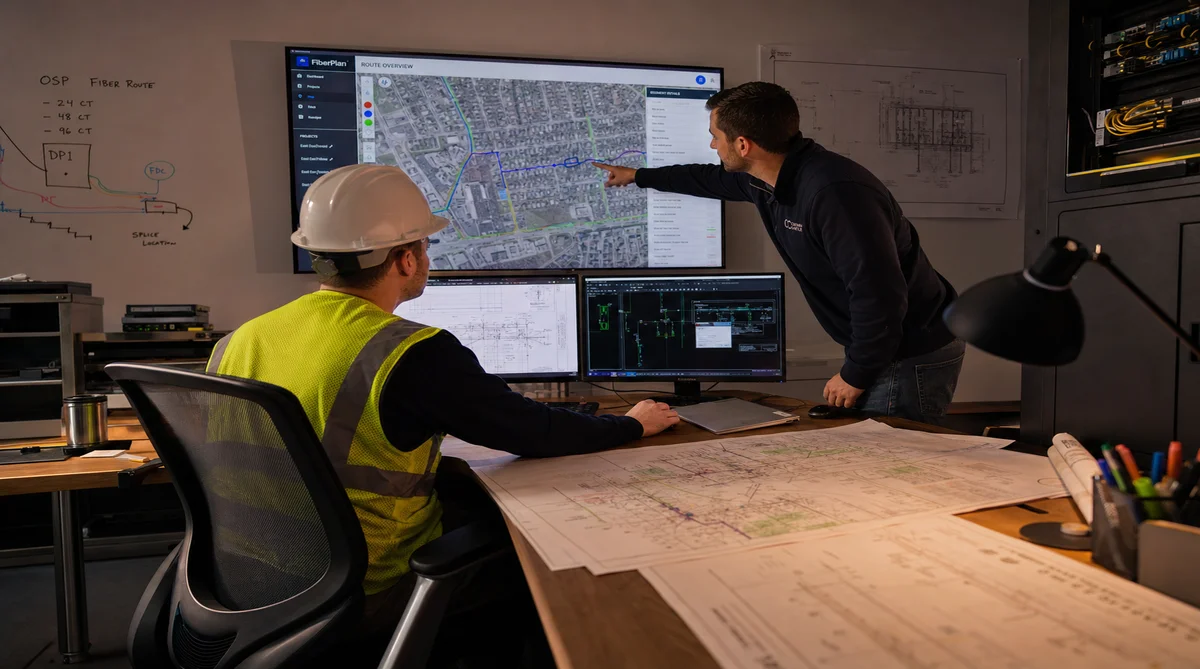
There are two kinds of ISPs building fiber right now. The first kind treats OSP engineering as something that happens between the business plan and the construction contract, a necessary box to check, best done cheaply and quickly so the real work can begin. These are the ISPs whose projects stall at the permit office because the drawings didn't meet DOT submittal standards. They're the ones who hit make-ready surprises three months into a build because no one ran proper pole loading calculations before the attachment applications went out. They miss BEAD construction start milestones because the permitting clock never started: it can't start until the drawings are submitted, and bad drawings don't get submitted, they get sent back.
The second kind treats OSP engineering as core infrastructure, the phase that determines whether everything downstream works. ISPs that treat OSP engineering as a commodity get commodity results. A cut-rate design package that saves $38,000 on a $4.2M build will cost you that and more when the state DOT bounces your encroachment permit submittal, when a utility owner flags 37 poles for complex make-ready that wasn't caught in the loading analysis, or when your construction contractor hits the field and finds the drawings don't match what's actually in the ground. I've seen all three of these happen, sometimes on the same project. This article explains what OSP engineering actually covers, how to evaluate who's doing it for you, and what timelines you need to build your program around.
What OSP Engineering Actually Covers
Most ISPs, when they first engage an engineering firm, think they're buying drawings. What they're actually buying, or should be, is six distinct workstreams that gate each other in sequence. Treating any one of them as optional or abbreviated is how you create problems that show up two phases later.
Field Survey
Field survey is where the data that drives every other workstream gets collected. A field crew walks or drives the proposed route, documenting existing aerial strand, pole inventory, span lengths, conduit locations, access constraints, and site conditions that don't show up in GIS or satellite imagery. In areas with heavy tree canopy (say, a rural route in East Tennessee or upstate New York), the difference between what imagery shows and what's actually there can be significant. Utilities depend on field survey data to validate attachment capacity and identify where rearrangements will be needed. Construction crews depend on it to plan equipment access. If field survey is rushed or done from a desk using only existing GIS, every workstream that follows is built on guesswork. The cost of bad field survey data shows up at the worst possible time: during construction, when guesses become change orders. For a detailed breakdown of what accurate field survey data does to project outcomes, see our guide on field survey data accuracy in fiber construction.
Route Design
Route design covers both high-level design (HLD) and low-level design (LLD). HLD establishes the architecture: route corridors, feeder and distribution topology, node placement, equipment specs, address coverage verification. For a BEAD project, HLD documentation also has to demonstrate scalability to at least 1 Gbps symmetrical and show coverage of all eligible locations in the subgrant area. LLD takes that architecture and translates it into a pole-by-pole, span-by-span construction design: cable placement, hardware callouts, slack storage locations, splice point placement. LLD is what the contractor actually builds from. If HLD and LLD aren't clearly separated and sequenced, you get designers who jump to LLD detail before the architecture is locked and then have to rework everything when the route changes. That's not hypothetical: it's one of the most common sources of engineering rework on rural builds.
Permit Drawings
Permit drawings are the version of LLD formatted to meet the submittal requirements of each permitting authority: state DOT, county road department, railroad, USACE. These are not the same as construction drawings, though inexperienced firms often conflate them. A DOT encroachment permit submittal in Georgia requires a specific plan-and-profile format, a title block with the engineer's license number, and a separate traffic control plan. A railroad crossing permit requires its own structural calculations and a separate narrative. Getting these formats wrong doesn't mean a slow review: it means a bounced submittal, a reset clock, and weeks or months of delay. Permit drawings are also where PE stamping becomes non-negotiable; most DOTs and many municipal jurisdictions will not accept unstamped drawings.
Pole Loading Analysis
Pole loading analysis runs NESC-compliant structural calculations for every pole where a new attachment is being added. The calculation accounts for existing wire loads, the proposed fiber attachment, wind and ice loading by geographic zone, and any equipment mounted on the pole. The output tells you whether a pole can accept the new attachment as-is, or whether it needs to be replaced, guyed, or have existing attachments rearranged before yours can go on. In dense rural routes (we've run programs with 14,000 poles across three counties), this analysis regularly surfaces 15 to 22% of poles with loading deficiencies that weren't visible from field inspection alone. Each deficiency is a make-ready cost and a timeline delay. Finding them during the engineering phase costs a fraction of what it costs to find them after the attachment application is already in, or worse, after construction starts. Firms that can't do pole loading in-house will subcontract it, add markup, and introduce a coordination delay at exactly the phase where you can least afford it.
Utility Coordination
Utility coordination covers the process of getting pole attachment applications submitted, tracked, and responded to, and then managing the make-ready work that comes out of those responses. In states with active one-touch make-ready (OTMR) frameworks, this process can move relatively quickly. In investor-owned utility territories without OTMR (and there are a lot of them), attachment applications go into a queue, get a field inspection that takes 30 to 60 days, come back with make-ready specifications, and then require separate work orders to be executed before your attachment can be placed. Coordinating this across dozens or hundreds of pole owners simultaneously, tracking open applications, following up on delayed field inspections, and documenting completed make-ready for BEAD reimbursement purposes is not administrative overhead. It's engineering project management, and when it's done poorly, it's the single most common reason ISP builds fall behind their BEAD milestones.
Construction-Ready Deliverables
The end product of OSP engineering is a package that a contractor can take into the field and build from without ambiguity. That means permit-cleared drawings with make-ready clearance documented, a bill of materials with quantities that match the design, splice diagrams keyed to the LLD, a fiber assignment plan, and GIS-accurate as-designed data. It also means a BEAD-compliant deliverable package if that's what the project requires, with the specific feature datasets, attribute schemas, and narrative documentation that state program offices actually review. For a detailed breakdown of what a complete construction package should include, see our fiber construction package deliverables guide.
| Factor | In-House OSP Engineering | Outsourced OSP Engineering |
|---|---|---|
| Ramp time | 3 to 9 months to hire, onboard, and reach full productivity | Engagement begins within 1 to 3 weeks of SOW execution |
| Surge capacity | Fixed headcount; overtime is the only lever | Scales to project volume; multiple concurrent builds manageable |
| State-specific expertise | Limited to states where you've operated | Firm has institutional knowledge across many jurisdictions |
| Pole loading | Requires licensed PE and specialized software (O-Calc, SpidaCalc) | Included in-house; no subcontracting markup or coordination delay |
| BEAD deliverable compliance | High learning curve if team hasn't done it before | Experienced firm has template packages and state program familiarity |
| Cost structure | Fixed overhead regardless of project volume | Variable; aligns to project scope and timeline |
| Turnover risk | Losing one OSP engineer on a small team creates a critical gap | Firm provides continuity; personnel changes managed internally |
Why Most ISPs Outsource OSP Design
The ISPs who struggle most with this decision are the ones who already have engineering staff, usually a network engineer or two who can handle the existing plant, and assume that scaling up means hiring a few more people. The math doesn't work out that way. Hiring an experienced OSP designer with HLD/LLD competency and GIS skills takes, conservatively, 90 to 120 days from posting the job to first productive day. A licensed PE with fiber attachment experience can take longer and costs $115,000 to $145,000 base salary in most markets. You're competing for that person against Tier 1 carriers and large cable operators running BEAD programs at 10 times your scale. And you need that person on the project now, not in four months.
The Pole Attachment Regulatory Problem
Pole attachment is one of the most underestimated complexity drivers in ISP fiber builds. The NESC governs structural requirements, but state-level pole attachment rules vary: Georgia, Tennessee, and Florida each have different attachment timelines, dispute resolution processes, and make-ready frameworks. Investor-owned utilities in states without OTMR can take 4 to 9 months from application to make-ready clearance. A firm that has run attachment campaigns in your state before knows which utility operations centers to contact, what format they accept, and how to escalate a stalled application. An in-house team doing it for the first time in a new state will spend the first three months learning things that cost you time on the permitting clock.
Make-Ready Surprises
The make-ready cost problem is related to the pole loading point above, but it's worth separating. Make-ready surprises (poles that require rearrangement, replacement, or guying that wasn't budgeted) are one of the most common sources of project cost overruns in rural ISP builds. On a 47-mile route we supported, the pole loading analysis identified 112 poles requiring make-ready, of which 23 required full replacement. The ISP had budgeted for 30 make-ready poles total. Finding those 82 additional issues during the engineering phase, before applications were submitted and before construction was mobilized, meant the make-ready costs could be properly scoped and included in a BEAD budget amendment rather than appearing as a surprise mid-build. The analysis took 11 days. Discovering the same deficiencies during construction would have taken months to resolve and potentially jeopardized the subgrant timeline.
BEAD Documentation Requirements
What BEAD state broadband offices actually review is more specific than most ISPs expect when they first read the NOFO. They want GIS feature datasets with defined attribute schemas, typically NTIA-aligned, though each state has added its own requirements. They want HLD documentation that explicitly addresses scalability to 1 Gbps symmetrical and includes a coverage methodology narrative tied to the Fabric-derived eligible location list. They want as-built submittals with OTDR records, splice documentation, and GIS accuracy within 1.5 meters. They want quarterly reporting maps in a specific format. An ISP whose engineering partner hasn't produced these deliverables before is going to learn the requirements the hard way, on a timeline that the program office is tracking. For a fuller breakdown of what the permitting and BEAD submission timeline actually looks like phase by phase, see our guide on BEAD permitting timelines for fiber construction.
How to Evaluate an OSP Engineering Firm for Your ISP Build
The evaluation process matters. The cheapest firm and the most credentialed-sounding firm are both wrong answers if they can't actually produce what you need on your timeline. Here's what to ask and what to look for.
Questions Worth Asking
- What GIS tools do you use for design and deliverables? The answer should include specific platforms (ArcGIS, QGIS, AutoCAD Map) and should describe how GIS data is maintained through design iterations and tied to as-built documentation. A firm that doesn't have a coherent GIS workflow will produce deliverables that can't be maintained or used for BEAD closeout.
- What is your QC process for permit drawing submittals? You want to hear about a specific internal review step before drawings leave the firm, not "the designer reviews their own work." Permit submittals that get bounced because of formatting or completeness errors set back your timeline by weeks.
- Have you completed BEAD-compliant deliverable packages? Ask for a redacted sample. If they can't show you one, they haven't produced one.
- What are your typical turnaround times by deliverable type? Field survey processing: 5 to 8 business days. HLD package: 12 to 16 days after survey data is finalized. LLD and permit drawings: 18 to 25 days depending on route complexity. If the answer is "it depends" with no reference ranges, the firm doesn't have a production process that can support your milestone schedule.
- Do you have in-house pole loading capability? And specifically: which software (O-Calc Pro, SpidaCalc), which PE licenses, and in which states?
Red Flags
- Can't separate HLD from LLD. This is a fundamental competency issue. HLD and LLD are different work products with different purposes, audiences, and review cycles. A firm that conflates them or jumps straight to LLD without locking HLD first will create rework cascades that cost you weeks.
- No in-house pole loading capability. Subcontracting pole loading means a markup, a coordination dependency, and a delay at the exact phase where your permitting timeline is most sensitive.
- No GIS output in deliverables. If the firm produces drawings only, without GIS-native design files, you don't have a deliverable that supports BEAD closeout or as-built maintenance. Every construction-ready package should include GIS-native network geometry.
- No state-specific permitting experience. "We've done permits" is not the same as "we've successfully submitted DOT encroachment permits in your state and we know the current review coordinator." States change formats, update submittal requirements, and have reviewers who have preferences that aren't written down anywhere. State-specific experience matters.
For a detailed walkthrough of what separates capable firms from marketing-heavy ones, our guide on how to choose an OSP engineering partner for fiber goes deeper on the due diligence process.
OSP Engineering Timelines ISPs Should Plan Around
Timeline expectations are where most ISP build programs go wrong. The instinct is to compress the engineering phase to get to construction faster. What actually happens is that compressed engineering produces submissions that get rejected, which restarts clocks and pushes construction back further than a properly-paced engineering phase would have.
Phase Breakdown
- Field survey: 8 to 14 days in the field depending on route length and terrain, plus 5 to 8 days to process and QC survey data. A 30-mile route in flat terrain can run faster; 30 miles through hilly, wooded terrain with limited road access takes longer.
- HLD: 12 to 16 days after survey data is finalized. Includes route design, node placement, coverage verification against eligible location list, and BEAD narrative documentation where required. HLD must be reviewed and approved before LLD begins. Skipping this step is how you end up redesigning the LLD two months later.
- LLD: 18 to 25 days for a 20 to 30 mile build, longer for more complex routes. This is the pole-by-pole, span-by-span construction design. LLD and permit drawings are typically produced concurrently.
- Permitting: The most variable phase. DOT encroachment permits vary from 21 days (some rural counties) to 90+ days (state DOTs with high volume or complex review processes). Railroad crossing permits often take 60 to 90 days minimum. Filing fees and specific submittal formats must be correct on first submittal or the clock resets.
- Make-ready clearance: In OTMR jurisdictions, 30 to 60 days post-application is achievable. In non-OTMR investor-owned utility territories, 90 to 150 days is a realistic planning assumption. This timeline runs concurrently with permitting in most cases but is often the long pole in the tent.
- As-built documentation: 15 to 21 days post-construction for a typical segment, assuming field crews are capturing as-built data during construction rather than trying to reconstruct it afterward.
The permitting clock doesn't start until the drawings are submitted. Submit bad drawings and it doesn't start at all. Every week of delay in engineering is roughly a week of delay in construction start, but a bounced permit submittal can cost 3 to 6 weeks because the agency queues your resubmittal separately from the original intake. On a BEAD project with a defined construction start milestone, this is the difference between meeting your program commitment and requesting an extension that may or may not be granted.
For ISPs who want to understand how the make-ready component of this timeline works and what drives variance in it, the make-ready engineering timeline for fiber deployment covers the specific factors that push make-ready from 45 days to 120 days on similar routes.
What Draftech Delivers for ISP Clients
Draftech International is an MBE-certified OSP engineering firm that works across all 50 U.S. states. We've designed over 44,000 miles of fiber network, passed more than 2.6 million addresses, and completed programs across 24 states with 600+ engineers deployed. For ISP clients specifically, our engagement model is built around integrated delivery, meaning HLD, LLD, field survey, pole loading analysis, utility coordination, and construction-ready deliverables come from one team under one engagement, not from three different subcontractors trying to coordinate with each other.
That integration matters operationally. When the same team that did your field survey is producing your LLD, the survey data flows directly into the design without a data translation step that introduces error. When pole loading is run in-house by our licensed PE staff, the results go directly into the permit drawings and attachment applications without a handoff delay. When utility coordination is managed by the same project lead tracking your permitting status, conflicts between make-ready timelines and permit review timelines get caught before they create a schedule problem.
We've worked with ISPs who have no internal OSP engineering team at all: WISPs converting to fiber, electric cooperative broadband arms standing up their first FTTH programs, competitive providers entering new markets under BEAD awards. For organizations in that situation, the outsourcing model for rural ISPs explains how we structure those engagements and what you should expect from the process.
We're also familiar with the specific documentation requirements of BEAD state program offices. We've produced HLD packages, as-built GIS datasets, and quarterly reporting submissions across multiple state programs. If your program office has a specific format requirement or a deliverable checklist that differs from NTIA baseline standards, we've likely seen it or something very close to it.
ISPs who want to understand what the design cost side looks like (what drives per-mile pricing, what's included versus what's typically quoted separately) should review the fiber network design cost guide before engaging any firm. It'll help you evaluate whether you're getting a complete scope or a stripped one.
Reach out to us at info@draftech.com or call 305-306-7407 to discuss your ISP build. We'll tell you honestly what your project needs and what the realistic timeline looks like, including the parts that are outside our control, like permitting and make-ready clearance.