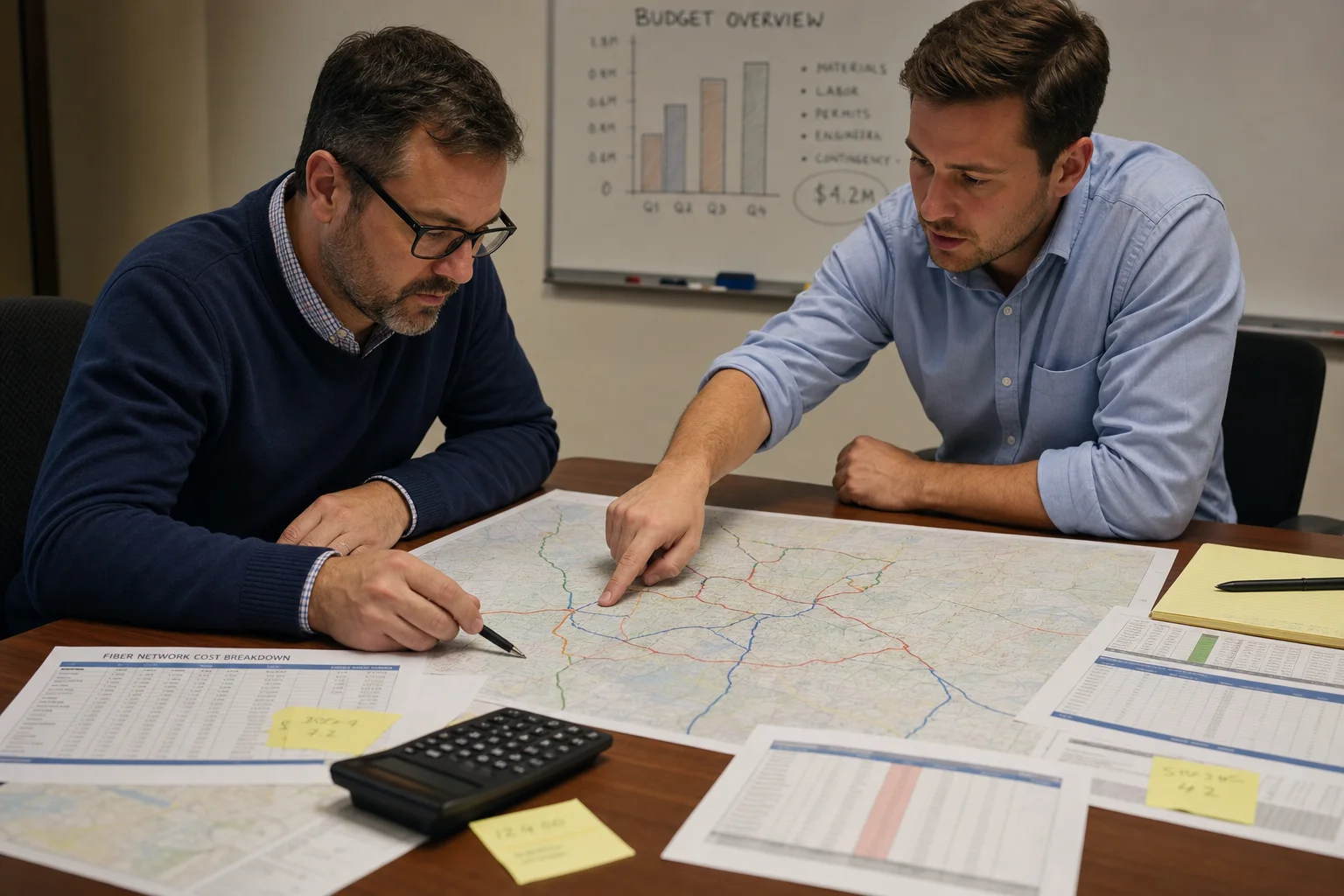
- Why Fiber Design Quotes Vary So Wildly
- What Drives Fiber Design Engineering Cost
- HLD Cost: What to Expect
- LLD Cost: The Construction Drawing Phase
- Permitting Cost: The One Everyone Underestimates
- GIS and As-Built Documentation Costs
- Total Cost by Project Type and Size
- Where ISPs Lose Money on Fiber Design
Somebody on your team got a fiber design quote last week. And now you're looking at a number that either seems surprisingly cheap or genuinely alarming, and you're not sure which reaction is correct.
Both reactions can be right. Fiber network design engineering costs vary by a factor of 3 to 5 for the same project scope depending on who's doing it, what they're actually scoping, and how much complexity your specific route introduces. A 20-mile rural aerial build that costs $62,000 to design through one firm might cost $31,000 through another, because the second firm isn't including GIS deliverables, isn't doing as-builts, and has never filed a permit with your state DOT before.
This guide breaks down what fiber network design engineering actually costs in 2026, what each phase includes, where the variables are, and, honestly, where ISPs consistently lose money by optimizing for the wrong thing.
Why Fiber Design Quotes Vary So Wildly
Scope ambiguity. That's almost always the answer. The term "fiber network design" means different things to different firms, and without a detailed scope document, you can't compare quotes at all.
Some firms quote "design" to mean route planning and a sketch-level HLD. Others include HLD, LLD, permit applications, QC review, GIS exports, and two rounds of as-built revisions. Both call it "design." Neither is lying. But one of them is quoting you something that can actually get built and closed out, and the other is quoting you the first chapter of a longer and more expensive story.
Geography matters too. An aerial build in flat rural Kansas (low vegetation, consistent pole spacing, consolidated utility ownership, predictable county permit process) costs significantly less to design than a hybrid build in West Virginia with mountain terrain, dispersed utility ownership, active railroad crossings, and a state DOT that requires specific drawing templates and 60-day review windows. Same route miles. Very different design effort.
Then there's labor cost. A U.S.-based OSP engineering firm with experienced telecom engineers billing at market rates produces drawings that reflect that experience, and costs accordingly. Offshore teams or domestic shops with limited telecom-specific expertise can quote dramatically lower. The downstream cost of revision cycles, permit rejections, and field-crew standdowns from substandard drawings often exceeds the original price differential. We've seen it happen enough times to say that plainly.
What Drives Fiber Design Engineering Cost
Before getting into specific numbers, understand the cost drivers. These are the variables that push any quote up or down regardless of who's doing the work.
Route miles. Longer routes cost more. Straightforward enough, but the relationship isn't perfectly linear. The first few miles of any project carry setup, coordination, and project management costs that don't scale with mileage. A 5-mile project costs more per mile than a 30-mile project with comparable complexity.
Construction method. Aerial design costs less per mile than underground design, sometimes significantly. Underground routes require bore plans, utility locate coordination, and highway crossing permit packages that aerial routes don't. An underground mile through an urban corridor can produce 3× the drawing sheets of an aerial mile through a rural area.
Permit jurisdiction count. Every permit jurisdiction your route crosses adds cost: not just permit fee cost, but engineering time. A 15-mile route that crosses a state highway, 3 county roads, and 2 railroad tracks needs 6 separate permit packages, each with its own format, required drawing details, and submission protocol. That's substantively more work than a 15-mile route that runs entirely on private easement with no crossings.
Homes passed count. For FTTH/GPON design specifically, the number of subscriber locations drives FDH placement, splitter cascade complexity, and distribution cable design. A 20-mile route passing 4,000 homes requires significantly more detailed design work than a 20-mile backbone middle-mile route passing no homes at all. The FTTH design explainer covers how FDH sizing and splitter cascade architecture add to project complexity.
Data quality going in. Good survey data going into design means less design time. If your field team has already collected GPS-referenced pole inventories, existing attachment heights, and verified pole IDs, that's a week of the engineer's time that doesn't get charged. If the design team has to work from incomplete records, inaccurate pole databases, or GPS coordinates with 10-meter errors, they're spending time on data cleanup that shows up in the invoice. How field survey data accuracy affects design cost is a bigger deal than most ISPs realize at project kickoff.
HLD Cost: What to Expect
A properly scoped HLD engagement for a rural FTTH project (route planning, FDH placement, splitter cascade architecture, fiber count schedules, technology specification, and a submission-ready BEAD documentation package) typically costs:
| Project Scale (Homes Passed) | Typical HLD Cost Range | Timeline |
|---|---|---|
| 500 to 2,000 homes | $12,000 to $22,000 | 4 to 6 weeks |
| 2,000 to 6,000 homes | $22,000 to $38,000 | 6 to 9 weeks |
| 6,000 to 15,000 homes | $38,000 to $58,000 | 8 to 12 weeks |
| 15,000+ homes | $58,000 to $95,000+ | 10 to 18 weeks |
These ranges assume: clean survey data in hand, a defined project boundary, and a route network that doesn't involve unusual complexity like large bodies of water, dense urban infrastructure, or a very high proportion of underground construction. BEAD subgrantees should add $3,000 to $8,000 for state-specific grant documentation formatting. Some state broadband offices have very specific HLD submission templates that require additional effort beyond standard engineering deliverables.
What should HLD include? Route maps, FDH placement diagram, splitter cascade architecture, fiber count schedules for every trunk segment, technology specification narrative, and a high-level BOM. If a quote doesn't explicitly list all of those, ask what's missing before you sign anything. The HLD requirements for BEAD subgrantees article details specifically what state broadband offices look for in HLD submissions.
LLD Cost: The Construction Drawing Phase
LLD, the construction drawing set, typically costs $800 to $2,100 per route mile, with the range driven primarily by construction method and plan sheet count.
An aerial build through flat rural terrain might produce 4.3 plan sheets per route mile. Underground in a mixed-use corridor might produce 8 to 11 sheets per mile. More sheets means more engineering time, and more time per sheet for routes with complex underground geometry, highway crossings, or congested utility corridors. A railroad crossing detail sheet, by itself, can take 6 to 10 hours to produce correctly, including bore plan geometry, clearance calculations, and the specific format that the railroad's ROW department requires.
Numbers that surprised our clients: The most expensive LLD mile we've priced was a 0.4-mile underground segment through a municipal downtown core: 11 plan sheets, 3 utility locates, 1 traffic control plan, and 2 permit packages for the same short segment. It came in at $4,800 per mile. The cheapest was an 18-mile aerial build across rural farmland: 3.8 sheets per mile, single utility owner, one county road permit for the whole project. $620 per mile. Same engineering firm. Very different conditions.
LLD includes the plan set, splice diagrams, FDH detail sheets, aerial-to-underground transition details, highway and railroad crossing details, and a cross-referenced BOM. A complete LLD review of the fiber construction package deliverables will show you everything that should appear in a well-structured LLD package. Use it as a checklist when evaluating what a firm is promising to deliver.
Permitting Cost: The One Everyone Underestimates
Permitting is where budgets go to die. Not always. But often enough that it deserves its own section.
Permit fees themselves aren't the main cost driver, though they add up. State DOT permit fees range from $200 to $2,200 per highway crossing depending on the state. Railroad crossing applications run $700 to $4,500 per crossing through most Class I railroads. County road permits are usually cheaper but vary enormously: we've seen county road crossing fees range from $0 (the county just needs a notification) to $1,800 per crossing.
The real cost of permitting is engineering time: preparing jurisdiction-specific permit packages, responding to requests for additional information, tracking application status, and managing resubmission when applications get rejected. A permit application for a TxDOT highway crossing requires a drawing set in TxDOT's specific format, with specific title block requirements, specific scale requirements, and specific coordinate datum requirements. If your engineering firm has never filed with TxDOT before, expect extra time, and probably at least one rejection cycle, while they learn the format.
Budget $1,100 to $2,800 per major crossing for engineering time related to permitting, on top of the permit fee itself. A route with 12 highway crossings could easily carry $15,000 to $25,000 in permitting cost beyond the plan set. The permitting delays guide covers how the permit process affects project timelines, worth reading before you set a construction start date without accounting for permit windows. Some state DOTs review applications in 30 days. Some take 120 days. A few have review schedules that are essentially unknowable until you're in them.
GIS and As-Built Documentation Costs
GIS deliverables (shapefiles, geodatabases, attributed feature classes) are increasingly non-negotiable. For BEAD projects, they're explicitly required for grant closeout. For any ISP that maintains a network management system, they're essential for future operations, expansion planning, and trouble resolution.
A GIS package produced alongside the LLD (not as a separate digitization effort, but as an integrated output of the design process) typically adds $200 to $600 per route mile to the design cost. That's not an extravagant premium for data that will be used throughout the life of the network. The alternative, digitizing from PDFs after the fact, consistently produces data quality problems that cost more to fix than the original GIS package would have cost to produce correctly.
As-built documentation, revising the design drawings and GIS records to reflect what was actually constructed, adds 25 to 40 percent to the LLD cost, paid after construction is complete. For a $40,000 LLD, expect $10,000 to $16,000 for as-built documentation. It's not optional for BEAD projects. Build it into your budget from the start rather than discovering it during grant closeout discussions. The BEAD as-built documentation requirements article covers what state broadband offices expect at closeout, and the common mistakes that trigger revision requests.
Total Cost by Project Type and Size
Putting it together, here's what a complete fiber design engagement typically costs for common project types in 2026:
| Project Type | Total Design Cost Range | Notes |
|---|---|---|
| Rural aerial FTTH, 15 miles, ~2,500 homes | $58,000 to $85,000 | HLD + LLD + permits + GIS + as-builts |
| Rural hybrid aerial/underground, 25 miles, ~4,000 homes | $95,000 to $145,000 | Underground adds significant LLD and permit cost |
| County-wide BEAD build, 80 miles, ~12,000 homes | $280,000 to $420,000 | Multiple permit jurisdictions, complex FDH cascade |
| Middle-mile backbone only, 30 miles | $42,000 to $68,000 | No FTTH distribution design; fewer permit jurisdictions |
| HLD only (BEAD proposal preparation) | $18,000 to $55,000 | Scale-dependent; LLD scoped separately |
These are 2026 figures for full-service U.S.-based OSP engineering firms delivering complete, construction-ready packages. If you're seeing quotes significantly below these ranges, ask specifically what phase of work is excluded. It's not that cheaper quotes are dishonest. They're often just scoped differently. But the gap between "design quote" and "total engineering cost to get this built" is where a lot of ISP budgets get surprised.
Where ISPs Lose Money on Fiber Design
This is the part nobody puts in a press release, but it's where the real cost lessons live.
Selecting the cheapest HLD firm, then switching to a different firm for LLD. The handoff between HLD and LLD engineering introduces data translation risk. If the LLD firm wasn't involved in HLD, they're interpreting someone else's route decisions, FDH placement logic, and fiber count assumptions, and they may not agree with all of them. Rework at the LLD-start phase is common in this scenario. Estimate $8,000 to $18,000 in added cost per 20-mile project from handoff inefficiency.
Starting construction before permits are cleared. This one hurts. A construction crew mobilizes before a highway crossing permit is approved, reasoning that approval is imminent. The permit takes 9 additional weeks: the state DOT had a staffing change and the queue reset. The crew has to work around that crossing, which means re-sequencing the build, potentially paying for two mobilizations, and accepting a gap in the network while the permit processes. We've watched this happen. The schedule and cost recovery from a single premature construction start can exceed $60,000 on a mid-size project.
Skipping the QC step to hit a deadline. LLD packages that haven't been through a proper quality control review before going to field crews produce construction errors. A plan sheet with a wrong pole ID sends a crew to the wrong pole. A clearance calculation that wasn't verified against the utility's current attachment records produces an NESC violation that requires re-work. These aren't theoretical. And the cost of fixing them in the field is always higher than the cost of catching them before the drawings go out.
Not budgeting for as-builts from the start. As-built documentation is a BEAD grant closeout requirement. It's also a practical network management necessity. ISPs that don't budget for it at project inception often end up negotiating scope additions with their engineering firm at exactly the moment they have the least leverage: during construction, with a grant closeout deadline approaching. Build it into the contract from the beginning.
Draftech produces fiber network design packages for ISPs across all 50 U.S. states, from BEAD subgrantee HLD submissions through LLD, permitting, GIS, and as-built closeout. If you're scoping a project and want a straight conversation about what it'll actually cost and why, reach out to our team. No obligation. We'd rather you go in with accurate numbers than discover the gap after construction starts.
For related reading: the OSP engineering outsourcing guide for rural ISPs covers how to evaluate and select an engineering partner, useful context before you start collecting quotes.