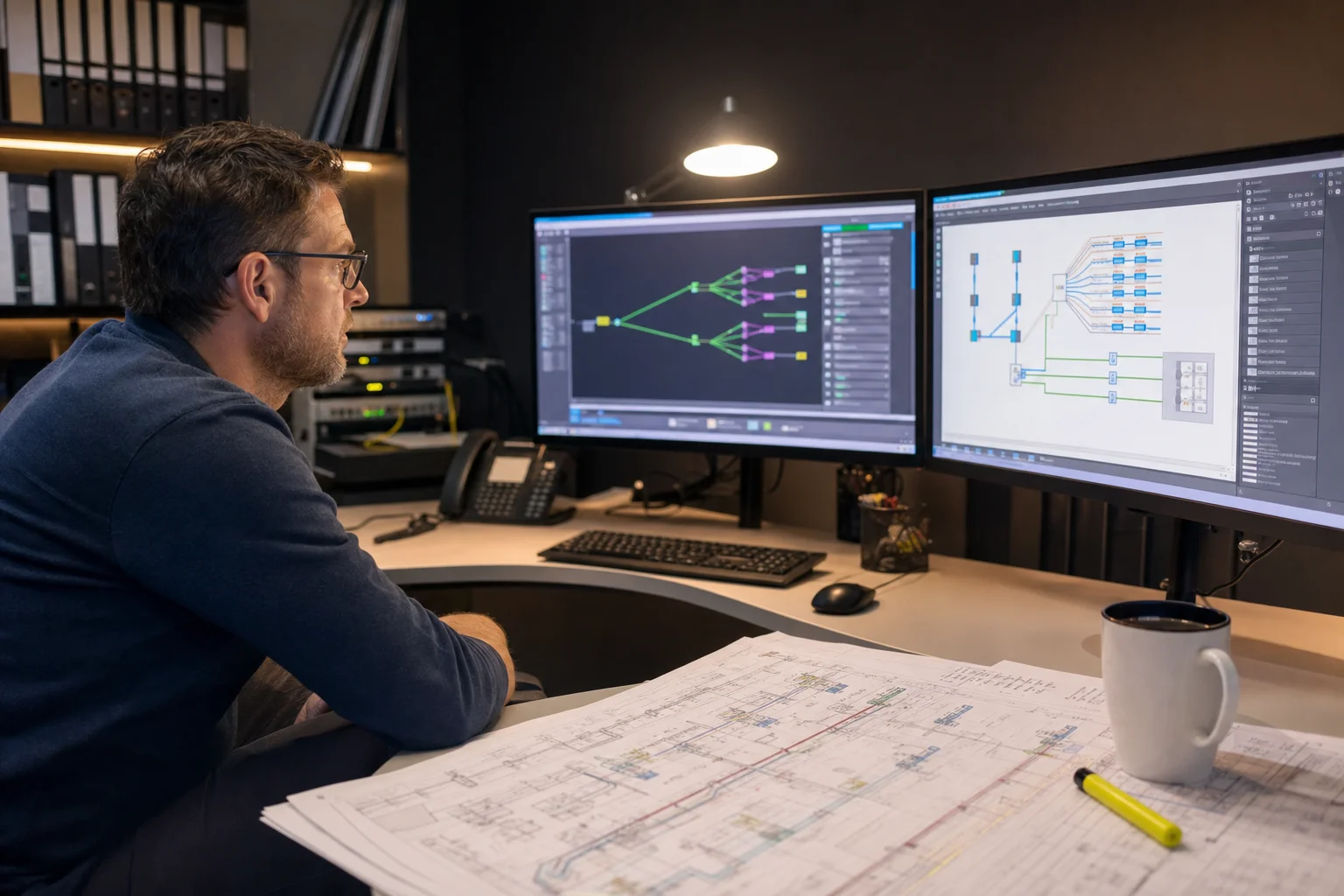
If you've started hearing "FTTH design" thrown around in every grant meeting and project kickoff and you've been nodding along without being completely sure what the term covers, you're not alone. A lot of ISP executives and even some project managers come from a background in network operations or sales rather than OSP engineering. They understand the business case for fiber. The actual design process? That part can feel like a black box.
This guide breaks down what FTTH design actually is, what it produces, and why each phase matters, especially for ISPs navigating BEAD subgrant requirements for the first time. We'll go from passive optical network architecture through FDH sizing, aerial route design, and what a complete design package looks like by the time it hits a permit reviewer's desk.
What FTTH Design Actually Means
FTTH design, also called FTTH network design or FTTP design, engineers the fiber network from the optical line terminal (OLT) to each home. We produce HLD and LLD packages, typically including 4 to 7 plan sheets per route mile for aerial construction, plus splice diagrams, permit submissions, bills of materials and GIS records.
That sounds simple until you realize that "how" involves hundreds of interrelated decisions. Which passive optical network standard do you use? Where do the fiber distribution hubs go, and how many fibers need to pass through each one? What's the splitter ratio? Do the primary routes run aerial or underground? Where do you cross the highway, and what permit does that require? How many splice points does a 23-mile route produce, and where exactly do they go?
FTTH design answers all of those questions in a format that field crews can build from, permit reviewers can approve, and grant offices can accept as documentation. It's an engineering discipline, not a software output, not a desktop exercise. The best FTTH design work comes from engineers who've been in the field and understand what construction crews actually face when they get to a route that looks clean on paper but has 14 unmarked buried utilities and a DOT that reviews permit applications once a month.
A related term you'll hear: FTTP: Fiber to the Premises. That includes both residential and commercial service locations. Most engineers use FTTH and FTTP interchangeably. In grant documentation and regulatory filings, though, the distinction can matter. When in doubt, check your state broadband office's specific definitions.
The Passive Optical Network: GPON, XGS-PON, and Why It Matters
The backbone of almost every FTTH build is a passive optical network (PON). The word "passive" refers to the fact that the optical splitters, the components that divide one fiber strand into many, don't require power. They split the light signal passively, which means no active electronics outside the headend and the subscriber's ONT. No powered equipment to maintain in the field. No batteries. No truck rolls when a node loses power in a storm. That's the architectural advantage of PON over active Ethernet designs.
The two standards you'll encounter most often right now are GPON and XGS-PON.
GPON (Gigabit Passive Optical Network) delivers 2.488 Gbps downstream and 1.244 Gbps upstream per PON port, shared among all subscribers on that PON. A single OLT port can serve up to 128 subscribers, though most ISPs design for 32 or 64 in practice, because 128-way splits start producing real bandwidth constraints during peak usage hours. If you've ever looked at a GPON port utilization graph during Thursday evening primetime and wondered why your customers are complaining about speed, you've met that problem. GPON has been the standard for most FTTH builds over the past 15 years. It works well. But it's showing its age.
XGS-PON runs 10 Gbps symmetric, both directions. Same passive splitter architecture, same fiber plant. The difference is in the OLT hardware and the subscriber ONTs. Most ISPs building new BEAD-funded networks today are specifying either XGS-PON or designing GPON plants with XGS-PON upgrade path compatibility, meaning the physical infrastructure can support an equipment swap to XGS-PON without rebuilding the outside plant.
Design Tip: If your BEAD project documentation specifies GPON and you're not planning for future XGS-PON compatibility, flag that during the HLD review. State broadband offices are increasingly asking about scalability. An FTTH network designed to a fixed GPON ceiling can create complications during grant closeout if reviewers interpret "future-proof infrastructure" requirements strictly.
The PON standard choice drives several downstream design decisions, particularly FDH sizing and splitter cascade design, which we'll cover shortly. Get the architecture wrong at the HLD stage and you're looking at expensive rework before construction even starts.
The FTTH Design Phases: HLD to LLD
FTTH design doesn't happen in one pass. It works through two distinct phases, High-Level Design and Low-Level Design, that build on each other. Skipping or compressing either phase is where projects get into trouble.
High-Level Design (HLD)
The HLD is the strategic layer. It answers the big questions: Where does the headend go? Where are the fiber distribution hubs placed? What is the primary route network, the backbone fiber that feeds each FDH? How many homes pass through each service area? What's the total fiber count needed on each trunk segment?
An HLD package for a BEAD-funded rural county project typically includes route maps, FDH location diagrams, splitter cascade architecture, technology specification (GPON vs. XGS-PON), fiber count schedules, and a high-level bill of materials. It's designed to be reviewed by the ISP, approved by the grant office, and used as the framework for detailed design. Our article on FTTH HLD requirements for BEAD subgrantees goes deep on what state broadband offices typically look for in HLD submissions, worth reading before your first grant documentation review meeting.
HLD is also where the BEAD-specific compliance piece lives. The NTIA has published design and documentation standards for BEAD-funded projects, and your state broadband office has added its own requirements on top of those. An HLD that doesn't address those requirements won't clear initial review, which means delays that eat directly into your grant timeline.
Low-Level Design (LLD)
The LLD is the construction layer. It takes the strategic decisions made in the HLD and turns them into actual construction drawings: plan sets that field crews can build from and permit reviewers can evaluate. Every pole gets identified. Every span gets measured. Every splice point gets placed. Every FDH gets a site detail showing how it mounts and how the feeder and distribution cables connect to it.
Common LLD deliverables include the plan sheet set (typically 4 to 7 plan sheets per route mile for aerial construction), splice diagrams, FDH detail sheets, aerial-to-underground transition details, and highway crossing details for every state DOT or railroad crossing on the route. The difference between HLD and LLD matters practically: they require different engineering skills, different tools, and different review timelines. Don't let a vendor quote you one without clarifying whether both phases are included.
LLD is also where the quality control process lives. A missing splice diagram, a pole ID that doesn't match the utility database, or a plan sheet that shows a route crossing a county road without the required permit detail: these are the errors that turn into construction delays. An LLD quality control checklist run before any package leaves the engineering team should catch cross-reference errors, missing detail sheets, and clearance calculation mistakes before they reach the field.
FDH Sizing and Splitter Cascade Design
Here's where FTTH design gets genuinely interesting, and where a lot of first-time fiber ISPs make expensive mistakes.
A fiber distribution hub (FDH) is the outdoor enclosure where feeder fiber from the OLT meets the distribution fiber going to subscriber homes. The optical splitters sit inside the FDH, or sometimes in smaller secondary enclosures closer to subscriber clusters, in a two-stage split design. Sizing the FDH correctly means you've designed enough capacity for the subscriber count in each service area without over-building hardware that won't get used.
Under-size an FDH and you're replacing it mid-deployment. That means a construction crew going back to a site that's already been conditioned, permitting the replacement, and paying for the return visit, usually $2,800 to $4,100 in direct cost per FDH swap, plus the schedule delay. Over-size and you're buying $900 enclosures when a $400 unit would have done the job. Across a 150-FDH deployment, that adds up fast.
The FDH sizing guide covers the calculation methodology in detail. Short version: you design for projected peak subscriber penetration (typically 65 to 75 percent of homes passed for a well-marketed rural FTTH build), apply your chosen split ratio, and size the FDH to match that demand with one stage of expansion capacity. That expansion capacity isn't optional: most BEAD grant agreements require demonstrated scalability.
The splitter cascade, how you arrange the optical splitting between the OLT and the subscriber ONT, is a separate but related decision. A single-stage 1:32 split puts all 32 splitter ports in the FDH. A two-stage design might put a 1:4 split at the FDH and a 1:8 split in smaller secondary enclosures closer to subscribers. Two-stage designs can reduce fiber count in the feeder plant, but they add field equipment and splice points. The right choice depends on subscriber density, route topology, and whether you're building in a sparse rural area where long distribution runs argue for minimizing active components versus a denser area where secondary enclosures are practical.
Aerial vs. Underground: The Route Design Decision
One of the first questions any FTTH design engagement answers is how the fiber gets from point A to point B. Aerial (strung from pole to pole) or underground, buried in conduit or direct-buried. The answer is almost always "both," because real routes encounter real infrastructure and real terrain that doesn't cooperate with a single construction method.
Aerial fiber is faster to deploy and cheaper per mile, usually $14,000 to $28,000 per route mile for an aerial build versus $45,000 to $110,000 per mile for underground, depending on soil conditions, crossing requirements, and congestion. But aerial requires existing poles and existing pole attachment capacity. In rural areas where the electric cooperative has poles with available attachment space, aerial is often the default choice. In areas where poles are fully loaded, shared with other carriers, or where the utility requires costly make-ready work before you can attach, the math changes quickly. The aerial vs. underground cost comparison covers those variables in more detail.
Underground design is slower: permitting for directional boring across state highways, county roads, and railroad crossings adds weeks, sometimes months, to a project timeline. We've had railroad crossing permits take 7 months to clear while the rest of a build sat waiting. That's not a scare tactic; it's just the reality of dealing with railroad right-of-way review processes. Plan for it early. The railroad crossing permits guide explains the process and how to get applications in front of the right reviewers without the delays that typically hit first-time applicants.
Real-world note: We've designed routes where a 4.3-mile aerial segment became a hybrid build mid-project because a utility inventory audit revealed 11 poles along the route didn't meet NESC Class requirements for additional attachments. Nobody caught it until the LLD field check. That surprise added 6 weeks and $38,000 to the project. A thorough HLD-phase pole inventory would have flagged those poles before construction scope was set.
FTTH Design for BEAD Subgrantees: What Changes
If you're an ISP with a BEAD subgrant, FTTH design isn't just about building a good network. It's about building documentation that satisfies your state broadband office's review process. Those are related goals, but they're not identical, and treating them as the same thing is how ISPs end up with technically solid networks and failed grant closeout submissions.
BEAD subgrantees need HLD packages formatted to their state's specific submission template. Some states provide an Excel-based template with required fields. Others want a PDF narrative with specific sections in a specified order. A few use portal-based submissions with structured data fields that don't accommodate free-form engineering documentation. Know your state's format before you start design, not after you've completed a package in the wrong format.
The NTIA's BEAD Notice of Funding Opportunity and your state's initial proposal requirements specify minimum design standards. Most states require FTTH (or FTTP at speeds meeting the BEAD definition of "reliable broadband") as the preferred technology, with a strong documentation requirement for any project proposing alternative technologies. The BEAD engineering requirements article covers what the NTIA expects to see in a technically compliant design submission.
As-built documentation at grant closeout is the other piece that catches ISPs off guard. You can't close out a BEAD grant without submitting as-built drawings that reflect what was actually constructed, verified against the original design, with GIS shapefiles updated to show constructed routes, splice points, FDH locations, and coverage polygons. The fiber as-built documentation for BEAD closeout guide covers what's required and what common mistakes look like in state broadband office review.
What a Complete FTTH Design Package Delivers
By the time a complete FTTH design engagement wraps, from initial survey through as-built submission, here's what a well-run project has produced:
- An HLD package with route maps, FDH placement, splitter cascade architecture, fiber count schedules, and a technology specification narrative
- ROW permit applications filed with each jurisdiction (DOT, county road authorities, railroad companies, and utilities), with tracking through the approval process
- An LLD plan set with full construction drawings: plan views, pole schedules, splice diagrams, FDH detail sheets, and highway crossing details
- A bill of materials for procurement, cross-referenced to the LLD
- GIS shapefiles with fully attributed network features (fiber segments, splice points, FDH locations, and coverage polygons), in a format compatible with your network management platform
- As-built drawings updated to reflect field conditions after construction, with reconciled GIS records
That full package is what a BEAD subgrantee needs to move from approved grant to closed-out project. If any piece is missing, you'll find out the hard way, usually at the worst possible moment in the grant closeout timeline.
Draftech engineers have produced FTTH design packages across 24 states, with experience across GPON and XGS-PON deployments ranging from 400-location rural builds to 38,000-location county-wide projects. If you're putting together a BEAD subgrant proposal and need engineering support from HLD through as-built, get in touch with our team. We've been through this process enough times to know where the surprises usually come from, and how to keep them from derailing your project timeline.
Also worth reading: our overview of OSP engineering covers the broader outside plant discipline that FTTH design sits within, useful context for anyone new to the field side of fiber infrastructure.