IN THIS ARTICLE
A cable operator can have fiber deep into its network and still face a difficult last-mile decision. The coaxial plant may have useful capacity left, while the next service offering demands more upstream bandwidth than the current configuration can deliver.
Starting with the service group, a replacement plan needs to explain what the existing network cannot deliver, how much work would correct it, and whether the proposed fiber route can reach paying subscribers.
To separate architecture from service promises, we compare HFC upgrades with an FTTH overbuild and examine how plant condition affects the case for each investment.
HFC vs FTTH: where the access network changes
HFC vs FTTH compares a fiber-and-coax access network with fiber extending to the home. DOCSIS 3.1 and 4.0 define cable broadband capabilities; FTTH can use passive optical networks such as XGS-PON. The practical choice depends on existing plant condition, required capacity and the budget available to build or upgrade the route.
HFC keeps coax in the subscriber path
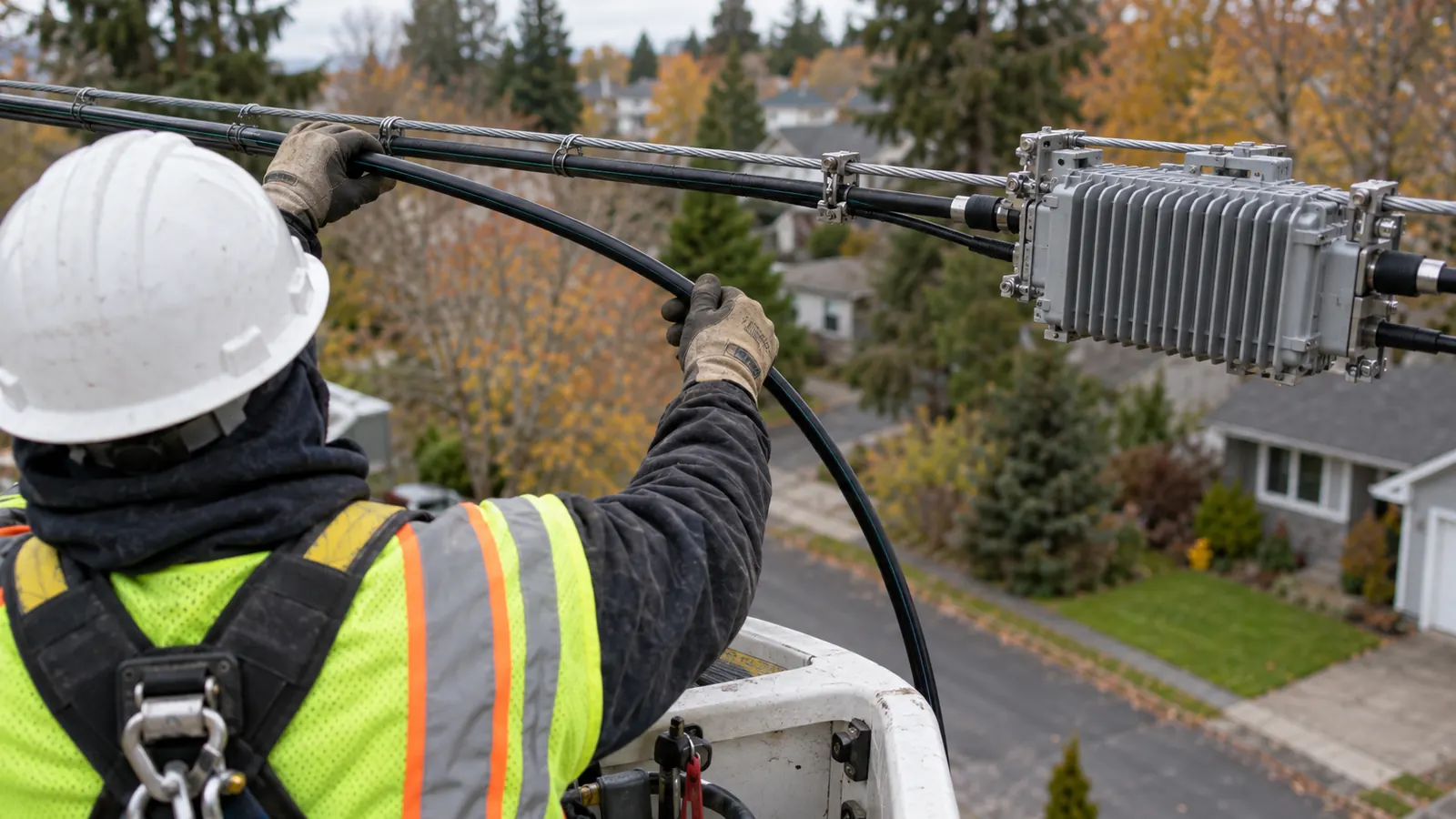
In an HFC network, fiber reaches an optical node and coax carries the connection toward subscriber cable modems. Taps connect the distribution cable to drops. Depending on the design, powered amplifiers extend the coax path beyond the node. We need that topology before estimating what a spectrum change would require, because every affected device must support the intended operating band.
The node location alone tells us little about usable capacity. Subscribers share resources within a service group, and an operator can change that grouping without replacing every coaxial drop. After counting the active modems, we compare their busy-hour demand with available upstream and downstream capacity, keeping the actual channel configuration separate from the equipment vendor's headline rating.
FTTH moves the optical endpoint to the premises
FTTH describes the reach of the fiber, rather than one particular access protocol. A passive optical network connects an optical line terminal to subscriber optical network terminals through an optical distribution network with passive splitters. Point-to-point Ethernet is another FTTH architecture. Here we focus on PON because its shared feeder and splitter design creates a useful comparison with shared HFC access.
Although passive splitters need no field power, the OLT and ONT still require it. We therefore separate the outside-plant power question from the customer's ability to stay connected during an outage, and we assess backup arrangements against the service requirement instead of assuming an all-fiber route guarantees continuous operation. A severed feeder can still interrupt every subscriber downstream of that cut.
Both architectures require an honest boundary for the comparison. If an HFC proposal includes refreshed customer equipment but the fiber proposal stops at a terminal outside the building, their scopes differ before any capacity calculation begins. For a consistent comparison, each scope must include a working subscriber connection to the same handoff point.
HFC capacity: DOCSIS 3.1 and DOCSIS 4.0
DOCSIS 3.1: use the installed spectrum well
DOCSIS 3.1 uses OFDM downstream and OFDMA upstream, with modulation profiles that allow operation to reflect channel conditions. CableLabs' DOCSIS 3.1 Technology overview describes downstream capability up to 10 Gbps. That is a technology capability, not a promised subscriber throughput, and we do not carry that figure into a service forecast without the deployed spectrum and equipment configuration.
Upstream work needs a separate scope because a change to the frequency split can require compatible diplex filters and other plant equipment, with customer devices assessed against the revised configuration. We ask which components remain and which must change before treating the project as an electronics refresh. Checking the return path first helps identify noise ingress that could undermine the result even when the replacement hardware supports the band.
Segmentation and spectrum expansion address different constraints: dividing a service group can reduce the number of subscribers competing for shared capacity, while expanding usable spectrum changes the resources available to that group. Our HFC cable network service addresses the plant design behind that choice, including how the retained coax fits the intended upgrade.
| Design question | HFC upgrade | FTTH with PON |
|---|---|---|
| Subscriber path | Fiber to node, then coax and cable modem | Fiber through splitters to an ONT |
| Shared capacity | DOCSIS service-group resources | PON-port resources shared among ONTs |
| Field equipment | Powered node and amplifiers where fitted | Passive distribution between powered endpoints |
| Upgrade scope | Segmentation, spectrum changes and compatible equipment | Optical platform changes within verified plant limits |
| Plant acceptance | RF performance and return-path condition | Optical loss, continuity and assignment accuracy |
| Migration constraint | Work on an operating cable network | New drops, ONTs and customer cutovers |
DOCSIS 4.0: choose the architecture before procurement
CableLabs' DOCSIS 4.0 Technology overview identifies specification capacities up to 10 Gbps downstream and 6 Gbps upstream, with implementation-dependent performance. It includes Full Duplex DOCSIS and Extended Spectrum DOCSIS. Full Duplex allows upstream and downstream use of overlapping spectrum through interference management; Extended Spectrum increases the available frequency range. A system design must be compatible with the chosen approach to deliver those capabilities.
To define the construction package, we need the operator's selected equipment architecture and a verified inventory of the retained plant, beyond the version label. Those details establish how much field replacement is necessary. The proposal should document early whether the upgrade touches many distribution components or concentrates on nodes and subscriber equipment, because that distinction changes the business case.
Specify the retained plant: Require the upgrade proposal to identify the existing components it relies on, then verify their suitability before releasing replacement equipment orders.
The limitation of retaining HFC is that an operator also retains responsibility for coaxial faults and the powered field assets that remain in service. When the plant is sound, a bounded upgrade remains worth evaluating because it can satisfy a defined capacity need without making every subscriber wait for a new fiber drop.
FTTH capacity: the optical design still sets boundaries
GPON and XGS-PON are different platform choices
The FTTH label leaves the speed unspecified; ITU-T G.984.2 defines GPON physical-layer characteristics, while ITU-T G.9807.1 (2023), amended in May 2025, specifies XGS-PON. The latter defines a nominal line rate of 9.95328 Gbit/s in each direction. These are optical line rates; protocol overhead and shared demand affect the capacity available for customer traffic.
We choose the PON platform against the intended service mix and the operator's equipment environment. A symmetric optical line rate can support a symmetric service strategy, but it does not remove the need for capacity planning at the PON port or farther upstream. Our EPON vs GPON comparison covers the standards families when that platform decision needs a separate review.
A split ratio describes connected branches rather than simultaneous demand. Consider an illustrative 1:32 splitter: its label identifies the fanout, but it says nothing about how many subscribers are active or what those customers upload at the busiest hour. We size the service group using those assumptions and document when a port split would become necessary.
Preserve optical margin and a credible upgrade route
The optical budget determines whether the selected transmitter and receiver can operate across the proposed path. Splitter loss consumes part of that budget, and the design must account for cable attenuation and connection losses. We include repair margin when verifying the full path against the selected equipment class, since distance alone is insufficient to approve a route.
An eventual PON upgrade can reuse outside plant only when the new platform's requirements fit that plant. Coexistence elements may add loss, and the optical characteristics of installed components need review before a migration is treated as an endpoint swap. Our GPON network design guide explains why splitter placement and optical loss belong in the architecture decision.
That is where our FTTH design work turns a service target into a route and distribution plan. We establish the premises served by each area before settling terminal locations, so the resulting drawings can support drop construction rather than merely showing fiber near a building. That requires a complete address inventory with a feasible connection for each passed premises.
We favor passive distribution for a new fiber access build when it fits the service requirements, but its shared feeder creates a real restoration trade-off. A fault upstream of a splitter can affect many downstream connections. Spare fibers and accessible closures help only when the maintenance team has accurate assignments and an executable restoration procedure.
Why operators overbuild HFC with fiber
Repeated plant work can change the decision
Fiber becomes more attractive when the retained coax requires extensive renewal to support the operator's capacity goals. At that point we compare the complete HFC scope with a complete FTTH scope, including the work needed inside the subscriber boundary. If either estimate leaves out drops or activation work, the omission can reverse the apparent preference without changing the underlying network.
Operators also overbuild to align new construction with a longer-term access architecture. The engineering argument is strongest when planned fiber routes can serve the required premises and the operating team has a credible migration sequence. Unconfirmed access weakens that argument because even a desirable technology still needs usable ducts or space for another attachment.
Test a difficult drop: Before fixing the overbuild scope, trace one representative premises connection from its proposed terminal to the ONT location. Use the result to expose access assumptions in the broader design.
Construction access can dominate either alternative
An existing HFC route can offer useful knowledge about access corridors without granting permission for every proposed fiber installation. We verify attachment rights and the physical space needed for new plant against the actual route. Existing occupancy provides evidence for that investigation but cannot establish approval for new work, including the additional fiber an HFC segmentation project may need to reach new nodes.
Our route review separates reusable assets from assumptions. A conduit shown on a record needs its condition and usable capacity confirmed before the design depends on pulling another cable through it, especially where a failed assumption would force excavation after equipment has been ordered. We keep that uncertainty visible in the build budget until field evidence resolves it.
While subscribers move, HFC and FTTH may run together, creating a temporary operating burden that the business case must cover through the final cutover. We define the retirement conditions before construction starts. Otherwise, a small group of unconverted customers can leave an operator maintaining plant that its forecast already assumed would be removed.
Planning for service continuity at each customer location means accounting for changes an ONT installation can make to the service handoff location and its power requirements. Before disconnecting the cable modem, the operator must also check any dependent services. We would record each cutover result against the premises inventory. Failed appointments and inaccessible buildings belong in the remaining scope, with responsibility assigned for resolving them.
HFC vs FTTH: choose by plant condition and build budget
A healthy cable footprint with a defined capacity gap
Evaluate the HFC upgrade first: When the plant is serviceable and the capacity gap can be closed with a verified scope, we recommend comparing segmentation and DOCSIS improvements before committing to replacement. The proposal needs measurable acceptance targets showing how the upgraded service group meets the operator's demand forecast and what conditions would trigger further investment.
A deteriorated footprint or a new access area
Develop the FTTH case: Where coax renewal would be extensive, or where no subscriber distribution plant exists to preserve, we recommend designing the fiber alternative through the customer handoff. Because the build budget must fund a usable network, feeder mileage alone is insufficient to approve a recommendation while drop access and activation remain unresolved.
A mixed footprint with uneven constraints
Make the choice by area: An operator can upgrade sound HFC districts while overbuilding areas that justify replacement. We support that approach when the operating team can maintain both architectures and the boundaries follow service and construction realities. Using one demand forecast across the alternatives prevents different growth assumptions from making either technology appear preferable on paper.
To protect the build budget, the decision package should let an owner trace the recommendation back to observed plant condition, with an explicit acceptance basis for each alternative. It should also identify unresolved field conditions that could change the scope, so a later procurement decision does not quietly turn a conditional design into an unconditional commitment.
Draftech International delivers turnkey telecom and power infrastructure with engineering performed 100% in-house and full turnkey construction delivered by Draftech-managed subcontract crews. Our company and delivery team carry the work from field survey and planning through construction drawings, permits and agency coordination, then construction, as-builts and closeout. Operators can use our contact page to discuss the plant evidence needed to compare their upgrade and overbuild scopes.
For an operator ready to test a fiber route against those constraints, our free design offer covers engineering the first 20,000 linear feet of a qualifying route at no cost, from feasibility and field survey through permit approval. The owner reviews each request before Draftech commits the package. Email us to discuss your route.