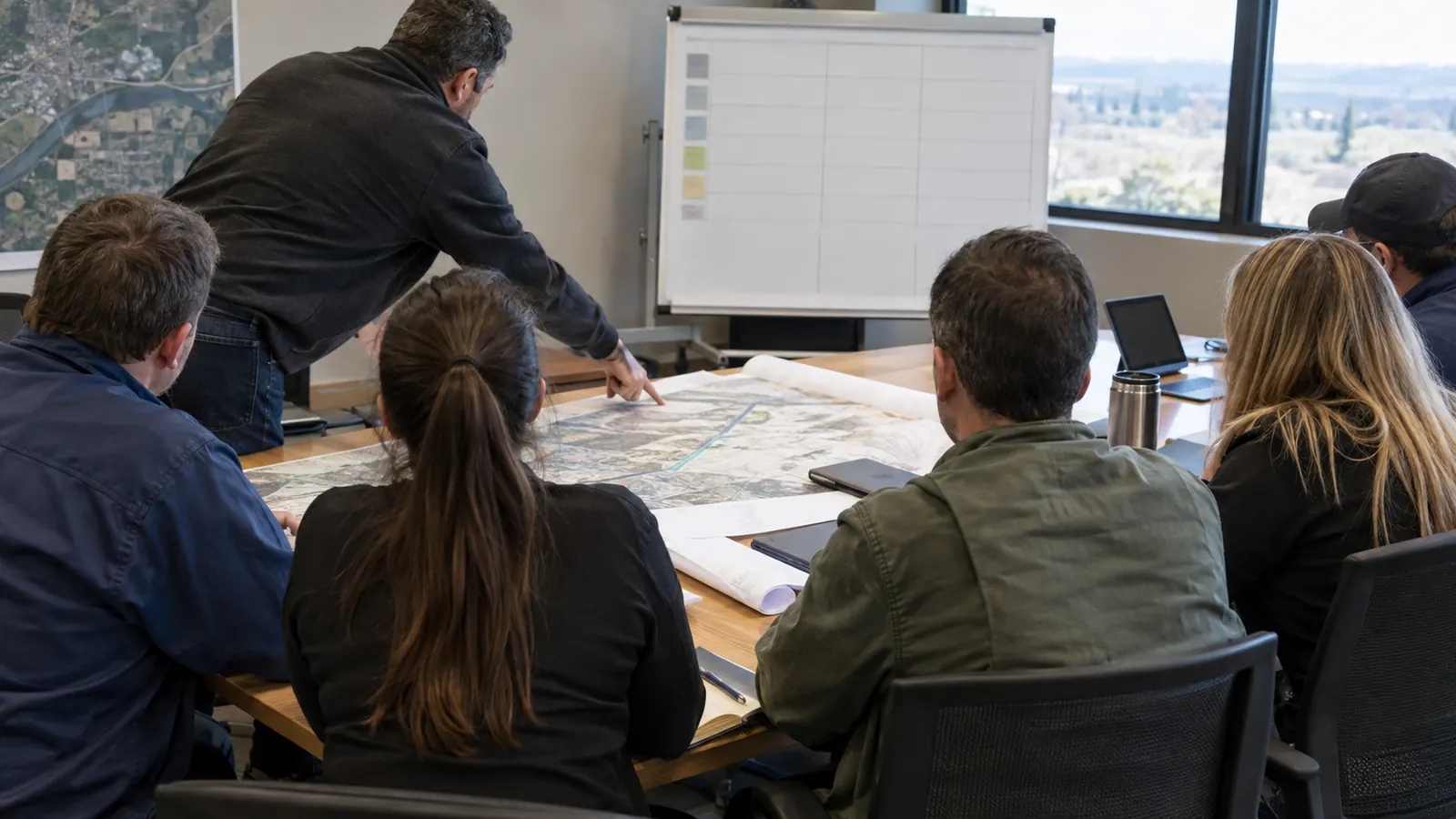
A blocked handhole reaches the project in fragments. The technician sees the ramp conflict. Hours later the utility coordinator learns another job has the shoulder next month, while the designer still has yesterday's linework open. Each report can be accurate and the route can still drift.
The field-operations answer is not a longer distribution list. It is a way to turn an observation into a decision while keeping authority, traffic effect, schedule exposure, and current geometry in front of the people who can act. The story starts before the first crew leaves the yard.
Broadband Project Stakeholder Communication Tips Begin with a Shared Route Story
Broadband project stakeholder communication tips only hold if the route has one current story. Chapter 4 of FHWA-HOP-16-013, Guide to Project Coordination for Minimizing Work Zone Mobility Impacts, names 3 essentials for that coordination. Field teams need those essentials in place before a field issue can become a decision. Audience changes the message.
Chapter 4 of FHWA-HOP-16-013 states that good project coordination requires collecting and sharing timely, accurate project data, understanding potential impacts of each project, and a defined coordination process that stakeholders actually follow. At kickoff we write the route story around the same data fields that chapter names: location and schedule. Scope and cost remain tied to the project-manager contact. We add controlling owners and expected impacts because a broadband corridor has those extra authorities. Those fields become the coordinates fielding and design use when a condition changes, so nobody has to invent a second narrative about the whole job.
Invite People by Decision Right, Not by Job Title
A stakeholder map is useful only when it says what each person can decide. On the ramp conflict, the field lead can verify the observation and stop unsafe work, while the OSP engineer can move geometry only inside the design scope. Attachment permission still sits with the pole owner under its process, and an easement question still sits with property counsel. Copying every title on every message hides those lines instead of coordinating them.
We also name the person who owns the integrated baseline. Chapter 4 of FHWA-HOP-16-013 notes that shared databases lose value when information is not maintained as projects change. One current route record, with accountable updates, beats five polished status decks. The integrated owner does not decide every issue. That person makes sure each accepted decision reaches the route and schedule. The field instructions receive the same approved change. Decisions need named owners.
Kickoff test: point to one route segment and ask who may verify the condition, who may change the design and who may approve access. Then identify who updates the baseline. If those 4 answers are uncertain, the project will grow 4 conflicting message threads.
An unsafe condition goes immediately through the approved field channel, while a design alternative belongs in the controlled issue record and routine status can wait for the baseline update. We name who monitors each channel at kickoff, including the backup when that person is off duty. An escalation path that nobody watches is only a slide in the kickoff deck.
Follow One Field Event from Discovery to Owned Decision
Take the handhole that landed on an access ramp the source record never showed. The technician's job is to capture the location, the visible geometry, the route impact, and any safe alternatives that sit inside the survey scope. The technician should not redesign the route from the curb, and should not promise the property representative that the conflict will disappear. Observation has done its work once the record is complete enough for someone else to decide.
The field lead validates that record before it leaves operations. Segment identifier, image match, coordinate reference, and whether traffic control, property rights, drainage, another utility, or the permit footprint could be involved all get a look. That review gives the designer a bounded problem. It also stops a vague note such as move handhole from circulating without a distance or direction. The consequence must also be stated. Silence is still status.
Send a Decision Packet Instead of an Alert
| Moment | Evidence carried | Question answered | Next owner |
|---|---|---|---|
| Field discovery | Segment, location, observed condition, image, access state | What changed from the baseline? | Field lead |
| Operations validation | Verified record and affected discipline flags | Is the issue real and bounded? | OSP engineer |
| Design response | Options, drawing impact and unresolved authority | What can change technically? | Permit or owner lead |
| External decision | Focused request with option consequences | What may the project do? | Baseline owner |
| Field release | Accepted revision, effective segment and superseded instruction | What should crews use now? | Field lead |
The packet stays short because it carries route context with the issue. We state the observed fact first, attach the evidence, show the baseline effect, present only technically viable options, identify the authority needed, and name the date or work window that delay would expose. A pole conflict may need an attachment sketch. A private-access question needs the property exhibit, not a longer engineering memo. When that packet reaches the decision owner, its route identifier and effective revision let the answer return to design without a coordinator translating the entire exchange.
Our own weakness used to be sending field discoveries too quickly. Speed felt responsive, but an unvalidated message forced designers to perform basic record cleanup while the thread grew. We now spend the first minutes confirming the event's segment and evidence, which gives the decision owner a stable problem and keeps later corrections from undermining trust in notices that really are urgent.
The response comes back in a form the drawing can absorb. The decision owner accepts an option or rejects it with a reason. The owner may instead request specified evidence or identify another authority as the decision maker. We avoid replies such as looks fine, because they cannot be applied to a sheet or a field release. The baseline owner records the effective segment and revision, and the original packet remains in history so the next reviewer can see how the instruction was earned. The event is closed when crews have an instruction they can build, not when the last email was sent. The record stays brief.
Change the Conversation When the Authority Changes
Ask an Agency and a Utility Different Questions from a Property Owner
Send the same ramp conflict to three desks and watch the question change. The permit reviewer needs to see how the proposed work sits against the agency's right-of-way rules and traffic conditions. The utility owner needs a facility-specific request under its attachment or conflict process. The property representative needs plain limits for the area and the right being asked. The observed condition stays identical while the decision being requested changes, because one all-purpose technical update serves none of them.
23 CFR Part 645 Subpart C is a State-level facilitation framework, not a field-email protocol. It applies to each State that receives funds under Chapter 1 of Title 23, and only to activities whose Federal obligations or expenditures are initially approved on or after the subpart's effective date. Section 645.307 requires the State DOT, in consultation with appropriate State agencies, to identify a broadband utility coordinator, establish a registration process for broadband infrastructure entities, notify those registered entities of the State Transportation Improvement Program at least annually, and coordinate with other statewide telecommunication and broadband plans. Section 645.309 states that nothing in the subpart requires a State to install or allow the installation of broadband infrastructure. We cite Subpart C only where that Title 23 frame actually applies. A county road still follows county procedure. A private parcel still follows the available property instrument.
When two authorities overlap, the message should not ask them to solve each other's question. A state permit office might accept the route geometry while an electric utility still controls attachment approval. The integrated baseline can show both states at once. That is more honest than a green project status that hides one unresolved dependency, and more useful than a red status that treats every unaffected segment as blocked. Escalation needs a trigger.
For permit state tracking, the defensible permit release ledger separates submission and review states. It also separates comments from acceptance and construction conditions. For broader delivery control, the ISP fiber build baseline explains how route and schedule decisions remain connected. This field-operations guide stays with the human exchange that moves an observed event into those systems.
Audience boundary: change the request, not the fact. Every stakeholder receives the same observed condition, but only the decision relevant to that stakeholder's authority should be placed in front of them.
Escalation should follow consequence rather than org-chart height. A minor clarification can wait for the normal reviewer channel. An access denial that strands a scheduled crew needs the owner and field lead the same day. We define triggers around safety, permit exposure, traffic impact, property access and critical-path schedule. Work that cannot be undone receives its own escalation trigger. Senior attention then stays available for the decisions that actually need it, instead of being spent on routine coordination dressed up as an emergency.
Keep the Field Release and Public Message on the Same Clock
A route revision becomes operational only when the crew knows which instruction it supersedes. We issue the changed segment, effective time, drawing or work-package revision and the access condition. Any hold point appears in the same field release. The field lead acknowledges receipt through the project's chosen system. A meeting note can explain the reason. It should not be the only construction instruction on the job. Meetings cannot replace evidence.
Translate the Route Change into a Mobility Impact
FHWA-HOP-16-013 treats project impact as part of coordination, not an afterthought. A broadband change may affect shoulder use, pedestrian access, a transit stop, a driveway, a lane-closure window, or another project already occupying the corridor. Traffic staff need the location and duration. Work type remains paired with expected impact. The public needs a truthful, approved notice about access or disruption. Neither audience is helped by raw splice counts or an unexplained CAD screenshot.
Public communication follows the owner and agency's approved channel. We can supply engineering facts, limits and dates from the accepted schedule. We also supply a map suitable for review. We do not invent a public promise while a permit condition is still open. If a work window moves, the communication owner updates the outward notice only after the field release and the agency record agree on the same limits. That is how we avoid crews arriving under one schedule while residents were told another.
Utility coordination meetings need the same discipline. Build the agenda from decisions that are due, not from a generic round robin. Closed issues leave the active view but remain in history. Open issues show evidence, owner, requested action and consequence. The next review point stays visible beside them. Unresolved facts stay visible without repeating the full project biography, which gives scarce meeting time to the people whose authority can actually change the route. Close the loop visibly.
The field-to-design data handoff provides the record architecture behind those releases. Communication points at the precise record that changed and captures the decision that follows, rather than replacing that architecture. Crews then receive one usable instruction while stakeholders receive only the slice they own, and the baseline retains the complete chain.
When a shift changes, the outgoing lead identifies active holds, accepted revisions that remain unacknowledged and pending access conditions. The outgoing lead also identifies the next decision due. The incoming lead confirms the current field package before dispatch. This is not a general project summary. It is an operational transfer of live exposure, and it is complete only when the incoming lead accepts that responsibility.
Close the Route with a Decision Record, Not a Victory Email
Broadband Project Stakeholder Communication Tips at Release
Closeout communication starts with the obligations that still sit on the route after the last crew day. Permit conditions, restoration inspections, owner notifications, as-built capture, access commitments, and deferred utility work can outlast the construction window. We assign each obligation to a record and an owner before calling the route complete. The final message then reports the accepted state and the remaining duties, instead of celebrating a finish the evidence does not support. Timing should remain explicit.
Single-jurisdiction work: keep the audience small and make the field release exact. A corridor with several utility owners needs one integrated issue view, but each owner receives only its authority-specific request. Where public mobility is affected, bind the approved notice to the same location and work window that traffic control and field operations use.
Our in-house OSP engineering and field coordination connects route evidence to crew-ready revisions. The Draftech partner team stays accountable for the engineering record. We do not replace an agency or utility decision. Property-owner and client decisions remain with those actors. We present the right question with enough consequence for that authority to act.
Set the route decision path before mobilization. If the corridor already has a stakeholder list and a current baseline, write info@draftech.com. To structure the handoff from a standing start, ask the field coordination team.
Judge communication by whether the next route decision reaches the proper authority and returns as one usable field instruction. Faster email is irrelevant if the drawing and the crew package disagree. Once acknowledgments and stale holds are visible in the baseline, project leaders can intervene on exposure instead of rewarding message volume.
Measure the system by stale decisions, contradictory instructions, missed acknowledgments, and work released against unresolved authority, not by how many messages were sent. A quiet project with current records can be healthy. A crowded meeting calendar can conceal delay. The owner decision that actually matters at this point is whether to approve the communication operating model together with the field and design baseline, before production scale makes informal habits expensive to unwind.
A decision record is easier to build when the opening segment already has one. Draftech engineers the first 20,000 linear feet of a new route free, through permit approval, so the stakeholder baseline starts from an issued package rather than a kickoff promise. Every request is read by our owner before we commit.