What network backhaul connects
The term network backhaul refers to the transport that carries traffic from access sites toward aggregation and the core network. A site with 2 access radios can share a backhaul connection, while larger groups of sites can feed a common upstream link. The transport medium and its capacity determine how much traffic reaches the core.
A subscriber can have a strong radio signal and still experience a congested service. The access connection may work perfectly while the link carrying the site's combined traffic runs out of usable capacity. When we investigate that mismatch, we follow the traffic beyond the customer connection to find the constraint that limits service as demand rises. That upstream path is where the backhaul choice starts to affect the subscriber.
For an ISP, carrier, WISP or municipality, that path can begin at a cell site or a remote building. Small cells and fixed wireless sites need upstream transport too. A passive optical network can place active equipment in a remote cabinet, but a cabinet containing only passive splitters has no active backhaul port of its own. We locate the active equipment before drawing its upstream connection.
Access, aggregation and the core
Access connects the user or endpoint to the network. Backhaul carries the combined traffic onward, sometimes through several aggregation points before reaching the core. Because those boundaries depend on the architecture, our drawings mark the specific demarcation. An installer needs to know which panel receives the cable, even when everyone in the planning meeting uses the same name for the network segment.
Backhaul also differs from Internet transit. Transport can connect a remote access site to an operator's core without providing the operator's onward connection to other networks. Before we treat a connected cabinet as ready to carry subscriber traffic, we establish who owns each arrangement: where transport responsibility ends and who supplies the upstream service.
Fronthaul links radio units with the processing functions nearer the radio, while midhaul connects distributed and centralized processing in a split radio architecture. Backhaul continues toward the core. The functional split changes transport requirements, so we confirm the actual endpoints rather than applying a backhaul assumption to a radio interface with tighter timing demands.
Follow the shared link
An illustrative layout makes the distinction useful: 4 access sites feed one aggregation location, which has a single uplink. Each site's local link may have spare capacity while that shared uplink is congested. We assess the combined busy-period demand at aggregation and then follow the path farther upstream. Adding capacity at an uncongested site would leave the shared bottleneck in place.
Our starting document is a traffic-path sketch with named endpoints and ownership boundaries. It should show which services depend on each link and where traffic goes after a failure. We keep that sketch readable because a cloud symbol can conceal the common uplink. The drawing then hides the very connection whose capacity may matter most to the project.
Set capacity and service requirements before choosing media
The useful capacity figure is the traffic the path can carry under the operating conditions the owner accepts. To get that figure, we separate the speed printed on the port label from the committed service rate. Then we follow the connection in both directions, checking for shared segments that restrict traffic before it reaches the core.
Capacity under load and failure
Busy-period measurements are the starting point for an existing network. A new deployment needs a demand model whose assumptions are visible, including the services expected to use the uplink and the point at which expansion becomes necessary. Adding advertised subscriber speeds gives us a total, but it leaves the sizing question unanswered: how much of that demand will arrive at the shared link at the same time?
Consider a planning example with 2 links that share traffic during normal operation. If either fails and the remaining link cannot carry the required load, the network has connectivity protection with reduced service capacity. Our design description needs to make that reduction clear. Before calling the design protected, we ask the owner which traffic must survive and check whether the remaining path can carry it.
Traffic classification also matters when demand exceeds a link's available throughput. A policy can preserve selected services by allowing less important traffic to wait or drop, but it cannot create capacity. In the acceptance plan, we describe which behavior the owner has agreed to. A connection can stay up through a failover test while the application the owner cares about becomes unusable, so connectivity alone tells us too little.
Latency at the application boundary
Latency is the time traffic takes across the path, and queueing can increase it when a link becomes busy. A requirement for one-way delay needs to be distinguished from a round-trip measurement. Our test plan names the endpoints so that a short result across one hop is not mistaken for performance across the full service path.
Variation in delay and packet loss deserve separate acceptance criteria. For applications with strict response requirements, we assess the entire route under load and after the planned failure, including any extra aggregation equipment introduced by the backup path. Testing only an idle link would miss the queueing behavior we need to understand. The acceptance plan therefore states the traffic conditions under which the result must hold.
These requirements belong beside the physical design. Our ISP network engineering work connects the proposed service footprint to the transport that must carry its demand, so a feasible access build does not arrive at an undersized aggregation handoff. We resolve that interface while route options are still open.
Compare the main network backhaul options
The same service requirement can lead to different media at neighboring sites. Reachable fiber may favor one location, while an unobstructed radio path suits another. We compare the options against the required service and the conditions at both endpoints. The table summarizes the first screening questions; a route or path study still determines feasibility.
| Transport option | Useful starting condition | Main constraint to investigate | Ownership question |
|---|---|---|---|
| Fiber | Reachable plant or a feasible new route | Physical routing and shared failure exposure | Who controls the route and restoration? |
| Microwave | Suitable sites with a viable radio path | Clearance and interference conditions | Who maintains both endpoints? |
| Millimeter wave | Shorter paths needing substantial capacity | Weather-related fade and mounting stability | Who can restore alignment and equipment? |
| Satellite | No acceptable terrestrial path | Service behavior and terminal visibility | Who controls the service and gateway dependencies? |
Fiber: start with the usable route
Where the owner expects sustained growth and can secure a workable physical route, fiber is usually our first candidate. Existing plant may support an upgrade without rebuilding the full corridor, but usable strands and equipment interfaces must be confirmed. A coverage map is only a starting point for our investigation; the actual handoff location can change both the route and the work required to reach it.
Fiber's limitation is its dependence on a buildable or leasable corridor that remains accessible for repair. We favor its upgrade potential, but that preference cannot resolve a blocked crossing or establish an independent second entrance. A route investigation can therefore overturn the initial choice even when the required traffic would fit comfortably on the proposed optical equipment.
Ownership changes the scope of that investigation. With an owned route, the operator must plan restoration access and maintain plant records; with a leased service, the operator needs clear service boundaries and evidence of any claimed diversity. Our fiber backhaul design discussion for cell towers develops the ring and spur choices once fiber is a credible candidate.
Microwave: investigate the complete path
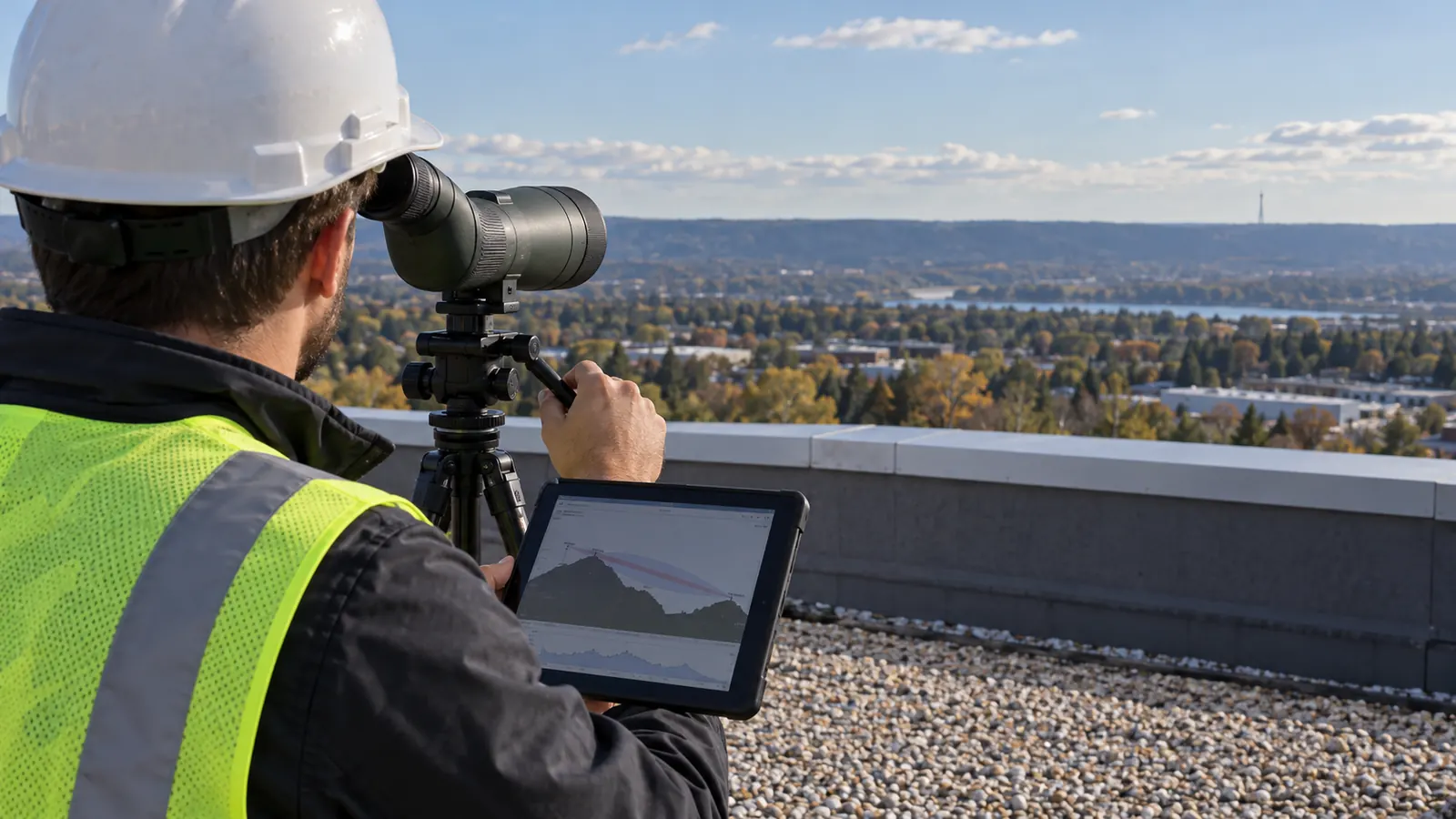
Microwave can connect sites where a terrestrial cable route is impractical, provided the radio path and its endpoints support the service objective. Even when the far structure is visible, we still need to assess clearance around the path and the interference environment. Those findings guide the proposed equipment configuration. Spectrum access must be established for the applicable location and band.
Radio capacity can change as propagation conditions change and equipment adjusts its modulation. For the service commitment, we need the throughput available under the conditions used to design the link. Its best-condition rate can leave the owner expecting more traffic capacity than the path will consistently provide. The detailed microwave backhaul engineering process explains the path evidence needed to support that decision.
Millimeter wave: match throughput to availability
Millimeter wave can be useful where a shorter radio path needs substantial transport capacity. Rain attenuation and other propagation losses shape the usable path length and service availability. Alongside those calculations, we examine the mounting: can the support hold the required alignment, and can maintenance personnel safely reach the installation when performance changes?
The ETSI White Paper No. 25, Microwave and Millimetre-wave for 5G Transport, first edition published February 2018, discusses combining radio bands with different propagation behavior. That is useful architectural background rather than a current equipment specification. We assess the actual configuration: if one band fades, the capacity remaining on the other must still support the services designated to survive.
Satellite: reserve it for the unmet terrestrial case
Satellite enters our comparison when acceptable fiber and terrestrial radio paths cannot be secured, or when the owner needs a deliberately limited backup. For the primary connection, it remains our last resort. Orbit and service architecture affect delay, so satellite should never be assigned a single universal latency value. We test the intended application and verify terminal visibility and service restrictions against the proposed site and operating use before accepting that option.
Internet Society's Solutions for Traffic Backhaul in Community Networks, published November 11, 2019, describes satellite's role where remote communities lack other backhaul choices. Our decision turns on the specific service available to the site today. A terminal that can reach the Internet does not by itself establish suitable transport for every application or prove that a carrier's required network interface is supported.
Prove diversity beyond the network diagram
Two service orders can share one physical failure. The same conduit may carry both circuits into a building, or separate radio paths may terminate at equipment using the same power source. We trace those dependencies before crediting redundancy. A second logical connection is useful only to the extent that it survives the event the owner wants protection against.
Route independence and surviving capacity
A diversity review follows both paths from the originating equipment to the destinations that provide the required service. Separate entrances can still converge upstream. We ask for enough route evidence to identify shared structures and crossings, then record any common segment the operator chooses to accept. A diagram should distinguish verified separation from a requested feature awaiting confirmation.
The scope of protection needs a named failure case. A cable cut and loss of an aggregation site demand different responses, and protecting against one does not establish protection against the other. For each failure case, our review checks both the capacity available for the assigned traffic and any additional delay along the alternate path. Either can prevent the protected application from working as intended.
Check the last entrance: Trace the backup through the building entry to its terminating equipment. Two routes that converge in the same vulnerable entry conduit retain a shared failure point, even when the rest of their corridors are separate.
Restoration access belongs in the design
Access arrangements can determine whether a repair team reaches a failed endpoint. We confirm who grants entry and whether the owner has the records needed to identify the affected equipment. For a radio path across leased rooftops, that includes the permissions and keys needed to get onto the property during an outage. Ordinary network monitoring cannot test or replace those access arrangements.
Those access and restoration responsibilities belong in our wireless backhaul design packages. Path calculations and the installation scope need a shared understanding of who owns each endpoint. The operational handoff should then identify the party responsible for restoring service when the fault crosses a property boundary or falls inside a leased transport segment.
Evaluate ownership through operation and expansion
Cost of ownership compares obligations across the intended service life, including recurring commitments and the work needed to restore or expand the connection. For a useful comparison, we hold the traffic requirement and failure condition constant across the options. A cheaper service may offer reduced protection, and the owner needs to see that difference before deciding whether the saving is acceptable.
Compare the obligations behind each option
Owned fiber requires an organization able to maintain its physical plant and arrange repairs. Leased transport shifts some physical work to another party while leaving the operator dependent on the contract and the available evidence of route separation. Radio creates endpoint maintenance responsibilities. We assign each obligation before procurement so an apparent saving does not become an unassigned operating task.
A common comparison error is treating the first installed configuration as the permanent design. Growth can require a larger interface, a new radio arrangement or more work along the physical route. We identify the upgrade trigger and ask which parts of the original installation remain useful. That gives the owner a practical basis for comparing expansion options without assuming future demand is certain.
Match the plan to the operating organization
A WISP needs a transport plan its operations staff can diagnose from end to end. A municipality may also need clear separation between departmental traffic and the infrastructure owner's responsibilities. Our acceptance criteria reflect how those teams will operate the connection. When a link degrades, the design package should give them enough information to identify the responsible party and begin resolving the fault.
For distributed rural sites, the wireless backhaul planning guide for rural broadband takes the discussion into topology and endpoint planning. Across a larger footprint, we look for sites that share the same constraints and group them for comparison. That gives us a basis for choosing media without assuming every location in the program needs the same solution.
The delivery organization also affects whether decisions survive construction. Draftech International provides turnkey telecom and power infrastructure with engineering performed 100% in-house. Full turnkey construction is delivered by Draftech-managed subcontract crews under Draftech's QA/QC. Our company and partner profiles identify the team accountable for connecting engineering decisions to delivery responsibilities.
Choose the backhaul plan by service consequence
Municipalities connecting remote facilities: The departments sharing a connection need to agree on which services must survive a link failure, who owns the transport and who can authorize changes. At acceptance, we ask the operations team to trace each critical service to its path and demonstrate the failure behavior they agreed to.
ISPs expanding a fiber footprint: Evaluate fiber where a usable corridor supports the intended aggregation demand. Require a documented expansion path before committing to a constrained handoff. We would accept a single route only when the operator explicitly accepts its outage exposure and has a restoration arrangement suited to the services using it.
WISPs connecting dispersed access sites: Screen terrestrial radio paths against usable capacity and endpoint access before purchasing equipment. Carry the combined demand through every aggregation hop. Use satellite where the terrestrial candidates fail the project's requirements, with the accepted service restrictions stated plainly for the staff who will operate the network.
Carriers connecting cell sites: Start with the transport boundary and timing requirements, then review normal operation separately from the required failure case. Before recommending approval, we want the surviving path's capacity documented. If the second connection drops essential traffic, the topology still falls short of full-service protection.
Unclear handoffs and shared failure points should be resolved before construction drawings fix the route. We connect field survey to planning, then carry the decisions through construction drawings and permits. Agency coordination and construction follow, with as-builts and closeout completing the delivery record. Use our project contact page to bring the endpoint information and unresolved transport questions into that review.
For a qualifying route, Draftech engineers the first 20,000 linear feet at no cost, from feasibility and field survey through permit approval. Our free design offer provides a way to develop the route evidence behind a backhaul decision; the owner reviews each request before Draftech commits the package.