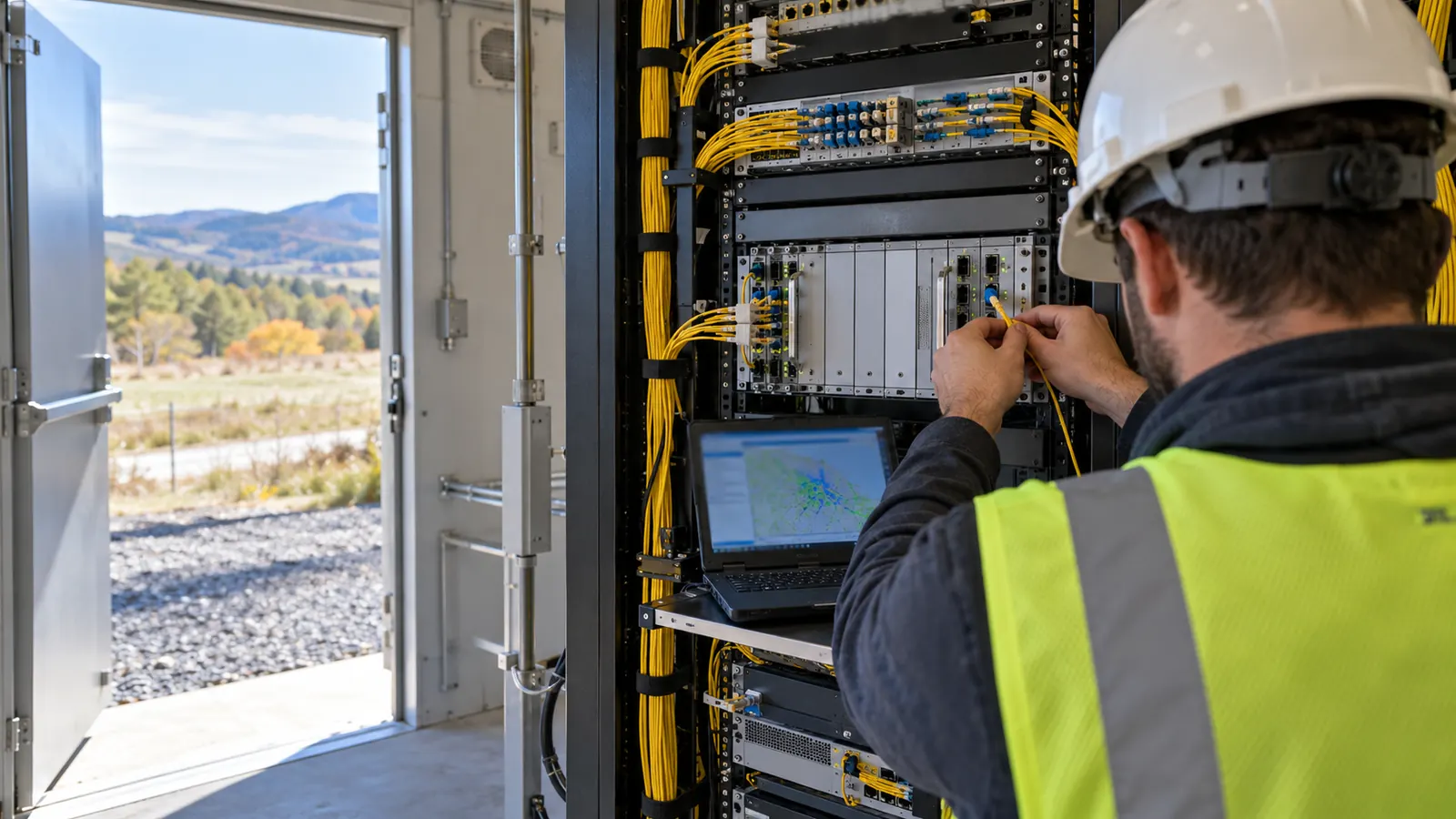
- How to become an ISP: define the network you will operate
- Assign registration and compliance responsibilities
- Secure upstream connectivity before freezing the route
- Move from field survey to accepted network
- Make installs and operations part of acceptance
- How to become an ISP: choose a buildable first phase
A service-area map can look ready long before an ISP can connect anyone. The route may cross poles that need replacement, or the proposed shelter may have no confirmed upstream handoff. Buying access equipment before resolving those dependencies puts the launch behind decisions the equipment cannot fix.
We approach a new ISP as an infrastructure program with an operating business attached. This guide follows the choices a founder, cooperative, municipality or utility must make before releasing a build. For an owner developing physical plant, the network build consumes most of the time and capital. We start there.
How to become an ISP: define the network you will operate
The practical answer to how to become an isp is to secure upstream internet access and deliver it through a network you can operate. Start with 2 connected decisions: where service will be offered and how premises will connect. Validate demand and funding before committing to detailed engineering or construction.
Draw a service boundary that can be built
A useful service-area boundary follows reachable premises and plausible routes. We want the planning map to distinguish an address that appears nearby from a property that needs a difficult crossing or a long private-access agreement. Check the gaps. An isolated pocket can change the backbone route even when its demand looks attractive.
Take rate is the share of serviceable locations expected to buy service. Test the business case against weaker demand than the initial interest survey suggests, because expressions of interest do not create construction access or establish when a household will order. We separate demand evidence from engineering certainty, because a financial model based on strong interest still needs a route that the owner has authority and funding to build.
Capital planning must cover the physical network and the ability to keep operating while construction remains incomplete. Ask who authorizes scope changes and what happens if a critical crossing becomes unavailable after funds are committed. Our recommendation is to define a smaller independently operable phase before financing a footprint that depends on every route succeeding.
Choose fiber, fixed wireless or a deliberate mix
Fiber fits an owner seeking a durable wired access network with room to change active equipment later. Its route is the constraint. We assess available pole space or underground corridors before selecting cabinet locations, and we carry the proposed customer drop path into feasibility rather than treating the final connection as someone else's problem.
Fixed wireless can reach premises without extending fiber to every building, but the coverage map needs engineering behind it. Terrain and vegetation affect the usable path; interference and shared radio capacity affect what the network can support. Our review includes backhaul and power at the radio site before an area is described as serviceable, with site rights checked against the proposed equipment and access arrangements.
A hybrid plan should identify where each technology belongs and why that boundary will hold. Wireless can serve a difficult extension while fiber supplies aggregation, but a temporary radio solution may become a permanent operating obligation if the later fiber phase is never funded. We favor a written migration trigger over a vague intention to replace equipment.
Match funding conditions to the ownership model
Founders need a business case that survives slower adoption, while public owners must also establish who can approve the investment. A cooperative should decide whether the broadband business shares utility resources and how those arrangements will be documented. We recommend settling these responsibilities before requesting construction proposals, because bidders otherwise inherit assumptions about ownership and operating support that the people authorizing the investment have not accepted.
Grant funding requires its own eligibility review. Federal broadband grants, state broadband programs and rural development financing can have different applicant and project conditions; availability must be checked with the administering agency. A prospective award should not become permission to proceed with unrecoverable work. Keep the funding decision separate from the engineering release.
We recommend carrying an explicit allowance for unresolved field conditions in the owner's financial model, with a decision point for releasing that allowance after the route has been checked. The figure belongs to the project. It should come from its quantities and risks, rather than a generic startup estimate borrowed from a different access technology.
The launch can now be organized around the following handoffs, each of which needs evidence before the next party can rely on it.
| Workstream | Decision to settle | Release evidence |
|---|---|---|
| Registration and compliance | Which obligations apply to the proposed services? | Assigned filing owners and agency guidance |
| Upstream connectivity | How does traffic leave the access network? | Confirmed handoff and transport path |
| Design and approvals | Can the selected route be built? | Construction drawings and applicable permissions |
| Construction and acceptance | Does installed plant satisfy the design? | Inspection records and accepted test results |
| Operations and installs | Can an order become a supported service? | Proven provisioning and support workflow |
Assign registration and compliance responsibilities
The operating entity needs a named compliance owner before service launches. Start with the Federal Communications Commission and the relevant state agencies, then have qualified counsel determine which requirements apply to the proposed business and services. The discussion here identifies checks, not legal conclusions. Adding voice or licensed wireless changes the questions.
Check FCC registration, reporting and disclosures
CORES, the FCC's Commission Registration System, manages FCC Registration Numbers and account access. Its Broadband Data Collection FAQs describe how users are associated with an entity's registration number to access the reporting system. We recommend assigning account custody to the operator and documenting who can maintain access when an employee or outside adviser leaves.
The same FCC FAQs describe broadband availability reporting by location identifiers from the Broadband Serviceable Location Fabric. A construction address list may need reconciliation before it can support a filing, and planned coverage must remain distinguishable from available service even when both appear on the same planning map. Draftech does not perform FCC BDC filings; the operator must assign that responsibility separately.
The FCC's Broadband Consumer Labels guidance addresses disclosures at the point of sale. Have the compliance lead check the current requirements against the actual sales channels and service offers before those offers are released. Wireless spectrum authorization needs a separate review for the chosen band. An entity registration alone does not settle that question.
Keep state authority and construction permission separate
Contact the state Public Utility Commission or Public Service Commission about obligations associated with the proposed services. Check entity registration with the Secretary of State and funding conditions with the state broadband office. Public ownership also calls for a review of the municipality's or utility's authority to provide broadband. These answers vary by jurisdiction.
Construction permission belongs in the route review. The state Department of Transportation may control a highway crossing while a local public works department controls an adjoining street. Pole owners retain their attachment approval process. We identify the receiving authority for each affected segment so a general business registration never gets mistaken for permission to install cable.
Secure upstream connectivity before freezing the route
Transit provides access to networks beyond the ISP's own system. Middle mile carries traffic between the service area and an upstream connection point. Peering exchanges traffic with participating networks under the relevant arrangements. These are different functions. A transport circuit to a carrier facility does not, by itself, establish an internet transit service.
Specify the handoff and its physical dependencies
Ask the upstream provider to identify the delivery location and interface, with a clear boundary for responsibility on each side. We want the proposed handoff tied to a real equipment space that the operator can access. If transport requires a new lateral, that lateral needs its own engineering and permissions before the access build can depend on it.
Route diversity must be checked physically. Separate carrier contracts can still share a conduit or building entrance, so the owner should request enough route information to evaluate the common failure points that matter to its service promise. We also check the surviving path's capacity, because a backup connection that cannot support the intended operating condition needs a different recovery plan before the owner can promise continuity.
Plan addressing and expansion together
The American Registry for Internet Numbers describes IP address and Autonomous System Number requests in its Requesting IP Addresses or ASNs guide. Decide with the routing engineer whether upstream-assigned resources fit the launch or independent resources are needed. IPv4 availability and an IPv6 deployment plan deserve attention before customer equipment and provisioning workflows are locked.
Peering can be a later decision when traffic patterns justify it. First make the initial upstream arrangement operable and maintainable, with routing responsibilities clear on both sides. Our discussion of fiber architecture for ISP expansion explains why spare capacity must exist along the actual path, rather than only inside a future equipment schedule.
Move from field survey to accepted network
The build begins with field evidence. Existing records can suggest a route, but the team must verify conditions that determine whether the proposed installation is possible. We want unresolved access issues visible while alternatives remain open. A change discovered before detailed drawings can be evaluated against the entire service area instead of patched into an issued package.
Connect high-level design to construction drawings
High-level design establishes the network arrangement and the relationship between serving areas and upstream access. Low-level design translates that arrangement into construction instructions, including the cable path and splice assignments. Our engineering review checks that these documents describe the same network, since a moved cabinet can affect drop reach even when the backbone line on the map barely changes.
A coordinated delivery model becomes useful when survey findings keep changing permit packages. Draftech International is one option for turnkey ISP network engineering and delivery, covering fielding, planning, construction drawings, permits, agency coordination, construction, as-builts and closeout. Engineering is 100% in-house; full turnkey construction is delivered by Draftech-managed subcontract crews under Draftech's QA/QC and safety program.
That continuity can shorten the build by reducing repeated surveys and the delay between a field change and an approved drawing revision. It still needs owner decisions. A limitation of our preferred turnkey approach is that concentrating delivery with one partner makes the owner's acceptance criteria and access to project records especially important.
Release permits and make-ready by work area
Pole attachment review can require loading analysis and changes to existing attachments before new cable is installed. Make-ready may involve other attachers or replacement work controlled by the pole owner. We keep those dependencies attached to the affected poles so the schedule distinguishes an approved application from a construction-ready pole that has had the necessary work completed.
Underground work needs an equally specific release. Route permissions must cover the proposed installation method, and the work package must account for utility locating and any required traffic control or restoration. Our recommendation is to track readiness by the area a crew can build. A broad permit status can hide a blocked crossing inside an otherwise accessible route.
Resolve the shared segment first. If several service areas depend on the same crossing, establish a viable route through that crossing before advancing all of their detailed designs. Otherwise one unresolved permission can force revisions across the entire first phase.
Keep splicing, testing and as-builts connected
Construction progress should be measured against accepted plant. Installed cable still needs the planned splice continuity and testing before it can carry the intended service, and a field change must reach the network records while its location remains clear. We want inspection findings tied to the drawing revision so the owner can accept or reject work against an identifiable requirement, including where an approved change altered the original installation.
The acceptance plan should state the required optical loss measurements and where OTDR testing is needed, with pass criteria established before the crew submits results. Match each result to the tested fiber and endpoints. Labels matter. A folder of traces that cannot be mapped to the splice record leaves operations unable to distinguish a testing issue from a network fault.
As-builts must reflect the installed route and the final connection records, including approved field changes. Our ISP fiber build project-management guide follows these handoffs through release and turn-up. Give operations access to the accepted records before service activation, when mistakes can still be corrected without disrupting an operating connection.
Make installs and operations part of acceptance
An order must flow from a serviceable location to a provisioned connection. The business support systems, BSS, handle the commercial record; operational support systems, OSS, support network inventory and service activation. We recommend testing their handoff using the actual equipment configuration before launch, since a billing record can appear correct even when the wrong access port has been provisioned.
Test the customer journey against the physical plant
Start with address qualification and follow the order through the install appointment. The technician needs a usable drop path and the correct termination assignment, while support needs to know what was installed. Check cancellations too. If a failed installation leaves a port reserved indefinitely, the commercial system can overstate how much capacity the network has available.
Equipment management needs a clear owner. Customer devices must receive the intended configuration, and administrative access should be controlled separately from ordinary customer access. Include software maintenance and recovery procedures in acceptance. We recommend proving that a replacement device can be activated from the recorded service information without relying on the original installer's memory.
Prepare for faults before advertising availability
Monitoring should lead to an action. Assign who responds to an upstream alarm and who can authorize a field dispatch when the cause appears to be in the outside plant. Keep emergency access arrangements available to that team, because an equipment shelter that nobody can enter after hours turns a repairable fault into a service-management problem while alarms continue to arrive.
The operator also needs maintenance responsibility for the access network after construction closeout. Establish the spare-equipment plan and the process for recording repairs, then verify that a changed splice assignment will reach the same inventory used for the next installation. Our construction handoff should support that work. The ISP retains responsibility for running the service.
How to become an ISP: choose a buildable first phase
For founders: prove demand against a bounded service area before committing to expansion. Select a phase that can operate even if the next area is delayed. We recommend confirming upstream delivery before ordering access equipment, because the backbone path determines where that equipment can usefully be deployed.
For cooperatives and utilities: reconcile the broadband route with existing asset records and operating rules. Ownership can help establish access, but attachment suitability still requires engineering review. We recommend assigning broadband change authority explicitly so an attractive route does not depend on an undocumented assumption about shared utility resources.
Municipal owners: settle operating responsibility and procurement authority before releasing the build package. Decide who accepts the network and who maintains it after handover. Make record ownership explicit in the procurement documents so the public owner can operate or transfer the assets without reconstructing their history.
Evaluate the proposed delivery team against those decisions. Draftech's partner and company information identifies the people accountable for delivery, and our service-area information helps owners assess coverage. Active in 24 states. Available across all 50 U.S. states. We still scope each route around its actual authorities and field conditions.
Unresolved crossings and mismatched drawings need one accountable delivery team that can carry changes from fielding through closeout. Bring those constraints to a discussion about your ISP build, or write to info@draftech.com. We can define the infrastructure scope while the owner assigns the separate obligations of running the ISP.
For a route ready for an initial engineering review, Draftech engineers the first 20,000 linear feet of a qualifying route at no cost, from feasibility and field survey through permit approval. The free engineering offer starts with the owner reviewing each request before Draftech commits the package. Use that review to establish whether the first phase can proceed.