IN THIS ARTICLE
What trenchless changes in a conduit crossing
For fiber and power conduit, trenchless construction places a new underground pathway without excavating a continuous trench over the crossing. We compare 3 methods: horizontal directional drilling, auger or jack-and-bore and pneumatic piercing. The choice turns on ground conditions and crossing geometry, with existing utilities and permit conditions setting the usable envelope.
A road can stay intact while the installation beneath it becomes the hardest part of the route. Even with enough room underground, the bore needs working space at both ends. Starting with the finished conduit alignment, we work outward to the contractor's setup area and check whether it overlaps an entrance that must remain open.
Surface access belongs on the route drawing. A route drawing should show the working area beyond the pavement edge, including space for handling the conduit before installation. At the receiving end, we need a practical connection to the adjoining route. If the bore exits where the next handhole cannot be built, the design has moved the conflict rather than resolved it.
Compare the installed pathway, not just the bore
Fiber and power can share an installation method without sharing a conduit design. The electrical owner still sets the requirements for its distribution circuit, and cable loading can make the thermal environment important. We keep those requirements separate from the contractor's drilling proposal. A successful bore only establishes that a pathway was placed; acceptance also depends on what that pathway must carry.
For a fiber route, our design review follows the cable into the connecting structures. A bend that works for the empty conduit can still complicate the later cable pull when the approach to the handhole forces another change in direction. Our review covers both installation stages. Conduit installation and cable installation impose different loads, so the drawings must accommodate each rather than treating empty duct as the finished system.
Open trench remains a real alternative throughout our selection process. Where excavation is permitted and the route has frequent connections, direct access may give the designer better control over the arrangement. We include restoration and the adjoining route. Shorter bores can still complicate construction.
Ground, depth and utility conflicts set the envelope
Read the ground along the crossing
A ground description such as "soil with rock" leaves too much unresolved for method selection. Continuous competent rock presents a different cutting problem from isolated boulders inside loose fill. We ask the geotechnical specialist to relate the available investigation to the proposed bore elevation, because a shallow observation beside the road may say little about the material beneath its center.
An entry excavation that appears stable during a dry visit may need different support or water control when groundwater conditions change. The contractor needs that information before committing to the setup. On our drawings, we identify the investigation's boundaries and distinguish assumed layers from those supported by boring logs.
Define what the depth is measured from
We measure cover from the surface the crossing owner specifies. Pavement elevation and ditch bottom are different references, and a rail crossing may use base of rail instead, so a depth note cannot travel between crossing types unchanged. We check the profile against that surface. Future grading also matters when the authority has an adopted improvement that changes the available cover.
Increasing cover may lengthen the entry curve or deepen the launch pit. Either change can move work beyond the available easement, even when the center of the crossing remains acceptable. After a depth change, we revise the whole profile, giving the tie-in elevations the same attention as the low point.
Resolve conflicts before choosing a steering allowance
A line on a utility record gives us a location to investigate before we can establish a measured clearance. We coordinate the available owner records with the required locating and exposure work by the responsible qualified parties, then use the resulting information in the crossing design. Where a critical utility remains unresolved, our design should retain that uncertainty explicitly rather than assign an invented elevation.
When checking clearance, we allow for the full installation envelope: the later reamer or casing is larger than the pilot head, and construction tolerances need room around the intended path. We check separation against the largest operation. A pilot route that misses a utility can still leave insufficient space for the installed conduit assembly.
Keep unresolved conflicts on the profile. If a utility elevation controls whether the crossing fits, require its resolution before releasing that portion for construction. Moving the note to a general sheet makes it easier to miss when the bore subcontractor reviews only the crossing detail.
Trenchless methods compared with open trench
| Method | Useful starting condition | Access requirement | Reason to reconsider |
|---|---|---|---|
| Horizontal directional drilling | Curved conduit alignment beneath a surface that must stay intact | Rig setup and conduit handling space | Unmanageable fluid risk or inadequate tracking |
| Auger or jack-and-bore | Straight cased crossing with suitable ground | Launch and receiving excavations | Unsupported face conditions or pits that cannot fit |
| Pneumatic piercing | Short straight crossing in displaceable ground | Small launch and receiving areas | Obstructions or insufficient control of the path |
| Open trench | Accessible corridor with permitted surface excavation | Continuous work and restoration corridor | Surface closure restrictions or protected crossing features |
Horizontal directional drilling: room for a curved path
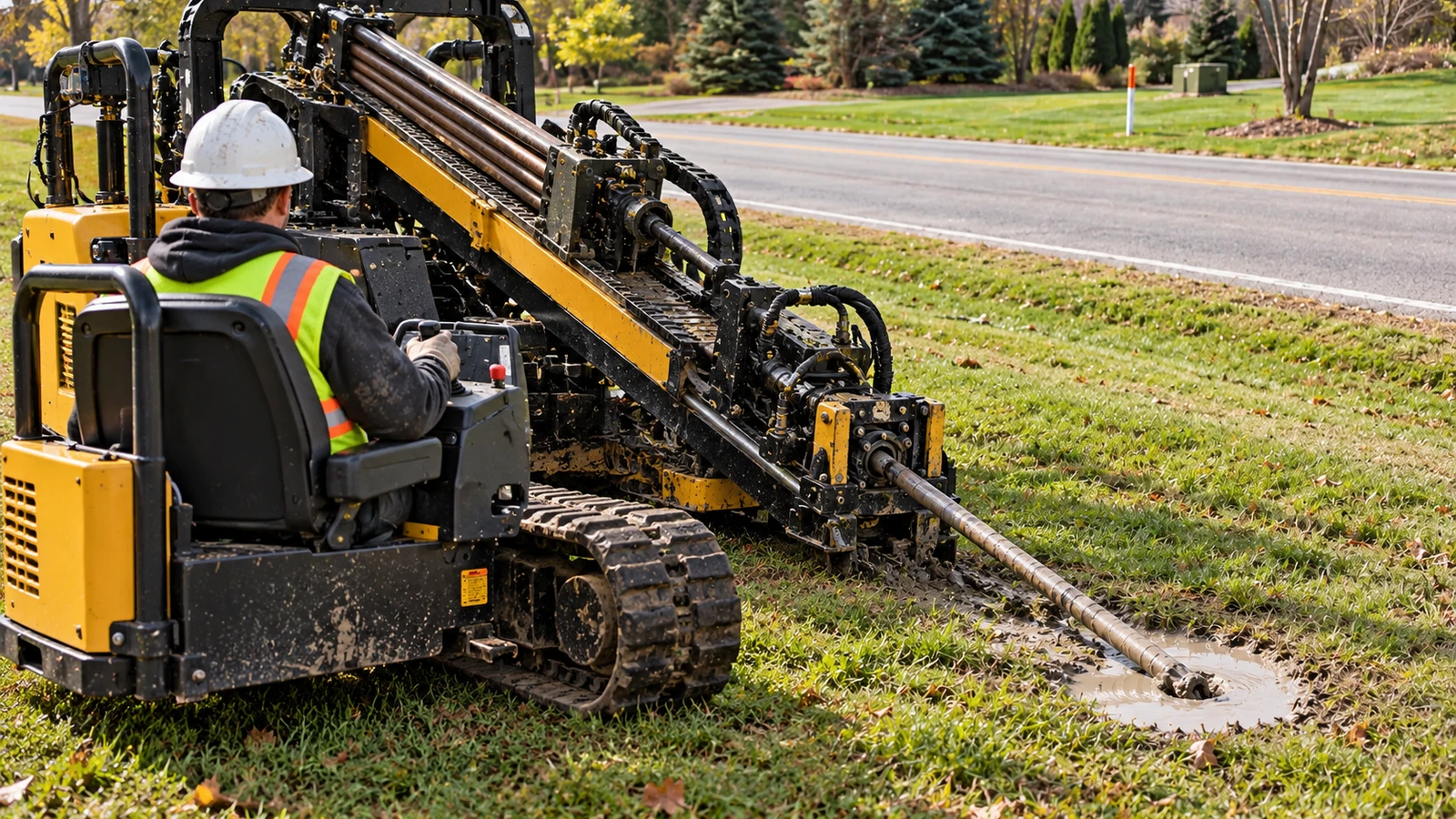
HDD offers a steerable alignment where a continuous surface opening is undesirable. The pilot bore establishes the route. Enlargement and conduit pullback follow. Within the limits of steering, we need an achievable profile that respects the drill string and product bend requirements. The drawn alignment cannot bend sharply around every conflict the survey identifies.
The FHWA's Manual for Controlling and Reducing the Frequency of Pavement Utility Cuts, chapter 4, describes the pilot and enlargement sequence and the importance of tracking. It is background guidance for understanding the method, not the crossing owner's approval. Our HDD conduit installation guide addresses the drilling controls in more detail; this comparison concerns whether HDD belongs in the route at all.
Rock does not automatically eliminate HDD. Ditch Witch's technical article Maximize productivity on fiber jobs with HDD tooling distinguishes tooling for soft ground from equipment suited to solid rock. Before accepting the proposed equipment, we check it against the investigated ground; experience drilling one rock formation does not establish suitability for a different mixed face beneath the next crossing.
When we select HDD to protect the surface, we can concentrate uncertainty underground, where changing the alignment after drilling starts is much harder. That makes fluid behavior a separate part of our assessment. The design and contractor's work plan must address containment and response when returns depart from the intended circulation path, especially where the bore approaches sensitive ground or water.
Auger or jack-and-bore: a straight casing with working pits
Conventional auger boring advances a casing while rotating flights carry excavated material toward the launch pit. Jack-and-bore is often the crossing specification's name for that cased installation approach. In the submittal, we confirm the intended system and look beyond its label to how the face will be controlled and how accurately the contractor can maintain alignment.
To judge whether the launch pit will fit, we account for the boring equipment, casing handling space and reaction needed for jacking. Its support arrangement must also account for loads beside the excavation. With access needed at the receiving end too, we plot both excavations before choosing a straight cased crossing that looks convenient only in the underground profile.
Conventional auger equipment provides limited correction compared with a steerable HDD path. Some systems add guidance, but that capability must be specified and accepted for the proposed work. Loose saturated ground requires particular attention to face stability. We do not treat an open-face auger proposal as suitable merely because the casing diameter and crossing length fit the machine's stated capacity.
For a conduit bundle inside a casing, the drawings must explain how the ducts will be supported and how the ends will be treated. Supports and installation tolerances take up internal space, so a casing that accepts the nominal duct diameters can still leave an unbuildable arrangement.
Pneumatic piercing: reserve it for a suitable short crossing
A pneumatic piercing tool advances by displacing ground around its body, creating a passage for the product. Long steerable bores serve a different purpose. We consider it for a short straight crossing where the ground can accept displacement and the required pathway is compatible with the tool, paying particular attention to alignment at launch.
Basic piercing tools allow little course correction. A buried obstruction can deflect the tool, and a shallow displacement operation can disturb the surface above it. We would not recommend pneumatic piercing through an unresolved utility corridor. The attraction of a small setup disappears when the receiving point must be exact and the ground gives no reasonable basis for expecting it.
Because recovering a tool that stops short may require excavation, the crossing detail should leave a feasible recovery path. If the protected pavement cannot be opened under the applicable permit, the project cannot quietly assume an emergency opening will be allowed. Our method review asks the contractor to address that failure condition before accepting the proposal.
Open trench: retain direct access where it earns its place
Open trench exposes the installation corridor and allows direct placement of the conduit arrangement. We favor evaluating it where the surface can be opened and frequent connections would otherwise require repeated pits. Restoration belongs in that design review because the authority's pavement and backfill requirements may determine whether the proposed corridor is practical.
A shallow narrow pavement cut belongs in a separate evaluation. Our microtrenching and traditional trenching comparison covers that decision without treating a slot cut as a substitute for a designed road or rail bore. Where a route combines methods, we draw the transitions explicitly so the conduit depth and approach geometry remain workable at the changeover.
Road, rail and waterway conditions change the choice
Road crossings start with the allowed surface occupation
The road authority may restrict pavement openings while still requiring traffic control for the equipment beside the travel lanes. Intact pavement still requires that coordination. We check how the rig or pit affects visibility and access, then compare the construction footprint with the permitted occupation. The proposed method must fit the work area for its entire installation sequence.
As we follow the crossing toward the shoulder, a profile that has enough cover at the road centerline can rise toward a ditch or intersect space reserved for a culvert. Drainage can therefore control the alignment beyond the pavement. Our profile follows the full ground width. Where the road owner requires casing, that requirement enters the method comparison before the contractor selects its equipment.
Rail crossings need an accepted system and access plan
The rail owner's crossing requirements determine the design basis for its property. We confirm the required reference for cover and the permitted installation system before fixing the bore geometry. Because track access is controlled separately, even a technically workable crossing can remain unbuildable until the approved work window and required railroad coordination are in place.
Jack-and-bore can be a strong candidate for a straight cased rail crossing, but we never infer acceptance from the method's name. The railroad may specify casing and monitoring. If HDD is proposed instead, obtain the owner's acceptance of that approach and its profile. The contractor should not arrive expecting to negotiate a method substitution beside an operating track.
Submit the actual construction footprint. A permit drawing that ends at the conduit centerline leaves the reviewer unable to assess the launch area. Show the proposed pit or rig position relative to the controlled property so access problems surface while the layout can still change.
Waterway crossings extend beyond the visible banks
A waterway profile must account for the bed and the ground beneath it. We evaluate erosion or scour information where applicable, rather than using the water surface as the cover reference. We also check bank access: an HDD route may preserve the channel while placing its setup in an area that needs separate environmental authorization or cannot support the equipment.
Fluid containment and response can determine whether HDD is acceptable. A credible plan needs a way to observe the crossing and act on an inadvertent return under the project's conditions, including locations that cannot be reached by a truck. We coordinate the design with the responsible environmental specialists and permitting authorities. Calling the method trenchless does not establish that the work is exempt from review.
These interfaces are where our utility construction delivery and crossing coordination connect engineering decisions to field execution. Draftech International provides turnkey telecom and power infrastructure delivery with engineering 100% in-house and full turnkey construction delivered by Draftech-managed subcontract crews. Our construction oversight carries the accepted crossing conditions into the work package instead of leaving them in the permit correspondence.
Choose the method, then make the crossing buildable
Fiber route owners: compare HDD with open trench at the corridor level before dividing the work into isolated shots. Favor HDD where protecting the surface has a clear purpose and the alignment can be tracked. Retain trenching where direct access and frequent connections make it the better fit. The method boundary should follow the route's physical conditions.
Electric distribution owners: settle the conduit arrangement and cable requirements before accepting a bore substitution. A change from an accessible duct bank to a buried bundle can change the installation conditions that the electrical design relies on. That review stays with engineering, including when conduit work connects to a substation or accompanies make-ready work.
Crossing package managers: select a cased auger approach where the owner accepts it and the pits fit; reserve pneumatic piercing for a short crossing with suitable displacement ground and a clear path. Method changes require a fresh review. An accepted plan for one system should not become permission for another through an informal field instruction.
Before closeout, we need the installed route tied to the project's survey reference and the conduit acceptance results required by the owner. Record deviations while the cause remains clear. A completed crossing should leave the next cable installer enough information to use it without reconstructing the bore from photographs. Our partner and delivery responsibilities identify the team accountable for that handoff.
Draftech International supports route owners across its service areas: Active in 24 states. Available across all 50 U.S. states. If pit access or an unresolved crossing condition is holding your route, send the design question to info@draftech.com so we can assess the engineering and construction interface.
For an early route whose crossings still need engineering, Draftech engineers the first 20,000 linear feet of a qualifying route at no cost, from feasibility and field survey through permit approval. The free design offer gives the route owner a way to request that package; the owner reviews each request before Draftech commits the package.