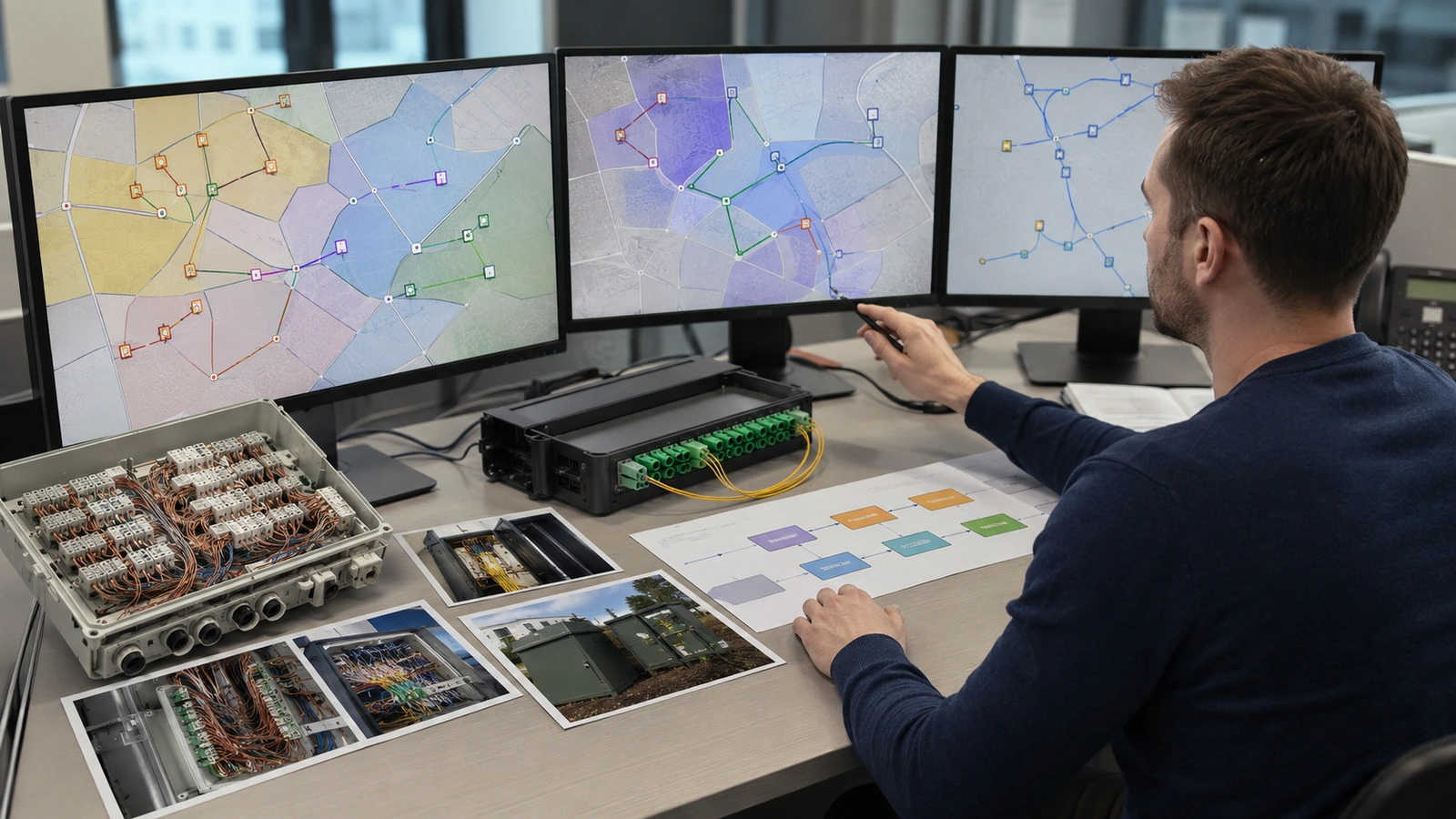
A monthly bill can describe a line as voice while the wire actually serves a gate controller or a substation modem. That naming problem is why replacement programs fail before equipment selection begins. The account record rarely describes the full operating dependency.
This guide treats replacement as an engineering migration rather than a handset swap; we cover circuit discovery plus application requirements; we also address power resilience and carrier process. The owner still controls acceptance, while the serving carrier controls its network actions.
POTS Replacement Engineering Scope and First Decision
POTS replacement engineering converts each legacy analog circuit into a documented service that preserves its approved function. A defensible program uses at least 4 gates: inventory, application validation, resilience review and witnessed cutover. It separates carrier retirement activity from the owner's decision to accept a replacement endpoint.
The first decision is not which adapter to buy. It is whether a billed line still exists at the demarcation and what happens when it receives a call; we compare the carrier service identifier with the physical pair. Then we trace the pair to its endpoint. A line that rings nowhere stays unresolved. Do not guess.
Our circuit register gives every candidate 1 stable ID and one accountable owner. Billing number is useful, but it is not enough because trunks or hunt groups can conceal the actual endpoint relationship; we record demarcation location and serving account; we also record observed voltage state plus endpoint function. The register keeps evidence separate from interpretation.
Carrier copper retirement and service discontinuance are related but different regulatory actions. The FCC's 2018 wireline deployment order explains changes to the federal network transition framework. Current 47 CFR 63.71 addresses applications involving discontinuance or impairment of service. Neither source approves a particular replacement device for a utility site.
The FCC's public 2015 Technology Transitions Order explains the federal transition framework and consumer protection concerns around changing network technology; it is a source for process context, not a product specification; we still need the current tariff or contract. Local authority requirements also remain project inputs.
One dangerous shortcut is to treat dial tone as the acceptance test. An alarm panel can seize the line even though an ordinary handset call succeeds; a modem can connect yet fail its data exchange. Elevator communication can require location identification plus two way operation that a casual call never tests. Function governs.
Our self-critical note is explicit: the limitation of a circuit first method is that discovery can feel slow when invoices contain hundreds of numbers; we accept that friction. A fast bulk order built on unverified labels moves uncertainty into the cutover window, where each unknown becomes harder to isolate and more expensive to reverse.
Inventory rule: No circuit receives a replacement class until a named owner accepts the observed endpoint function.
Lifecycle ownership begins at acceptance because batteries and network subscriptions create recurring tasks that legacy account records may not have exposed, leaving a technically successful cutover vulnerable to an expired service plan or an ignored replacement interval. We assign each recurring task to the owner's maintenance system. Keep it visible. The acceptance record names the first due action plus repository, allowing operations to manage the replacement as an asset rather than as a one time telecom order.
POTS Replacement Engineering Classification Matrix
We classify by behavior rather than by department. The 6 rows below are screening classes, not universal acceptance criteria. Each site replaces the generic test with its approved procedure. The table appears early because classification determines which evidence must exist before design can begin.
| Circuit class | Critical interface | Engineering question | Acceptance evidence |
|---|---|---|---|
| Voice or dispatch | Analog handset or console | What calling features are essential? | Inbound and outbound call record |
| Alarm reporting | Panel communicator | Does the approved path carry every signal? | Monitoring station confirmation |
| Elevator communication | Car phone and answering point | Does the full emergency workflow operate? | Authority accepted functional test |
| Fax or telemetry | Modem protocol | Is analog emulation technically suitable? | End to end transaction result |
| SCADA or utility control | Remote terminal equipment | What latency and recovery behavior apply? | Owner witnessed operational test |
| Unused or unknown | Unconfirmed endpoint | Can the service be retired safely? | Documented owner disposition |
Voice and Alarm Circuits
Voice circuits need a feature inventory; we check inbound reachability and outbound dialing; we also inspect extension behavior plus caller identification needs. A dispatch line may depend on a hunt arrangement that disappears when one number is migrated alone; the accepted design states which carrier features are part of the service and which live inside owner equipment.
Alarm circuits require the alarm provider in the acceptance chain; we do not infer compatibility from an adapter data sheet. The panel model and communicator path need identification. Test signals must reach the named monitoring station under an approved procedure, and restoration must return the panel to its intended state. One successful phone call proves none of this.
Elevator and Access Circuits
Elevator communication is governed by the applicable adopted code plus the authority having jurisdiction. The federal 2010 ADA Standards section 407.4.9 addresses emergency communication features in covered elevators. It does not certify a cellular gateway; we document the installed interface and obtain the required acceptance path before scheduling conversion.
Gate phones and access controllers can present analog ports while relying on tones or timing that an emulated service handles differently; we capture the controller make plus approved configuration; we then test the real workflow from a remote caller through release action. A local off hook test is too narrow. Test the transaction.
Modem and SCADA Circuits
Modem traffic is the hardest class to generalize because the physical jack reveals almost nothing about the protocol above it. Utility telemetry can rely on polling intervals or line conditioning established years earlier; we record endpoint equipment plus communications settings from an accepted source. The replacement architecture must be evaluated against that actual transaction.
For utility control traffic, we separate operational communications engineering from ordinary business voice. Security zoning and remote access policy become design inputs. So do failover behavior and recovery authority. Our copper to fiber migration engineering guide covers broader plant transition controls, while this post stays focused on individual analog service dependencies.
Unknown and Apparently Unused Lines
An apparently unused line is a finding, not a retirement authorization; we observe the endpoint and review available call records under owner policy; we also check whether the line serves seasonal operations or a dormant emergency device. If ownership remains unclear, the register states the evidence gap. A named authority decides the next action.
Unknown circuits deserve a controlled isolation method rather than an improvised disconnect. The owner defines notification and rollback conditions; we establish a bounded observation window based on the site's operating cycle. No national duration fits every site. The final record explains why the selected window was adequate for that circuit.
Power, Network and Cutover Design
Legacy copper service often delivered line power from carrier facilities, while an Internet protocol or cellular replacement places new power dependencies at the customer location; we diagram every powered element from source to endpoint. That includes the gateway and network terminal. It also includes any switch between them. Hidden power paths cause quiet failures.
Backup duration is an owner requirement tied to the application risk; we do not publish one universal battery number. Instead, the design basis identifies required operating time and load. It also records battery environment plus monitoring method. The calculation distinguishes nameplate capacity from usable capacity under the approved replacement interval.
Network diversity must be physical enough to survive the stated hazard. Two services sharing one entrance conduit are not independent against an excavation event. Two cellular paths can share a commercial power dependency; we map common failure points through the demarcation and local equipment. Then the owner decides whether the residual exposure is acceptable.
Signal quality needs an application test. Analog emulation can alter tone transmission or modem negotiation. Packet networks introduce delay plus jitter. Cellular service adds radio conditions that vary inside mechanical rooms; we measure at the proposed equipment location under an approved method. A coverage map does not replace an on site test.
Cutover design assigns a sequence and a stop condition. The old service remains available until the new path passes its defined test when the carrier arrangement permits overlap; we identify who can call the monitoring center or answering point; we also name who declares rollback. Authority should be obvious before the first pair moves.
The test script uses observable actions. Place a call from the endpoint. Receive a return call when required. Transmit the approved alarm event. Confirm the remote transaction. Each class gets only the steps relevant to its accepted function, and every result carries a timestamp plus witness identity. Concise evidence beats a generic checked box.
Power caveat: A replacement path is only as resilient as the least supported powered device in its end to end chain.
Carrier coordination starts with exact service identifiers; we record order numbers and requested actions. A port request is not the same as a copper retirement notice. A disconnect order is different again. Our engineering register mirrors those distinctions so billing cleanup cannot accidentally become technical authorization.
For cooperatives pairing communications upgrades with broadband work, the electric cooperative fiber design field guide explains the wider OSP design context. Shared facilities can reduce survey duplication, but the analog circuit acceptance record must remain application specific. A new fiber route does not prove an elevator phone works.
Limitations and the Acceptance Record
The largest limitation is evidence quality. Billing exports can contain stale addresses. Pair tags can be missing. Equipment labels can point to a prior configuration; we preserve these conflicts as exceptions instead of reconciling them by appearance. The accepted record states what was observed and who resolved each discrepancy.
A second limitation is jurisdictional variation. Fire alarm and elevator acceptance routes depend on adopted rules plus the authority having jurisdiction. Carrier offerings also vary by location; we therefore avoid claims that one gateway or one test script creates compliance everywhere; product approval and installation approval remain separate decisions.
Radio based replacements have environmental limits. Equipment rooms can attenuate signal. Antenna placement can conflict with building restrictions. A strong reading at an open doorway does not prove performance after the door closes; we document test location plus operating condition, then retain a follow up trigger if the environment changes.
Cybersecurity review is necessary when a formerly isolated analog endpoint moves onto an owner network; we identify management interfaces and update authority; we also record logging expectations; the security team decides approved controls. POTS replacement engineering should expose the new attack surface without pretending that a telecom drawing grants network authorization.
The final package contains a circuit disposition register and approved architecture. It also contains power basis plus test evidence. Open exceptions remain visible; we issue a cutover record and update owner drawings after acceptance. Disconnect proof closes the commercial loop only after the technical owner authorizes it.
Monitoring should distinguish loss of the replacement path from loss of the application itself, since a healthy gateway indicator cannot prove that an alarm event reached its destination or that a modem completed the expected transaction. We document which alarms are available and who receives them. Test escalation. If the selected device exposes no useful remote status, that absence becomes an accepted maintenance limitation with a manual verification method.
Procurement records need the approved interface and configuration revision because substituting a similar gateway after design review can change port behavior or power draw, invalidating both the application test and backup calculation. We place substitution authority in the package. No silent equivalents. A proposed alternate returns through technical review before installation, while ordinary stock handling remains under the owner's procurement controls.
Recovery documentation should be usable during an outage when the original migration team is unavailable, so we pair the stable circuit ID with endpoint location and support ownership while keeping sensitive credentials in the owner's protected repository. The field record identifies the approved restart or escalation path. It does not publish passwords. This boundary gives operators enough context to diagnose the service without turning a drawing package into an insecure access file.
Our in house electric utility engineering support can structure the circuit register and replacement design while coordinating owner reviews. Draftech does not claim carrier authority or authority having jurisdiction approval. If physical installation is included, construction is delivered through managed crews under the agreed project controls rather than represented as self performed work.
POTS Replacement Decision by Reader Role
A replacement program should proceed only when every circuit has an accepted class and test owner. Unknowns do not need fictional precision. They need a disposition path; we recommend holding a circuit whenever endpoint function or rollback authority remains unresolved. That is a firm gate.
Utility communications manager: approve the architecture only after common power plus transport failures are mapped. Require separate acceptance for control traffic. Keep the legacy path available through witnessed testing when the carrier arrangement allows overlap. Do not let a bulk purchasing decision define operational risk.
Facilities director: classify alarms and elevator lines before selecting hardware. Bring the maintenance provider plus required authority into the test plan. Reject a design that proves dial tone but omits the complete emergency transaction. The real endpoint decides the test.
Cooperative broadband lead: coordinate the migration with fiber work, but maintain a separate circuit acceptance gate. Use stable site IDs across both programs. Preserve carrier order evidence. For broader rural architecture decisions, review the production live cooperative guides before combining scopes.
Portfolio program owner: pilot by circuit class rather than by invoice size. Freeze the evidence model after the pilot. Then scale only the approved patterns and route every exception to a named technical owner. Volume is not a substitute for classification.
Confirm available service area support before planning a multi state survey. Review Draftech's engineering organization when assigning design responsibilities. If the circuit inventory is already exposing unknown endpoints, email our utility engineering team with the site count plus application classes.
Plan the POTS replacement review. We can turn account records and field evidence into an owner ready migration register.