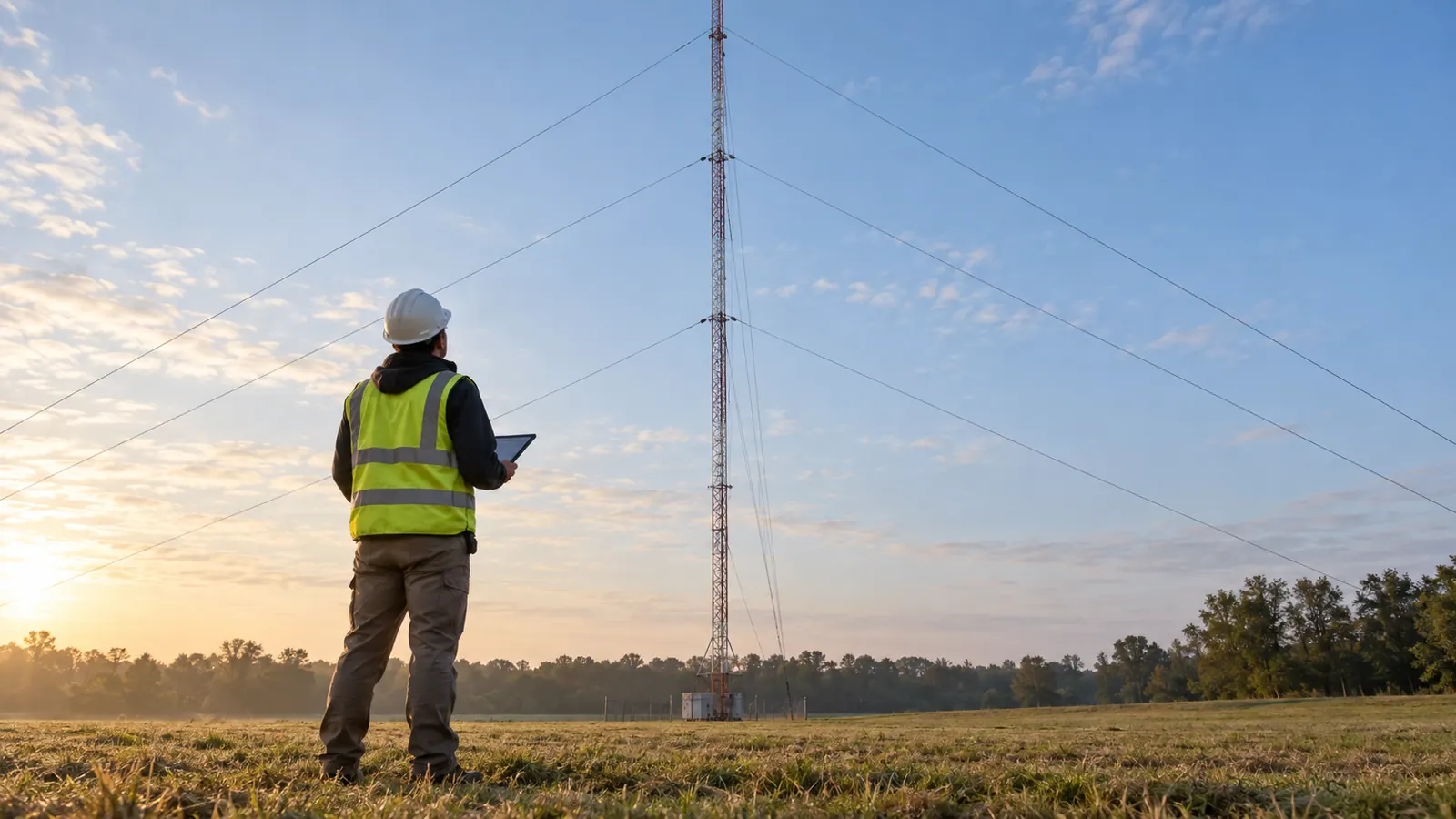
The cables running into the field belong in the same engineering decision as the antennas overhead. A carrier may be focused on a new mounting elevation, while the tower owner needs to know whether the existing anchors can support the changed reactions. We connect those questions before treating an antenna position as available capacity.
What a guyed tower is and how its parts work
A guyed tower is a communications mast stabilized by tensioned guy wires connected to ground anchors. Its load path has 3 main parts: the mast, the guy system and the anchors. Together they resist antenna and environmental loads, so a proposed equipment change requires evaluation beyond the visible steel at the mounting elevation.
Support extends beyond the tower base. The mast carries vertical compression and resists bending between its supports, while the inclined guys transfer forces toward anchors located away from the mast. We read the tower elevation beside the site plan to understand that geometry. Moving an anchor position on the drawing changes how we represent the support overhead, which is why the ground layout belongs beside the mast details during review.
The mast carries equipment between support levels
A guyed communications mast often uses an open lattice of legs and bracing, with guy attachments at selected elevations. That lattice construction describes the mast's shape; the guys describe its support system. Calling it a lattice mast therefore tells us only part of what we need to know. Before choosing a structural model, we establish whether the lattice stands on its own or depends on guys, and which areas of ground must remain usable for that support.
The unsupported length between guy levels influences the mast's behavior under lateral loading, and an antenna mounted between those levels introduces force at its own elevation rather than at a convenient model point. At that elevation, our review also follows the mount attachments: does the assembly load a leg directly, or does a designed frame distribute the force? The attachment details let us answer that question rather than assume the two arrangements behave alike.
Guy wires provide tensioned lateral support
Guys carry tension. They do not behave like rigid braces that can push back in compression, and the response changes as loading increases tension in some cables and reduces it in others. To represent that response, we need the initial tension, cable properties and actual geometry in the analysis. A nominal diameter alone leaves room for error; identifying the strand lets us use the stiffness and strength of the cable that is there.
A qualified crew can adjust a guy with a turnbuckle, but needs an engineered tension requirement to know the correct setting. When we specify an adjustment, the measurement conditions go with it. That includes temperature: without that context in the field record, the engineer cannot reliably compare the measured value with the intended condition or treat readings taken under different conditions as interchangeable.
Anchors complete the load path into soil
Each anchor transfers guy forces into a foundation and the surrounding ground. The visible connection is only part of that system: buried steel condition and the foundation's resistance can control the result even when exposed hardware appears serviceable. We separate what the field team observes from what drawings or investigation establish. A clean photograph cannot establish buried dimensions or soil properties.
Anchor access also needs protection throughout the site's life. A new fence or equipment pad can obstruct maintenance without touching the mast, and excavation near an anchor can disturb the ground that supports it. Our site review considers those conflicts before civil work is released. The anchor area deserves the same drawing coordination as the equipment compound.
Compare the guyed tower with freestanding options
Land availability often decides whether a guyed arrangement deserves further study. The mast itself can occupy little ground area, but the usable site must accommodate the guy paths and the anchors outside that small base. An empty-looking field can be misleading if the equipment lease covers only a narrow strip. Our first layout review therefore establishes the controlled parcel and access rights before using the surrounding ground for proposed anchors.
On a constrained site, a monopole may fit the available ground; where a broader base is acceptable, a self-supporting lattice tower offers another framing arrangement. The choice depends on those site conditions. Our preference for reusing a sound existing guyed structure has a real limitation: uncertain buried anchor conditions can require investigation before we can support an upgrade recommendation.
| Decision factor | Guyed mast | Monopole | Self-supporting lattice |
|---|---|---|---|
| Lateral support | Tensioned guys and mast act together | Shaft transfers bending to its base | Braced legs transfer loads to foundations |
| Ground footprint | Includes remote anchors and guy paths | Compact shaft base; compound still needed | Broader tower base without remote guys |
| Upgrade focus | Whole support system response | Shaft and base connection capacity | Leg and brace load paths |
| Field access | Access needed at mast and anchors | Access centered on shaft and compound | Access around legs and foundations |
| Movement review | Guy stiffness and tension influence response | Shaft stiffness influences response | Frame stiffness influences response |
When the guyed arrangement fits
For an existing site with secure anchor rights, retaining the mast can preserve a useful communications location while engineering addresses a defined equipment change. Even at a familiar site, we first establish the configuration that is there. An open antenna position tells us little about capacity when the proposed mount changes local loading between guy attachment elevations; that location needs to be evaluated with the rest of the equipment.
A new site gives the owner a chance to compare layouts across the full controlled area, beyond the concrete footprint. Guy paths can restrict where future buildings or access roads go, even if those uses appear compatible on an early concept drawing. Bringing the owner's expansion plan into our layout review helps expose those conflicts while there is still a choice of locations. A later anchor move changes the support geometry and needs engineering review of its own.
When a monopole deserves priority
A monopole deserves early consideration when remote anchor locations cannot be secured or would interfere with the site's intended use. Its shaft brings the lateral load path back to a concentrated base connection and foundation. Before allowing an upgrade, we would still analyze that load path. Neither a clean exterior nor an unused mounting position establishes the shaft and foundation capacity available for the proposed equipment.
Compare service requirements as carefully as appearance. The antenna configuration and the site conditions govern whether the shaft and foundation can meet the project requirements, and a compact base does not eliminate the need for equipment access or a construction working area. We ask the civil designer to show those areas rather than leaving them outside the concept comparison.
When self-supporting lattice fits the site
A self-supporting lattice tower uses its braced frame and foundations without remote guy support. Its base can occupy more space than a mast base while keeping the support system within a more concentrated area than a guyed layout. Our comparison considers both the available ground and the required loading, since selecting a tower type leaves the question of tenant capacity to the analysis of that particular structure.
Readers evaluating member and connection checks can use our lattice tower structural engineering discussion for that deeper scope. Here, the useful distinction is where support comes from: a guyed mast depends on its remote cable supports, while the freestanding frame carries lateral demand through its legs. That distinction follows the project into every foundation review.
What changes when antennas are added
An antenna's projected area contributes wind demand, and its elevation determines where that force enters the mast. Those effects can be missed when an addition is described only by its weight. In our evaluation, the proposed configuration includes the antenna, supporting mount and attached lines as an assembly, with each load applied where it reaches the structure.
Define the installed condition before the proposed condition
Retained equipment stays in the model. We reconcile the owner's inventory with the observed arrangement so an old drawing does not quietly erase equipment that remains on the tower. For each planned removal, we establish when the equipment will leave the tower. Equipment that stays temporarily during a migration still contributes load, so the engineering scope must include that overlap and the final arrangement shown on the drawings.
The proposed antenna needs an identified elevation and orientation, with its mounting arrangement described well enough to trace the force into the mast. Along the route down the tower, attached lines can contribute distributed demand that a top-of-tower equipment summary misses. We include their routing in the review and check whether the line supports also need local evaluation.
For the detailed change schedule, our antenna-upgrade loading analysis guide explains how to track retained and removed equipment. On a guyed site, we carry that same discipline into the cable support system. An upgrade conclusion should identify the modeled arrangement so the owner can tell whether a later radio revision changes the basis of acceptance.
Use an explicit structural design basis
The Telecommunications Industry Association announced the release of ANSI/TIA-222-I, Structural Standard for Antenna Supporting Structures, Antennas and Small Wind Turbine Support Structures, on October 2, 2023. We establish the applicable adopted code and owner criteria for each assignment before choosing the analysis basis. The release date tells us when the standard was published; local adoption determines its use on a project. Our report identifies the governing revision and any applicable amendments so the owner can see the basis we used.
Under the selected basis, structural evaluation considers the relevant environmental loading and the equipment configuration together. Wind direction can alter how demand reaches the guy system, so a single convenient direction cannot stand in for the required analysis cases. Passing the strength checks leaves another question for our serviceability review: will the movement meet the antenna system's operating criteria? We evaluate that requirement alongside the load cases rather than treating strength alone as a complete result.
Keep the antenna revision attached to the report. When RF design changes an elevation or mount after analysis, send the change back for engineering review before treating the earlier result as permission to install it.
Our tower structural analysis service connects that defined equipment arrangement to the structural checks. The conclusion should show the owner what can proceed and any conditions that remain. If we still need an anchor detail or a guy property confirmed, that assumption belongs there, where it can be resolved before the work proceeds.
Guy tension and anchor checks need field context
Before interpreting a tension reading, we match it to the guy and the conditions under which it was measured. The field record and engineering model need a shared identification scheme for this to work. A plausible value entered against the wrong attachment level may escape notice, leaving the engineer evaluating a different cable from the one the crew measured.
Evaluate the system before changing a setting
Guy tension and tower alignment interact, so adjustments require a coordinated procedure that accounts for the structure's response. Tightening an individual cable can change forces elsewhere and affect mast alignment. We do not recommend adjusting guys to make them look equally taut. The engineer must establish the required condition, and qualified crews must execute the approved procedure.
Visible sag alone cannot establish compliance with a tension requirement. Cable length and temperature influence what an observer sees, while the applicable measurement method determines how the field result should be interpreted. Keeping the cable length, temperature and method beside the reading gives our engineer a basis for comparison. Where an observation is missing, we ask for it before specifying an adjustment; otherwise, the crew could be changing a setting on the strength of an incomplete record.
Record before adjustment. Preserve the initial tension observations and alignment information before corrective work begins so the engineer can distinguish the original condition from the completed work.
Resolve the anchor information that controls acceptance
Anchor records should establish the installed foundation and the properties needed to evaluate its resistance. Where records are incomplete, we define an investigation scope with the owner rather than assigning convenient dimensions to hidden construction. Until that investigation supplies evidence, the buried condition remains an open question in our review. Exposing anything near a loaded anchor also requires a planned approach that protects the support system while the investigation is under way.
A capacity concern can lead to a revised antenna arrangement or engineered reinforcement, depending on what controls the result. The controlling failure mode guides our comparison. An anchor deficiency remains after a mast member is strengthened, for example. Changing initial guy tension also calls for evaluation of the whole system, because the adjustment may introduce a different problem without resolving the original concern.
Colocation engineering carries the decision into construction
Colocation brings a new tenant into an existing structural and operational arrangement. The tower owner needs a traceable engineering conclusion, while the carrier needs the installation to match its RF requirements. Keeping both parties on the same equipment revision is part of our coordination through wireless engineering and site delivery work so a structural condition does not disappear between design disciplines.
Construction sequencing can change the loaded condition. If an upgrade requires reinforcement or temporary equipment overlap, the construction package must identify the sequence that the engineering has evaluated. Our review also covers the installation approach, since the finished configuration may differ from what the structure carries during the work. Before releasing construction that depends on the analysis, the owner needs that approach reconciled with the structural scope.
Draftech International provides turnkey telecom and power infrastructure delivery with engineering performed 100% in-house. For communications sites, full turnkey construction is delivered by Draftech-managed subcontract crews under our QA/QC and safety program. Our partner and company information identifies the organization accountable for that delivery. Engineering conditions remain attached to the work package through field changes and closeout.
Closeout should let the owner compare the installed equipment with the configuration that received acceptance. We resolve substitutions with the responsible engineer and retain the resulting record with the final drawings. During that final review, we also check that new fencing and restoration preserve the owner's access to the anchors. The maintenance route needs to remain usable after the construction work is complete.
Choose the next step for your communications site
Carriers adding antennas: send the proposed configuration and removal plan before requesting a capacity decision. Confirm whether the migration leaves existing equipment in place temporarily, because that overlap may create a loading condition the final antenna schedule never shows. We recommend resolving the installation configuration before reserving a construction release around an assumed structural pass.
Tower owners evaluating colocation: reconcile the current inventory and anchor documentation before offering an unrestricted loading allowance. Keep any unresolved field condition attached to the proposed tenant's acceptance. Our recommendation is to make the acceptance specific to the evaluated arrangement, with later substitutions returned for review rather than absorbed into a vague statement of spare capacity.
Utilities using communications towers: begin with the operational antenna requirements and the ability to maintain access to every anchor. For a new site with restricted land, compare freestanding alternatives before committing to a guyed layout. For an existing mast, preserve the communication service requirements while engineering evaluates the proposed change and its installation sequence.
Draftech's service-area coverage supports communications-site planning across the country. Active in 24 states. Available across all 50 U.S. states. For the antenna position considered at the start of this article, our answer depends on both the mast overhead and the anchors out in the field. Carrying those findings into construction drawings and closeout gives the owner a record of the configuration we evaluated and the equipment that was installed.
When the tower project also needs a fiber route, our qualifying-route engineering offer can address that separate part of the build. Draftech engineers the first 20,000 linear feet of a qualifying route at no cost, from feasibility and field survey through permit approval; the owner reviews each request before Draftech commits the package. That route work can help coordinate the connection to the site while tower capacity remains a distinct engineering decision.