A colored coverage map can make a fixed wireless build look settled before anyone has checked the proposed antenna height. Before we can rely on that footprint, we need to know which premises can be installed, what the shared sector can carry, and whether the site can reach the rest of the network.
FWA meaning: fixed wireless access from the builder's side
The telecom fwa meaning is fixed wireless access: a broadband connection that uses radio between a network base station and equipment at a fixed customer location. The access link has 2 ends, but a working service also needs backhaul into the provider's network and a usable connection inside the premises.
The word fixed refers to the service location, leaving the operator free to choose a radio generation and an appropriate supporting structure without requiring a tower at every site. An operator may use cellular radio technology or a purpose-built fixed wireless system, with antennas mounted on an appropriate structure. We begin with the intended coverage area and the available sites, then test whether the proposed architecture can serve the actual buildings.
Base stations and customer equipment
A base station serves customer equipment through its antenna coverage pattern. Many deployments divide that coverage into sectors, each aimed toward part of the service area. When subscribers gather near one road or settlement, the sector facing them can become busy while capacity facing another direction remains unused. We account for those boundaries in the design because shifting that capacity may require changes to the sector arrangement.
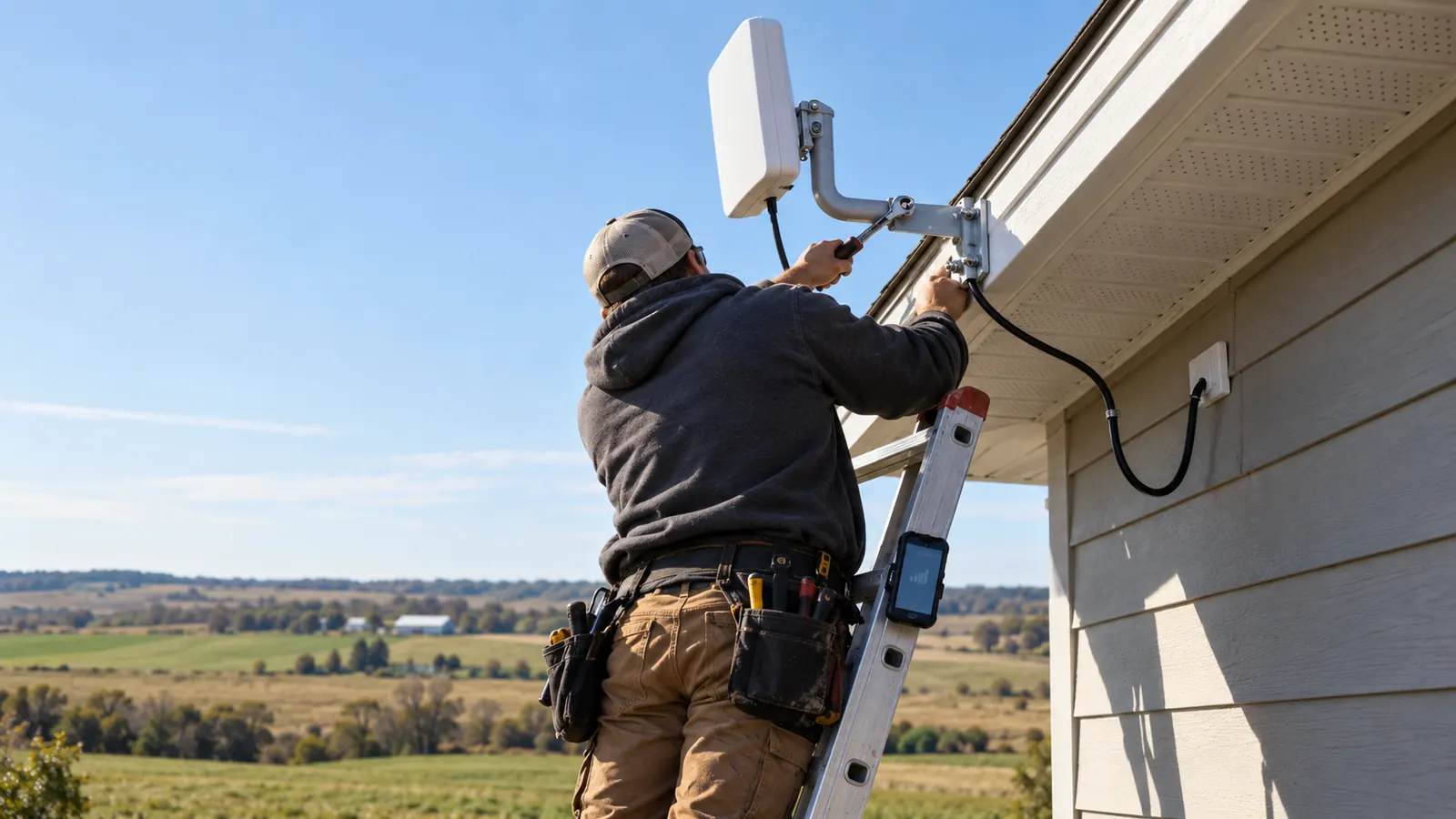
Customer premises equipment, usually shortened to CPE, terminates the access radio link. An outdoor installation may place the antenna and radio near a roofline, with a cable running to indoor networking equipment. Indoor CPE is another arrangement where the radio conditions support it. We specify the installation assumption in the coverage model because a roof-mounted receiver and an indoor receiver face different losses.
Even where a base station reaches a customer, the customer equipment may be unable to send a sufficiently strong signal back under the proposed settings. We evaluate both directions before accepting a location into the serviceable footprint. Otherwise, the installer may discover a return-path problem at a location that engineering qualified using only the downlink prediction.
Backhaul and the indoor handoff
Traffic leaving the base station needs a path toward the provider's network. That path is backhaul, which can use fiber or a separately engineered wireless link. Because its capacity and availability affect every subscriber using the site, we identify the network handoff early, including who provides the connection and who owns the equipment on either side.
Wi-Fi serves a different part of the connection. It commonly distributes service inside a building after the FWA link has reached the CPE. With both links in use, a commissioning test at the customer handoff helps separate access-network behavior from an indoor coverage problem. Our acceptance requirements specify that test location so the installer knows which part of the connection is being evaluated.
Spectrum choices change the operating assumptions
Before ordering radios, we check the lawful operating basis and develop a channel plan for the selected location. A band that is useful at one site may present interference or coordination constraints at another, even when the same equipment can tune to it, so availability needs checking for each proposed site.
Licensed spectrum
Licensed operation requires checking the operator's rights against the intended service and location. The relevant authorization determines the permitted use; owning a radio does not establish those rights. We keep the licensing assumptions visible in the design so that an equipment substitution or site move receives the appropriate review before installation changes the network's authorized operating configuration.
Even with the protection rights that licensing can establish under the applicable rules, adjacent-channel effects and poor isolation between the operator's own installations can cause interference. Antenna placement and the proposed channel arrangement have to work together. We also ask who will resolve coordination issues during operation, rather than leaving that responsibility undefined at handover.
CBRS shared spectrum
The National Institute of Standards and Technology's article Validating Spectrum in the CBRS Band: From Models to Measurements, published September 23, 2026, describes CBRS across 3550 to 3700 MHz. Its three-tier framework places incumbent access above Priority Access License users, with General Authorized Access below both. An automated Spectrum Access System assigns channels and power levels.
CBRS therefore combines shared access with managed authorization. General Authorized Access should not be treated as an exclusive channel reservation. NIST explains that protected federal activity can cause the Spectrum Access System to direct affected devices to stop using or move from particular frequencies. We carry that operating dependency into the design and the operator's support plan.
Keep authorization separate from coverage. A propagation model can estimate a radio path, but the deployment still needs the applicable spectrum permissions. Record the operating assumption beside the proposed channel plan so that a site revision cannot silently inherit an invalid assumption.
Unlicensed spectrum
Unlicensed operation remains subject to the rules for the selected band and equipment. It does not give an operator exclusive use of the channel. We assess the local radio environment and the network's own reuse pattern before choosing an arrangement. The survey captures conditions at the time of the visit; a channel that appears quiet then may become busier after neighboring systems are installed.
These options overlap in practical networks. Licensed backhaul can support an access network using shared spectrum, and fiber can feed a site with unlicensed access radios. In our design records, each link carries its own operating assumptions so the access and backhaul decisions remain clear when the broadband plan uses several spectrum arrangements.
The engineering behind a serviceable footprint
We use the following design checks to turn a candidate coverage area into a buildable scope. Each check can change the answer reached by another discipline. Raising an antenna may improve a path while increasing structural demand, and a different site may improve coverage while creating a much harder backhaul route.
| Design check | Question to resolve | What the answer changes |
|---|---|---|
| Site selection | Can the operator secure and maintain the site? | Candidate location and access scope |
| Propagation | Can the proposed installation reach the premises? | Antenna height and serviceable area |
| Link and sector design | Does the radio design support the planned load? | Channel arrangement and admission limits |
| Structural review | Can the structure and mounts support the installation? | Equipment placement or reinforcement scope |
| Backhaul | Can traffic reach the network at the required availability? | Transport route and resilience plan |
Site selection starts with access and rights
When screening a high location, we check installation rights and maintenance access separately before selecting it for further design. A parcel can be reachable during a survey yet unsuitable for routine service if the access agreement does not cover the vehicles or working hours the operator will need.
Power availability also belongs in site screening. The proposed equipment load must fit a deliverable electrical arrangement, and backup operation must match the owner's intended outage response. We ask how equipment will be reached when normal access is disrupted. That answer can eliminate a site before detailed radio modeling consumes time on an option the operator cannot maintain.
Our wireless site feasibility discussion explains the early checks in more detail. For an FWA program, the useful result is a candidate-site decision with unresolved conditions stated plainly. We keep rejected alternatives and their reasons in the project record so a later equipment change can be assessed against the original constraints without repeating the entire site search.
Propagation depends on the installation
Terrain data establishes the broad shape of a path. Buildings and vegetation can change what happens close to the receiving antenna, especially where the model lacks current surface detail. During field verification, we compare the modeled mounting position with a place where equipment can physically be installed and maintained, checking the nearby obstructions and whether the position would require an unapproved extension.
A visible line between antennas does not describe all the space relevant to propagation. The Fresnel region around the direct path also matters, and obstructions can reduce usable margin even when the endpoints appear visible. We use the proposed frequency and actual path geometry to assess clearance. The Fresnel zone clearance guide develops that calculation without treating one antenna height as suitable for every link.
A limitation of model-led planning is its dependence on the accuracy of clutter and installation assumptions. We prefer modeling for comparing candidate designs, then field checks for resolving the assumptions that could reverse a decision. For a path observed through bare branches, our field notes also need to account for the different conditions expected when those branches carry leaves.
Link budgets and shared sector capacity
A link budget accounts for transmit power and antenna gain against the losses between the radios. We assess the resulting received level against receiver requirements and the interference environment to understand the available margin. Recording the assumptions behind that margin gives us a basis for reviewing a later antenna or operating-channel change, including whether the revised configuration still supports the planned link.
Signal quality and available capacity answer different questions. A customer can have a usable radio path while sharing a sector that lacks capacity for the planned demand. We examine the traffic assumptions at the sector level, including how less favorable radio conditions affect airtime use. Increasing the number of admitted subscribers without revisiting that model transfers the shortfall into operations.
The design should state how the operator will recognize an approaching capacity limit. We prefer an agreed monitoring trigger tied to observed sector behavior over a promise based only on an equipment headline. The expansion plan can then respond to that trigger with a defined next step. If the response requires a new sector and another antenna position, we revisit the structure and channel plan even when the operator already has permission to occupy the site.
Tower and mount structural review
A structural review starts with the proposed equipment configuration and reliable information about the supporting structure, even where mounting space is available. We account for antenna wind area, the mounts and the way loads reach the structure. Changing the installation height or adding attachments can change those loads, so the review has to address the arrangement crews will install.
We keep structural acceptance tied to the equipment schedule used in the analysis. If procurement substitutes a different antenna, the revised dimensions and loading information need review before crews install it. Where existing conditions are uncertain, we may need additional investigation to reconcile the records with what is observed on site. A professional seal on an old drawing does not resolve that uncertainty if the drawing omits later modifications to the structure.
Resolve height changes across disciplines. When radio design raises a proposed antenna, send the revised position back through structural review before releasing construction drawings. The original acceptance covers the original configuration; the revised geometry needs its own engineering disposition.
Backhaul is part of the site decision
For a fiber-fed site, finding nearby fiber starts the search for a defined connection point and a feasible route to it. We confirm that usable capacity and a commercial handoff are available before the broadband plan relies on that connection, then carry the route's permitting and construction dependencies into the site schedule.
Wireless backhaul needs its own path assessment, separate from the subscriber coverage model. We review its operating band and clearance against the intended availability objective. Subscribers depend on that transport path even when the access sector performs well. Where resilience is required, our review checks whether apparently separate connections share a power source or upstream point of failure that could interrupt both.
These interdependent decisions are the reason our wireless engineering scope connects radio planning with the physical site. We want the operator to receive an equipment layout that can be installed and supported, with transport dependencies visible before the build is released. The remaining conditions should have named owners and a clear effect on the construction sequence.
Where FWA fits beside fiber
FWA and fiber can serve different parts of the same broadband program. Fiber may provide the backbone and selected premise connections while radio reaches other fixed locations. To decide where each belongs, we compare the service objectives with the actual installation conditions and the operator's ability to maintain each part of the network.
Fiber access requires a physical path to the premises and the associated construction permissions. FWA requires a serviceable radio path and enough shared access capacity, supported by a usable site. Backhaul is a requirement for both, and we include it alongside the access dependencies in the comparison. That lets the operator evaluate the work involved without assuming every fiber extension is straightforward or every address inside a coverage contour is installable.
Plan the transition before calling it temporary
An interim wireless deployment needs a defined role after fiber arrives. The site might continue serving premises beyond the fiber build, or the operator might remove some equipment. During planning, we establish the exit conditions for that temporary role because the expected use after fiber arrives changes the value of a lease term and the justification for permanent site improvements.
For a lasting mixed network, keep the premise records consistent across both access methods. A location identifier should survive a change in technology. That continuity helps the operator distinguish a planned migration from a duplicate address and ties the service history to the correct building when a customer moves between access technologies. It also makes the next expansion review easier when coverage assumptions change.
Construction and acceptance follow the design
The released construction package must describe the accepted installation rather than the first feasible concept. We identify the CPE mounting assumptions separately from the base-station work so installers know which variations require review. If the specified mounting point is inaccessible, we need to resolve the location and check the revised path before installation proceeds; moving equipment for convenience can invalidate the prediction that qualified the premises.
At acceptance, test the completed access connection at the agreed handoff and compare the installed configuration with the design record. We want exceptions visible before closeout, including any mounting change that affects the radio path. Operational records should preserve the final equipment location and connection arrangement so a maintenance visit begins with the installation that exists, including approved changes made during the field work.
Turn the FWA meaning into a build decision
For ISPs: establish sector admission and expansion criteria before opening the planned footprint for orders. Match service qualification to the mounting arrangement installers can deliver, and keep uncertain premises out of the confirmed installation count until the relevant field check is complete. This gives operations a defensible starting point for managing growth.
For co-ops: evaluate existing sites against the broadband use rather than assuming utility ownership settles access or capacity. Confirm the installation rights and operating responsibilities. We recommend mapping the proposed wireless footprint against the planned fiber routes before selecting permanent site improvements, because the shared transport investment can influence both parts of the program.
For municipalities: define the asset owner's role separately from the network operator's role before releasing site access. Resolve who maintains the installation and who accepts service at the network handoff. The municipality can then assess a proposal against an operating arrangement, instead of approving a coverage image whose maintenance responsibilities remain unsettled.
Draftech International delivers turnkey telecom and power infrastructure with 100% in-house engineering and full turnkey construction by Draftech-managed subcontract crews. Our partner and company information identifies the team behind that work. For an owner facing uncertain mounting locations or unresolved backhaul, our fixed wireless access service connects field survey and planning to construction drawings, permits and agency coordination, followed by managed construction, as-builts and closeout. Use the project email contact to bring those site constraints into scope.
When the FWA plan also needs a qualifying fiber route, Draftech engineers the first 20,000 linear feet at no cost, from feasibility and field survey through permit approval, under the free route design offer. The owner reviews each request before Draftech commits the package. That route work can resolve the transport dependency while the wireless site design proceeds against a defined connection.