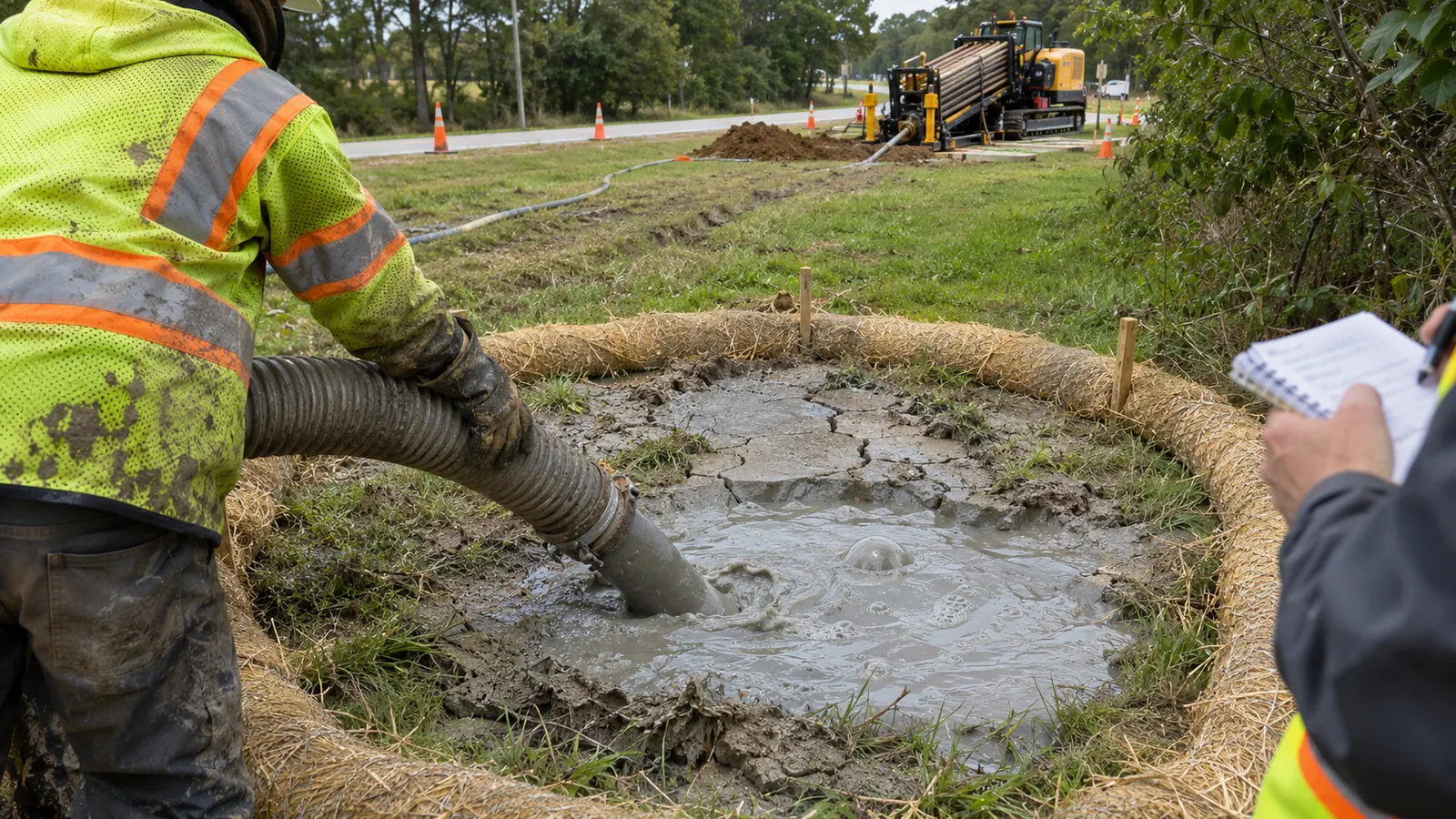
What a frac out means at a directional bore
A frac out is an inadvertent return: drilling fluid escapes the borehole and reaches the surface or a waterbody instead of returning to the pit. The response plan needs 5 linked actions: stop, contain, recover, notify and record. Site conditions and permit requirements determine how the crew carries them out.
Fluid appearing beyond the intended return pit changes the job immediately. The operator needs a clear stop instruction while the designated observer identifies where the material is emerging. Our pre-bore briefing needs to settle who calls the stop and who receives it, because a supervisor trying to find the correct contact during a release has less attention available for the crossing itself.
This guide is for ISPs, utilities, co-ops and contractors responsible for planning or inspecting directional bores. We focus on decisions that belong in the crossing package and the field briefing. For the installation sequence, use our HDD boring guide for fiber installation; the issue here is keeping a fluid release from becoming an improvised response.
Lost circulation deserves its own response
A reduction in returns is a warning. It does not by itself establish where the missing fluid went. Fluid can enter the surrounding formation without an observed surface release, so our field notes distinguish a loss of circulation from a confirmed inadvertent return. Each condition calls for the response specified in the plan.
The distinction matters to an inspector. A dry observation point cannot prove that fluid stayed inside the bore, especially where the path passes beneath ground that cannot be watched directly. An observation log should tell us what the inspector saw, what the equipment indicated, and what additional investigation or monitoring the plan required.
Guidance supports the crossing-specific plan
NASTT's Horizontal Directional Drilling (HDD) Good Practices Guidelines, fifth edition, released in 2024, provides industry guidance for HDD planning and execution. It gives us a technical reference for planning the bore; approval of a particular alignment or response method still belongs with the permit issuer. The permit issuer's conditions govern the permitted work. Owner requirements also need to be carried into the construction package.
FERC staff's Guidance for Horizontal Directional Drill Monitoring, Inadvertent Return Response, and Contingency Plans, published in October 2019, distinguishes normal drilling, lost circulation and inadvertent returns. Its stated scope concerns natural gas infrastructure; we use that distinction here as a useful planning reference, without treating the document as a universal permit rule for fiber or electric distribution crossings.
Why drilling fluid leaves the intended return path
Drilling fluid must travel through the available return path while carrying cuttings. The ground around that path can contain weaknesses before the drill arrives, and drilling conditions can change as work progresses. Even with a rig the crew knows well, we need to check the proposed geometry and the ground assumptions. Knowing the equipment does not tell us whether the ground along this crossing can contain the fluid.
Shallow cover and connected ground pathways
Shallow cover reduces confinement. A bore profile can look comfortably below a crossing at its center while approaching the surface near a bank or at an entry transition. On the profile sheet, we look at those bank and entry transitions as closely as the deepest point. The center depth alone cannot establish protection along the entire crossing.
Fractured rock and loose or permeable ground can let fluid travel away from the bore. Existing voids and disturbed ground can provide additional pathways. The U.S. EPA's How to Evaluate Alternative Cleanup Technologies for Underground Storage Tank Sites: A Guide for Corrective Action Plan Reviewers, Appendix A, Horizontal Remediation Wells (EPA 510-B-17-003, published October 2017), describes inadvertent returns through hydrofractures and existing preferential pathways. That discussion explains a mechanism; it does not prescribe this crossing's design.
The surface location of a release may therefore differ from the drill head's position. When we mark the observer's search area, we follow the site assessment, including ground beyond the narrow line directly above the planned bore. The observer also needs access to that area. If the observer cannot reach a sensitive area, the package needs an accepted way to monitor it.
Pressure and blocked returns interact
As cuttings accumulate, a restricted return path can raise annular pressure, the fluid pressure around the drill string. Fluid pressure that exceeds what the surrounding ground can contain can open or enlarge a pathway outward. Pump readings alone do not describe every downhole condition. The drilling contractor's qualified personnel must establish the operating controls appropriate to the equipment and ground.
Using similar conduit does not justify copying operating settings from another bore. We need the contractor to account for this crossing. The return path and formation may be different, and a setting that worked elsewhere cannot establish an acceptable condition here. Require the contractor to explain how abnormal returns will be detected and who can stop work when the agreed triggers occur.
Build frac out prevention into the crossing design
The design review should connect each concern to something a crew can locate or follow. The following comparison helps us work through those concerns with the crossing designer and drilling contractor, who supply the details for this crossing. Each row identifies a different gap that can survive in a package containing only an alignment drawing.
| Design control | What the package should establish | Field question it answers |
|---|---|---|
| Profile and cover | Reviewed geometry beneath the crossing and through its transitions | Does the intended bore remain within the reviewed profile? |
| Entry and exit placement | Usable work areas with access and containment space | Can equipment reach the planned response locations? |
| Ground information | Known conditions, uncertainty and required specialist input | What observation requires the design assumptions to be revisited? |
| Monitoring | Observation locations, responsibilities and stop triggers | Who sees an abnormal condition and tells the operator? |
| Containment readiness | Approved methods and staged resources suited to the site | Can the response begin without unauthorized disturbance? |
Review the profile through the entire crossing
Depth needs a design basis. The profile should show the relationship between the bore and the feature being crossed, including the approaches where available cover changes. Before issuing the drawing, we compare the ground information with that geometry, particularly where a proposed adjustment moves the bore into a different material or closer to a sensitive feature.
Moving the bore deeper can change the drilling demands and the space needed at the ends. That revised profile needs engineering review before the crew relies on extra cover to address the risk. Even when we resolve the profile early, the ground information cannot reveal every connected fracture or pocket of loose ground between investigation points. A limitation of our planning approach is that monitoring can identify a return only after fluid has already escaped the intended path.
Place the ends where the response can work
Entry and exit locations need enough practical room for the intended operations. Ask how the contractor will reach the return pit and where recovery equipment can stand without blocking the operator or crossing an unauthorized area. The drawing's work limit must accommodate the contractor's access needs before the setup can be accepted.
The recovery route deserves a walk-through. A vac truck shown beside a bore on a plan may have no usable approach once the actual work area is occupied, particularly if the access depends on land outside the approved limits. Walking that approach during planning gives us a chance to resolve the access problem before the crew needs to recover mud.
Make uncertainty visible in the ground information
The crossing package should identify the ground information supporting the profile and where that information remains uncertain. The specialists interpreting the ground need to explain what additional investigation is needed if the proposed alignment encounters conditions the available records do not explain. Keep inferred conditions distinguishable from observed ones so the contractor knows which assumptions require particular attention.
For owners coordinating multiple construction activities, our utility construction delivery connects route design and permitting with work by Draftech-managed crews. The bore package still needs clearly assigned specialist responsibilities. A construction handoff should show who supplies the ground interpretation and drilling-fluid controls instead of leaving either task implied by a general design note.
Specify observation and containment before mobilization
Monitoring instructions need to identify who observes the route and how that person communicates with the operator. Plotting the observation locations alongside sensitive features and access constraints helps us check whether the observer can see the ground from those locations. A method that depends on seeing the ground needs to account for vegetation or other obstructions at the actual crossing.
Containment provisions should match the receiving area rather than repeat a standard equipment list. The designated response contractor needs an approved method that can be deployed within the permitted work limits, with resources available where the plan requires them. A land-based barrier should never be assumed suitable for a flowing waterbody merely because it is already on the truck.
Check the access drawing against the response plan. If the recovery equipment cannot reach the designated location within the authorized work area, resolve the access or change the plan before drilling begins.
Give the crew a usable response sequence
The field briefing should let an observer describe a suspected release and receive an immediate, unambiguous response from the operator. At the crossing, we ask the observer and operator to test the radio from their working positions and confirm that the stop instruction gets through. A contact list inside a binder cannot compensate for a message that never reaches the person controlling the drilling operation.
Stop and contain under the approved procedure
Stop drilling and pumping as the response plan directs. The designated lead should confirm that the operator has received the instruction and protect people from the affected area. The crew then applies the approved containment method where it is safe and authorized to do so, while the field lead and assigned observers determine the extent of the release.
Containment needs its own limits. Digging a new pit or moving equipment into a waterbody can create additional disturbance that the original crossing authorization does not cover. Put those restrictions beside the containment instructions in the briefing, with a named contact for the field lead to call if the planned method cannot be used within the authorized footprint.
Recover material and notify the required contacts
Recovery belongs to the personnel and equipment designated in the contingency plan. They should follow the approved method for collecting the material and managing its disposition. The recovery record must distinguish mud collected from the site from estimates of the release. Preserve the basis for each estimate so the person reviewing the event can check it.
Notification runs alongside the response. The plan should name the people responsible for contacting the permit issuer and any other required parties, with notification triggers taken from the permit and owner requirements. Where the owner or permit requires a backup contact, we check that the list includes one. The assigned caller needs to know whom to try next when the first call goes unanswered.
Record the first observation before details blur. Capture its location and the drilling activity underway when it appeared, while another assigned person handles the required notifications.
Record the event and control restart
The event record should allow the owner to connect field observations with the response decisions. Include the drilling condition at detection and the actions taken, then preserve the communication record and supporting photographs. List unresolved questions alongside the confirmed observations so we can see what still needs an answer. An estimate should remain labeled as an estimate after it moves into the final report.
Restart requires a separate decision. The drilling contractor and the owner's designated reviewers need to assess the cause and proposed corrective action, then obtain any approval the permit or owner requires before work resumes. A return pit receiving fluid again does not settle those obligations. If the revised method changes the authorized crossing, resolve that change through the required review process.
What a contingency plan should show the permit issuer
Permit issuers need to see how the proposed response fits the specific crossing. Their conditions control the required submission and any subsequent changes; a generic form cannot establish that a response is acceptable at this site. Before the contractor mobilizes, we work through the actual permit conditions and identify any requirements that remain unresolved.
For the broader authorization questions, our guide to waterway permits for fiber crossings explains the permitting context. Here, keep the contingency submission tied to the bore's proposed footprint. A plan that describes response access on different land from the crossing drawing leaves the reviewer unable to judge whether the procedure can be carried out.
The reviewer needs names and mapped locations. The plan must identify the accountable field lead and the people to notify, with drawings locating the bore and sensitive receiving areas. The monitoring procedure should explain how a concern becomes a stop instruction. Names and roles must agree with the contractor's current field organization.
Response methods also need a basis. The submission should explain the intended containment and recovery arrangements, including how the designated recovery contractor will handle material removed from the site. We ask the issuer which supporting information must accompany those arrangements. Avoid treating acceptance of an equipment list as acceptance of any place the contractor might choose to deploy that equipment.
Before releasing the package, we compare the accepted contingency plan with the issued construction drawing. If an entry point moves after review, examine whether observation coverage or recovery access also changes before releasing the revised package. Keep those versions together in the field package so the crew can identify the controlling document when an older print remains in a vehicle.
Our recommendation before releasing a directional bore
ISPs: Assign the crossing package to a named owner-side lead before handing it to the drilling contractor. Unresolved access and response questions belong in the release decision, because a network route can be ready for installation while an individual crossing still lacks a workable contingency plan.
Utilities and co-ops: Review the proposed crossing against your operating assets and the conditions imposed by the permitting authority. Require a defined route for reporting abnormal conditions to the responsible owner representative. Your acceptance decision should account for the nearby infrastructure that must remain protected during both drilling and the response.
Contractors and inspectors: Walk the observation and recovery access before starting the bore, then confirm the stop instruction and restart authority with the field lead. Inspectors should record departures from the accepted plan when they occur. Contractors should bring proposed changes forward for review before relying on them in the field.
Draftech International provides turnkey telecom and power infrastructure, with engineering 100% in-house. Our underground construction service covers route design and permitting, with directional boring and restoration delivered by Draftech-managed crews under our QA/QC. The Draftech partner team identifies our leadership, and our project contact page is the starting point for discussing a proposed crossing. You can also write to info@draftech.com.
For an eligible route whose crossing details still need engineering attention, Draftech's qualifying route design offer covers the first 20,000 linear feet at no cost, from feasibility and field survey through permit approval. The owner reviews each request before Draftech commits the package. Bring the proposed alignment and known crossing constraints so that review starts with the work the route needs.