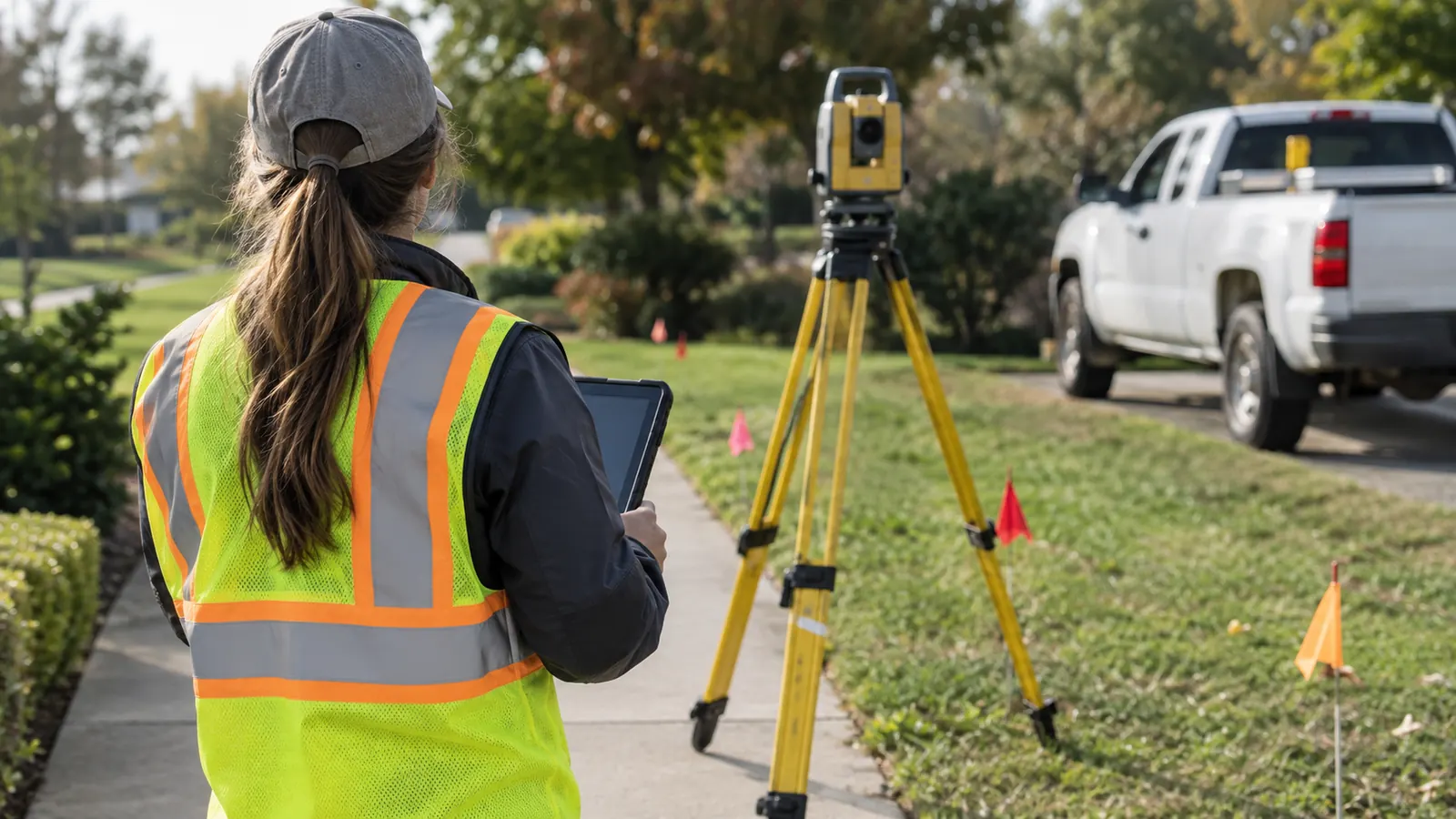
A designer can open a folder of splice-site photographs and still not know whether the crew stood at the recorded structure. The pin might belong to a different lid. The access note might live in a text thread. The one fact engineering needed, whether anyone was allowed to look at the cable entries, never made it onto the form.
This guide is the pre-design evidence package for one existing or candidate splice location. It is not placement design. Physical siting of the enclosure hardware lives on the later fiber cable enclosure placement design sheet. Completed-work splice records belong on a later sheet. The visit returns identity and access, then photographs and visible conditions. Record conflicts and open items go back to engineering.
What a Fiber Splice Point Survey Returns
A fiber splice point survey is the pre-design field evidence package for one existing or candidate splice location. It returns 6 records covering identity, access, photographs, visible conditions, record conflicts, plus unresolved items returned to engineering. Observation is not proof of cable condition or capacity, and it does not prove connectivity or ownership.
The unit is one location. A corridor walk that inventories poles and spans is a different product, and our existing infrastructure survey guide owns that wider reuse question. This visit answers whether the named splice site is the object in front of the crew and what the crew was allowed to occupy that day. What remains unknown after they leave stays on the return row.
The Fiber Optic Association published the FOA Standard for Installing Fiber Optic Cable Plants, 2025 V1, issued October 2025, which is the installation document we check before a crew treats a visible closure as a later splicing assignment. That document replaced the withdrawn NECA/FOA 301 standard. Section 10 covers fiber optic splicing and states that splice closures may be mounted on the messenger wire or poles for aerial cables and in pedestals or underground structures (manholes and handholes) for buried plant. That is a location class. It is not a license to pick a closure model on this visit, and it is not a spacing rule.
Draftech's field survey team records the package. Engineering stays in-house. When construction is later in scope, Draftech-managed subcontract crews deliver full turnkey under our QA/QC and safety program. We do not claim a self-perform construction crew today.
Fiber Splice Point Survey Evidence Limits
The FOA Reference For Fiber Optics page on fiber optic splice closures, copyright 2023, tells installers to follow the manufacturer's sequence for cable preparation, including strength-member lengths and buffer tubes. Fiber storage follows the same manufacturer sequence. That instruction belongs to a later authorized entry. We do not publish a house slack length or a house bend radius. Enclosure dimensions stay with the manufacturer sheet. The exact enclosure instructions control those values when someone is actually allowed to open the hardware.
One limitation of our preferred photograph-plus-pin package is that an unlabeled closure photograph sitting next to a GIS pin still looks complete to a designer who never walked the site. That unlabeled pair is not complete. Low-level design then treats the pin as the visited site. We now refuse a photograph that cannot be joined to the assignment ID.
Scope test: Hand the proposed form to the receiving designer before the crew mobilizes. If the designer cannot name the decision each field will support, adding more images later will not repair an undefined visit.
Identify the Site and Confirm Authorized Access
Identity is the first hold. A candidate splice location on a planning sheet is a hypothesis. An existing closure in the owner record is a different object. We write the assignment ID before the first photograph is taken. If the field object does not match that ID, the visit stops and the conflict goes back. Borrowing the nearest tagged pole does not create a match.
| Record | Question it answers | Failure if blank | Who closes it |
|---|---|---|---|
| Site and structure identity | Is this the assigned object | Photographs attach to the wrong lid | Owner register, checked in the field |
| Authorized access | What the crew was allowed to occupy | The next visit assumes an interior was seen | Owner grant, recorded as granted or held |
| Photographs and position | What was seen, from where, on what date | Images cannot be joined to the assigned site | Image and pin keyed to the assignment ID |
| Visible cable entry and closure space | What could be observed without opening or climbing | Design infers spare ports from a lid photo | Field observation, with the method limit written beside it |
| Record conflicts | Where field marks disagree with the owner file | The form silently picks a winner | Engineering, on a named conflict row |
| Unresolved items returned | What still blocks design, and who owns it | An empty cell is treated as a closed fact | Named party on the open-item row |
The table is a preview map of the six records a designer will query before LLD is allowed to freeze a closure on that assignment ID. The sections that follow expand those rows. A blank cell is a hold. Filling it from a desktop layer is how a nearby lid becomes the assigned splice site.
Give the Location a Stable Identity
Each planned observation begins with an identifier already present in the assignment. When the crew finds an unlisted pedestal or an extra aerial closure, the record receives a provisional ID under the project's naming rule. The assignment version travels with that ID so a later route edit does not orphan a valid photograph.
Identity has two parts: the structure and the apparent owner mark. A contractor logo on a lid is not ownership. A faded pole tag is not a lease. We copy the owner from the record the owner supplied, and we mark the field observation as matching or conflicting before any image is filed against that ID. A conflict is a hold. It is not a guess we bury in a note.
How that visit is scheduled and how access windows are requested is a crew-calendar problem, not an identity problem. Daily QA for the returned package lives with the assignment owner. This sheet assumes the unit has already been assigned. It does not reopen the crew calendar.
Access Is a Grant, Not a Request the Crew Invents
OSHA 29 CFR 1910.268, Telecommunications, current on eCFR as of September 16, 2026, covers specified work conditions and practices at telecommunications centers and field installations. Applicability follows the work performed and the employer's program. A survey request carries no added access authority. It does not authorize confined-space entry under OSHA 29 CFR 1910.146. It does not authorize climbing.
We write the access state before anyone asks for a second visit. Granted means the owner issued access for this visit and the crew stayed inside that grant. Pending means a request is in flight and the interior remains unobserved. Public-side only means the walk used the right-of-way and photographed the structure from an authorized standing point. Denied means the owner refused and the interior row is a hold. Those four states are not interchangeable.
A cracked handhole lid is not permission. A posted contact number on a cabinet is useful. It is not access. If the structure sits behind a locked gate the owner has not released, we photograph the gate from the public side and record the lock state. The interior stays open. The receiving engineer needs that boundary beside the image, not three days later in an email, because an interior that was never authorized will otherwise be read as a tray the designer can count.
Photographs and Position Evidence
Photographs have to answer a review question. A wide frame can establish which pole or pedestal was visited. A closer frame can show the visible cable entries and the closure body. Working space around it belongs in the same frame when it is visible. Extra frames that cannot be joined to the assignment ID add volume without strengthening the finding. We stop adding images when the reviewer can identify the unit and evaluate the stated observation.
Tie Photographs and Position to the Assignment ID
Every required view hangs off the same ID. A filename that already carries that ID is one join. An in-frame tag is another. A pretty image with no join cannot be replayed by the designer. Contextual and detail views, when both are needed, stay on the same row so a cracked component is not orphaned from the structure that holds it.
Position quality follows the intended use. The Federal Geographic Data Committee's Geospatial Positioning Accuracy Standards Part 1, FGDC-STD-007.1-1998, supplies a reporting methodology. It does not set a telecom splice-site tolerance. We record the collection method with its date. The source of the pin sits on the same row. A GNSS observation taken on the visit is one source. A GIS vertex with its layer name and export date is another. We write which one produced the pin. An owner as-built revision can replace either when that is the pin the owner told us to use. We do not publish a universal GPS accuracy for this visit. Displayed decimal places are display, not proof.
That provenance is the cheap control. Re-walking the site after a designer has already frozen a closure on the wrong pin is the expensive one, because the placement sheet and the construction staking inherit that pin once LLD treats it as visited. If the owner or the contract names a tolerance, we configure collection to that rule. If they have not, we still write the method. The later design will inherit these pins.
Record Visible Cable Entry and Closure Space. Do Not Infer the Interior
Visible conditions are facts the approved method can see without opening hardware and without climbing. Cable entries that face the standing point. Apparent closure type from the exterior. Standing water at a lid. Vegetation that blocks the working space. A locked clamp. Those are observations. They are not a finding that the closure has spare tray positions. They are not proof that the cables inside are continuous, or that the plant is ready to accept a new lateral.
The FOA closures reference, copyright 2023, notes that cables with metallic shielding or strength members must be properly grounded and bonded at splice points, and that location is determined by the installation type. We can photograph a visible bond or note that none was visible from the authorized point. We cannot certify the bond. We cannot certify moisture integrity. Sealed-closure pressure tests belong to an authorized installation or maintenance entry, not to this survey.
Workspace is a constructability clue, not a dimension spec. If a vault lid sits in a travel lane, or an aerial closure sits where a bucket cannot set up from the public side, we write the obstruction we saw. We do not publish a house clearance. The owner's procedure and the later placement sheet decide whether that site can be used. Our FTTH LLD splice point placement guide is where that placement decision lives. This visit only says whether the candidate was the assigned object and what could be seen there.
Do not open the closure to complete the form. A locked dome is evidence. Leave it closed. The form can carry a hold.
Record Conflicts and Return Unresolved Items
Conflicts are the honest part of the package. A field tag that does not match the owner GIS is a row. So is a mapped handhole with no structure at the pin. An owner drawing that shows two cables where only one entry is visible is a row too. The crew does not reconcile them. Engineering does, against the source revision the owner named.
Keep Record Conflicts Visible
We show the observed mark beside the recorded value. Picking the prettier ID in the field is how the wrong structure enters the construction set. A complete-looking form would be a poor substitute for resolving it. The exception names the affected unit and the two values, and it also names the person who can close the mismatch so the receiving engineer does not have to hunt a department nickname.
Negative findings need the same discipline. "No second cable observed" reaches as far as the approved method could see during that visit. Concealed entries remain outside the claim. We place the method limit in the same unit record, immediately after the finding, so the reader encounters both before making a route decision for that assigned unit.
Completed-work splice records are a different object. Tray maps, strand relationships, measured loss, and revision lineage belong after splicing, under the controls in our fiber splice record keeping best practices guide. A pre-design visit that copies those fields from an old PDF is not a splice record. It is an inherited claim that still has to be marked as a record, not as an observation.
Return Unresolved Items to Engineering
Each open item needs a named owner and a reason it blocks design. Missing identity blocks placement. Denied access is a different problem: the interior was never photographed. A conflicting owner mark leaves ownership unproven until engineering closes it. Held rows beat a complete-looking site nobody can occupy. Each hold names a person or organization, not a department nickname.
A revisit needs a defined gap. If the first visit lacks the one view needed to identify the structure, the exception states exactly what the returning technician must capture under a grant that did not exist the first day. Sending the same crew back with the same photo request is likely to reproduce the first gap at additional cost, and the second visit still cannot invent access the owner has not granted. Records review may close a conflict without another trip. The exception says which path is required.
Draftech's in-house fiber network design reads this package before LLD freezes a closure on the sheet. The field visit does not place the splice. It does not select the enclosure. It does not accept optical performance. Those jobs start after the six records are filled or held.
Recommendations by Receiving Decision
Rural cooperative or single-state ISP screening an inherited closure: run this visit before anyone treats the mapped symbol as reusable plant. Freeze the assignment ID. Freeze access as granted or held. Photograph what the grant allowed. If the owner has not authorized interior views, return a public-side package and a named hold rather than a tray count invented from a lid. Do not let a complete-looking map turn an unvisited structure into a design fact.
Overbuilder freezing LLD splice locations on a 2026 schedule: require this package as a gate before placement opens. Identity and access belong on the same row as the photographs. A program that reuses last year's GIS pins will issue closures that miss the visited structure because the pin never named the source date that would have flagged the move. Segment-based release lets one site wait on access while another proceeds.
Operator asking for a splice record from a pre-design walk: that is the wrong sheet. This visit can show that a closure exists, that the crew was or was not allowed to see it, and that a conflict remains. It cannot become the event record for fibers that have not been spliced. Keep the survey dated. Write the later splice record under its own authority after the work is done.
For a 2026 LLD freeze, that means the placement sheet does not open on a site whose identity or access row is still blank. Held rows stay holds. The receiving designer queries the six records, or the site waits while another segment proceeds.
Draftech keeps the visit in-house so engineering reads the package before LLD commits the unit. The service is that evidence gate, not a cleanup after a complete-looking form has already been treated as placed plant. Named owners keep the rest of the route moving.
Active in 24 states. Available across all 50 U.S. states. If a live route needs the splice-site package before LLD places a closure, reach out at info@draftech.com.
If fiber splice point survey is part of a qualifying route, Draftech engineers the first 20,000 linear feet at no cost, from feasibility and field survey through permit approval. Request the free design package. The owner reviews each request before Draftech commits the package.
Talk to our field survey team about the splice-site evidence package. Request a review of assignment IDs before the placement sheet opens.