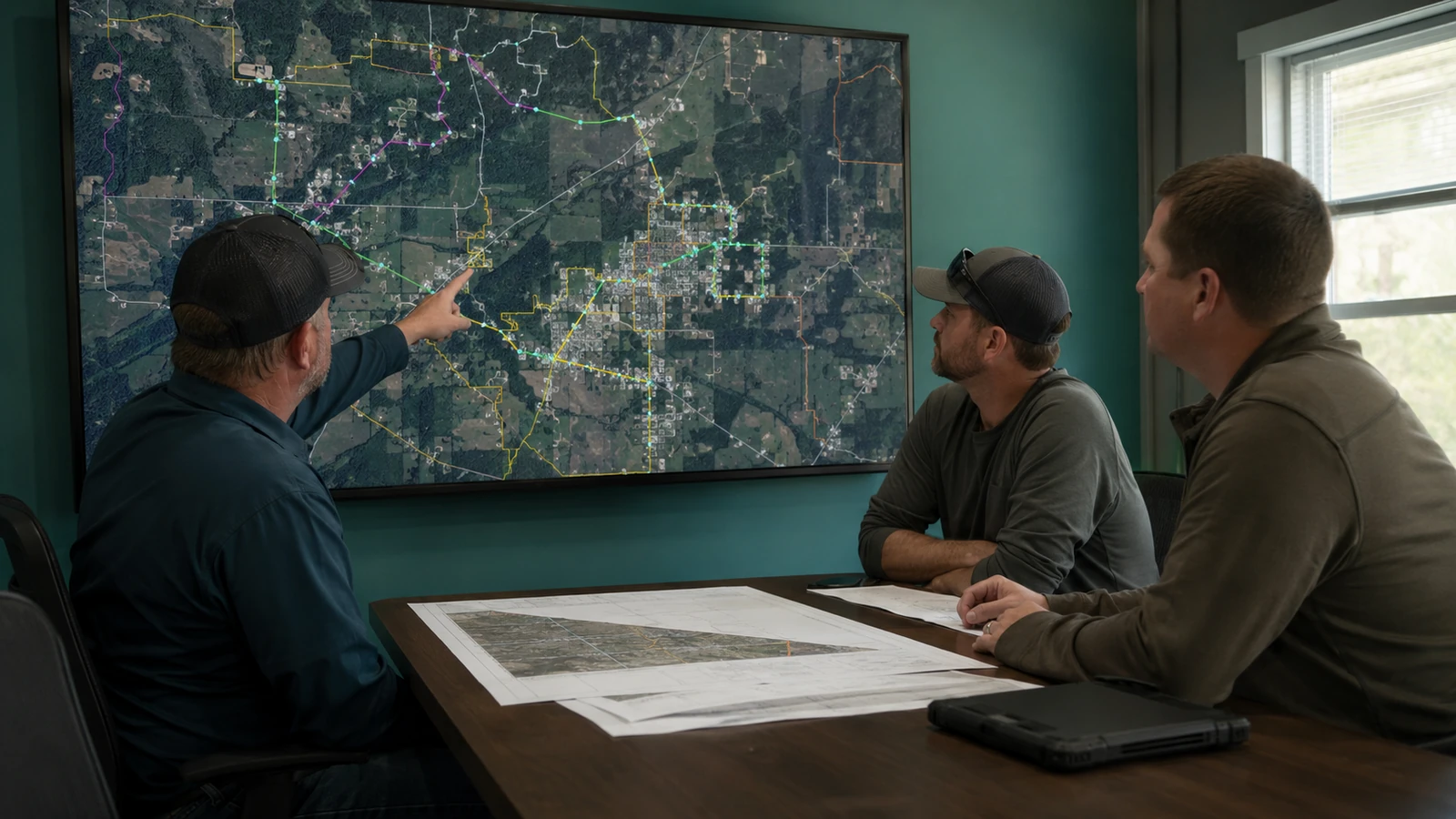
A BEAD award map is not a construction package. It identifies the public commitment and the funded locations, but an ISP still has to turn that commitment into a controlled network basis that survives field discovery. The pressure arrives early because route choices affect permits while material decisions affect cost evidence. Both can move before every site fact is known.
This guide separates federal program facts from state contract terms and engineering judgment. NTIA sets national program conditions. Each Eligible Entity runs its own approved subgrant process and agreement. The ISP must read those controlling documents before treating any drawing standard or closeout list as mandatory. We focus on the engineering controls that make that state-specific obligation buildable.
What BEAD ISP Engineering Support Must Control
BEAD ISP engineering support converts an approved service commitment into traceable design evidence for locations, routes, permits, network performance plus construction handoff. The national program sets a 4-year deployment deadline from subgrant receipt for deployment subgrantees. The Eligible Entity may grant no more than a 1-year extension under the conditions in the BEAD NOFO.
That federal clock does not make every engineering rule federal; the NTIA BEAD Notice of Funding Opportunity assigns subgrantee selection and oversight to the state or territory acting as the Eligible Entity. The signed subgrant agreement and incorporated program documents therefore control the ISP's submission dates, review gates plus required evidence. We build a requirements register from those sources before design production starts.
The register should name each obligation and its source. It should also identify who accepts the deliverable. A permitting authority can accept a construction sheet without deciding whether the file satisfies a reimbursement milestone; a state program reviewer can accept a location schedule without approving a pole attachment. Those are separate decisions. We keep them separate.
The award boundary is a control layer
An ISP needs a stable relationship among the funded project; its approved locations; the proposed technology; network nodes; route segments; cost basis plus schedule; Location IDs should persist through design revisions. Route objects need their own stable identifiers. If the route changes after fielding, the record should show which locations remain served and which permit packages changed. A colored polygon cannot carry that traceability by itself.
The 2025 NTIA BEAD Restructuring Policy Notice made the subgrantee process technology neutral for technologies that meet the program's performance requirements; it also directs Eligible Entities to minimize overall BEAD outlay during the Benefit of the Bargain round. Engineering support must therefore prove the selected technology and cost basis without assuming that fiber receives an automatic preference.
Control point: label every requirement as federal, Eligible Entity, subgrant agreement, permit authority or owner standard. Never present an internal checklist item as a universal BEAD mandate.
Set Engineering Gates Before Detailed Design
Engineering gates keep uncertainty visible. They are not a promise that every issue closes in sequence. Field access can lag while a service-area reconciliation continues. Pole ownership can remain open while underground alternatives are screened; the point is to define what evidence must exist before a package crosses each release boundary, then stop silent assumptions from becoming issued construction instructions.
We use the approved state material as the compliance baseline. Then we layer engineering acceptance onto it. This matters because a state submission template may ask for location-level data but say little about splice-sheet relationships; the ISP still needs a network that operations can test and restore. Compliance acceptance does not replace design completeness.
| Gate | Question | Controlled evidence | Release risk |
|---|---|---|---|
| Program basis | What did the ISP commit to deliver? | Agreement, approved locations, technology, match basis | Design drifts from award |
| Field basis | What conditions are verified? | Route evidence, structure data, access notes, exceptions | Desktop assumption reaches construction |
| Network basis | How will every location receive service? | Topology, capacity, performance model, handoffs | Location has no controlled path |
| Permit release | Which authority reviews each segment? | Jurisdiction matrix, drawings, status, comments | Unapproved work enters schedule |
| Construction release | Can crews build one accepted intent? | Issued sheets, bill of materials, change process | Conflicting instructions reach field |
| Acceptance | Can the ISP prove the installed outcome? | Redlines, tests, asset updates, exception disposition | Closeout cannot reconcile |
Freeze the program basis first
The program basis includes the executed agreement and all incorporated exhibits; it should identify the awarded project area plus location file; technology; performance commitment; matching contribution; milestones; reporting forms plus change authority. We record document versions. We also flag conflicts for written resolution rather than choosing the friendliest interpretation. Start here.
NTIA's current BEAD Final Proposal Guidance for Eligible Entities, version 2.1, requires Eligible Entities to submit structured records about subgrantees, deployment projects plus locations; it references the 10-digit FCC Registration Number and Broadband Serviceable Location identifiers. That federal submission structure does not prescribe an ISP's CAD layers. It does show why stable identity across project records matters.
Join field evidence to network intent
Desktop routing is provisional until the relevant field facts are checked. For aerial work, those facts can include ownership and attachment space plus access. Underground work needs pathway status and crossing conditions plus restoration constraints. Fixed wireless adds site control and propagation evidence plus backhaul. LEO projects have a different infrastructure boundary. One template cannot honestly cover all four technologies.
Network intent should trace every funded location to an approved serving path. For fiber, that path runs through feeder and distribution architecture plus drops; the fiber network HLD handoff guide explains how a high-level model carries service areas into detailed design. Whatever the technology, capacity and performance assumptions need named sources.
Reconcile Design, Permits and Cost Evidence
A route decision is never just geometry. It can change the permit authority; the construction method; material quantities; environmental review path plus milestone schedule; we assign a change identifier when one of those consequences crosses the approved threshold. The identifier follows the drawing revision and the cost narrative. This gives the program manager one decision trail instead of several disconnected explanations.
The permit matrix belongs beside the route register. Each segment should have an authority and application basis plus current status; it should show dependencies without predicting an approval date that the authority has not given. Some projects need utility attachment approval. Others need road occupancy or railroad permission. The exact stack is local. No national BEAD document creates a single permit package for every jurisdiction.
Cost evidence should reconcile to the same controlled scope; a design quantity can support a budget line only when its unit definition and revision are clear. We do not invent a cost-per-mile benchmark. We also do not claim that engineering acceptance guarantees reimbursement. The Eligible Entity decides allowability under its agreement and applicable federal award rules.
Performance proof begins in design
The restructured program defines a Priority Broadband Project around at least 100 Mbps downstream and 20 Mbps upstream with latency no greater than 100 milliseconds, alongside scalability plus reliability conditions stated in the policy notice; that is a program definition. The ISP's design needs technology-specific calculations and selected equipment evidence to show how its proposed network meets the approved commitment.
For fiber, we carry optical paths and passive events into a test index; for fixed wireless, the record must connect modeled coverage to approved site assumptions and final configuration. For LEO service, the funded project record has different project assets and acceptance evidence. We do not force one test artifact onto all technologies. The state agreement remains controlling.
SELF_CRITICAL limitation: our integrated engineering model adds document control early. That overhead is real. It is a poor fit for a tiny exploratory concept, but it becomes necessary once an ISP has funded locations and contractual release gates.
Carry One Record Through Construction and Reporting
Construction changes need a defined route back to engineering; a field redline can document observed work, but it should not approve a scope change by itself. The change process names who can authorize technical disposition and who can approve program impact. It also identifies which drawing and location records must update. Fast is useful. Uncontrolled is not.
Draftech provides in-house engineering and design. Construction is available as full turnkey delivery through Draftech-managed subcontract crews with our construction management plus QA/QC oversight. That distinction keeps design authority visible. Our crews do not turn a field preference into an engineering approval merely because equipment is already mobilized.
The ISP should build its reporting crosswalk before invoices accumulate. Each milestone needs source evidence and a responsible owner plus an acceptance state; the NOFO requires timely subgrantee reporting mandates and robust monitoring practices at the Eligible Entity level. It does not publish one universal ISP closeout folder. The agreement and current state instructions define the submission.
The BEAD subgrantee engineering checklist helps separate award evidence from design evidence; use it as a review aid, not as a substitute for the executed agreement. We preserve native files where required plus review-ready exports. We also maintain an exception log that states what remains open at each milestone.
Design for closeout before mobilization
Closeout-ready design establishes stable asset IDs and expected test relationships before construction. It names how service locations connect to the installed network. It also distinguishes planned from installed status. When a route revision occurs, the affected location and permit records move with it. That is far easier than rebuilding lineage after the final invoice.
Candidly, engineering cannot resolve every program question; it cannot interpret an ambiguous reimbursement clause with legal authority or guarantee that a state reviewer accepts a package. It can expose the ambiguity and preserve evidence plus route the decision to the proper owner. That boundary protects the ISP from confident but unsupported compliance claims.
Mobilization should also define the system of record for each object. The location source may remain an Eligible Entity file while engineering owns route and asset relationships. Finance may own invoice support. The interface register states how those records join and which transfer is authoritative. This is dull setup work. It prevents a later export from overwriting an approved status with an unreviewed office edit.
A periodic control review should sample the joins. Select a funded location and retrieve its serving path plus design release and current field state. Select a route change and retrieve its permit consequence plus cost disposition. Select a milestone claim and retrieve its source. Three perfect dashboard totals do not compensate for broken lineage underneath. Test the record itself.
BEAD ISP Engineering Support Recommendations by ISP Type
First-time BEAD subgrantee: build the requirements register before releasing detailed design. Tie every funded location to one approved network path and one evidence owner. Use the BEAD funding engineering requirements guide to frame the review. Recommendation: reject any universal checklist that does not cite your Eligible Entity's current documents.
Established rural ISP: preserve the operating network's identifiers and standards, then add the minimum program fields needed for BEAD traceability. Do not create a grant-only asset model that operations will abandon. Recommendation: make the approved location relationship part of the existing source of truth rather than a parallel spreadsheet.
Multi-technology applicant: keep the common program register but separate design proof and acceptance evidence by technology. Fiber calculations do not prove fixed wireless coverage. A radio model does not prove a buried route. Recommendation: require one accountable interface record while allowing different technical packages underneath it.
Prime contractor or cooperative: define design authority and field-change authority in writing. Carry the ISP's program obligations into subcontract exhibits without adding unsupported federal claims. Recommendation: stop work at any release boundary where the accepted drawing and field instruction disagree. That is cheaper than documenting an unauthorized outcome.
Our BEAD broadband engineering support connects the award basis to field evidence and network design plus construction handoff. We keep the state-specific register visible while our in-house engineering team controls technical revisions. Review our BEAD readiness checklist for the intake questions. The aim is simple: fewer undocumented interfaces before work reaches the field.
The recurring risk is a split record: one location file for the program and another route model for engineering plus a third folder for construction. We replace that split with stable identifiers and controlled release states. Read how Draftech structures accountable delivery. If your ISP needs an independent package review, email our BEAD engineering team or request a scoped engineering review.