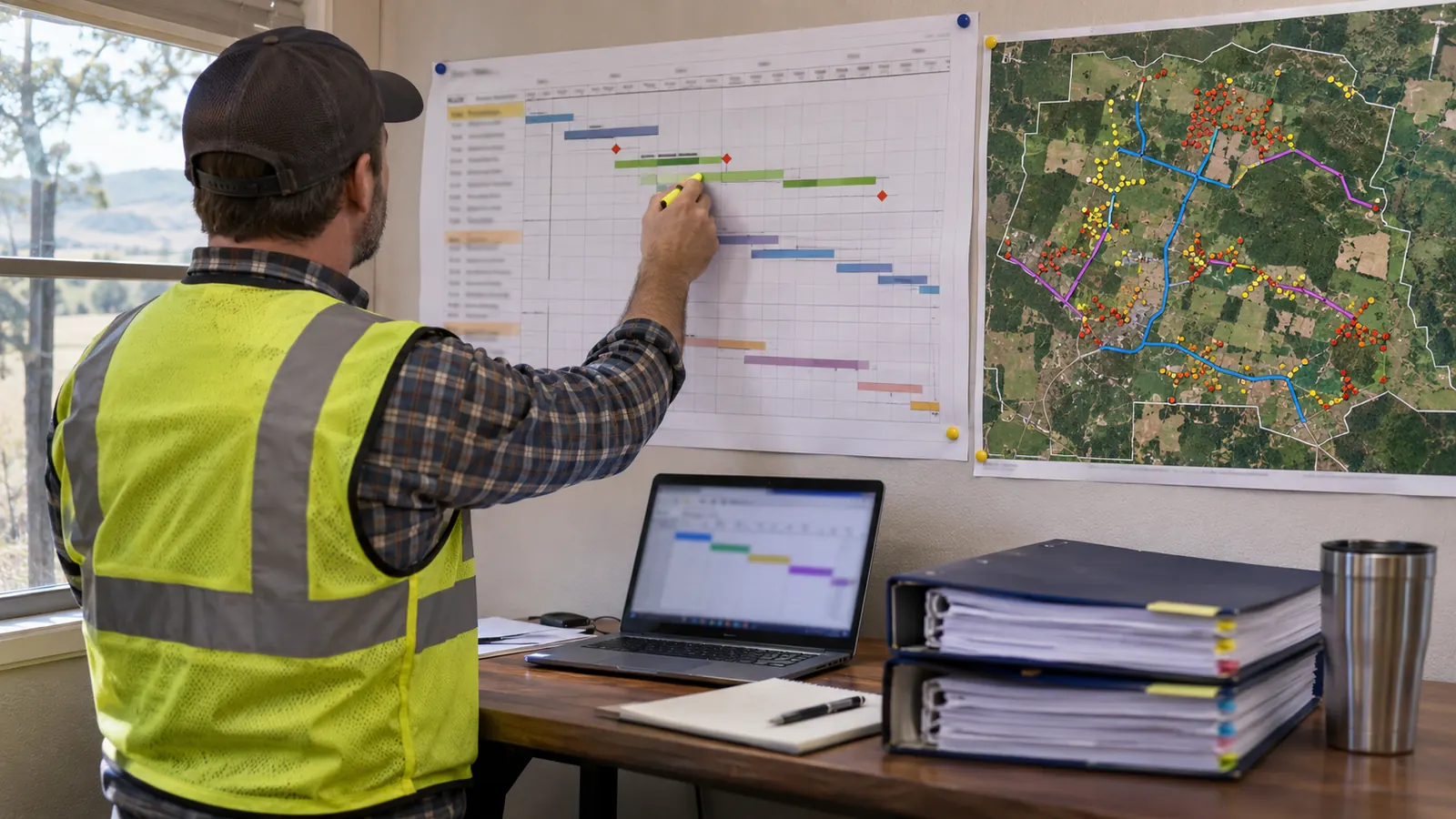
- Read the BEAD funding timeline from the award documents
- Match each milestone to engineering evidence
- Construction deadlines depend on permit and route release
- Tie payments and progress reports to accepted work
- Build closeout evidence while construction is active
- Put your next BEAD funding timeline decision on the route
Final Proposal approval leaves an engineering team with a practical scheduling problem: which route can move toward construction, and which still depends on a signature or an unresolved permit condition? We start with the controlling documents because an approval announcement alone cannot tell a superintendent where crews may work. Each route needs its own release decision.
This guide follows the work facing ISPs, cooperatives and municipalities holding or seeking a BEAD subgrant after federal approval of their state's Final Proposal. Our focus is the engineering evidence behind each handoff. Dates change, and the executed subgrant agreement controls project milestones and payment conditions within applicable federal requirements; confirm amendments with the state broadband office before committing a construction sequence.
Read the BEAD funding timeline from the award documents
The bead funding timeline runs from Final Proposal approval through subgrant execution, authorized construction, payments and closeout. NTIA's BEAD Notice of Funding Opportunity (NOFO), issued 05/12/2022, sets a 4-year deployment baseline from subgrant receipt. The agreement controls project milestones; Final Proposal approval alone does not release a route for construction.
Separate federal approval from your project start
Section IV.C.2.b.i of the NOFO establishes the deployment baseline. We use that provision to identify the federal starting point, then compare it with the executed award. A shorter commitment in the agreement deserves its own schedule line, alongside the event that starts its clock. Otherwise, a team can measure progress against a date that never governed its project.
The BEAD Frequently Asked Questions and Answers, Version 23, Section 8.2, describes a 6-month agreement-signing window tied to Final Proposal approval through the NIST Grants Office and the Notice of Award amendment. That is an Eligible Entity obligation. Before a signing deadline goes on our project calendar, the state office needs to identify the controlling amendment and any subsequent guidance. The FAQs place the subaward performance-period start at signature by both parties, subject to agreement terms, so the project record needs to retain both signatures.
The state broadband office executes and administers the subgrant, establishes reporting and payment procedures, and handles project changes under its federal award. Ask it for written confirmation when documents conflict. Our engineering schedule should reference that response so the designer and construction manager are using the same authorized scope, rather than separately interpreting a press release or a meeting note.
Turn dates into dependencies
A useful schedule records why a milestone can happen. For each activity, our schedule identifies the responsible party and acceptance evidence, with a separate field for the document that sets its deadline. For example, a permit package can be ready for submission while an attachment application still awaits corrected pole records. Those activities have different successors even when both appear under pre-construction.
An engineering forecast belongs beside the contractual milestone because the expected finish and the promised finish serve different purposes. If a crossing revision moves the forecast beyond the agreement's milestone, the schedule should expose that conflict immediately so the subgrantee can take it through the state's change process. Silently moving the contractual date in a spreadsheet hides the issue from the person responsible for resolving it.
Consider a planning example, not a completed Draftech project: a co-op has an approved project boundary, but its proposed feeder crosses a corridor where the receiving utility requests revised attachment information. The designer can continue checking unrelated laterals while the corridor package is corrected. In that situation, our release decision would hold the feeder-dependent locations until the approved path can support them, even if those laterals look finished on a map.
This approach has a limitation: separating route segments creates additional boundary checks, and incomplete interfaces can leave installed fiber without a usable connection. We therefore ask who owns each tie-in before recommending a partial release. The drawing should show where the released work stops and what remains unresolved beyond that point, with the dependency visible to the person assigning field work.
Keep the policy history attached
NTIA's BEAD Restructuring Policy Notice, released 06/06/2025, changed subgrantee selection requirements; an earlier selection calendar should therefore be checked against the approved award rather than treated as a construction schedule. The NTIA Supplemental Deployment Policy Notice provides a second Benefit of the Bargain round for eligible locations left unserved through defaults, provider misreporting or subsequent map changes. Keep any prospective supplemental scope separate from an executed project's location list.
Our preferred working record is a milestone register joined to the route GIS by a stable segment identifier. A map then shows the affected work when a dependency slips, and the schedule explains the consequence for service readiness. The awarded boundaries define the starting footprint; adding a nearby location to a drawing does not establish authority to include it in the funded project.
Match each milestone to engineering evidence
The sequence below is a planning map, with acceptance determined by the applicable agreement and written releases. Before mobilization, each row needs an owner who can obtain confirmation and assemble the supporting records. Some preparation can overlap, but the evidence required for a downstream decision still has to exist when that decision is made.
| Milestone | Controlling confirmation | Engineering evidence to prepare |
|---|---|---|
| Subgrant agreement | Executed scope and performance terms | Location reconciliation and design baseline |
| Construction readiness | Applicable permits and written releases | Issued drawings and resolved make-ready dependencies |
| Draw or reimbursement | Agreement's payment conditions | Accepted quantities tied to field records |
| Progress reporting | State reporting instructions | Reconciled GIS status and milestone exceptions |
| Closeout | State acceptance requirements | As-builts and traceable completion evidence |
Subgrant agreement: reconcile the design baseline
Before signing, compare the proposed network with the locations and obligations in the agreement. Our baseline review checks whether the HLD serves the awarded footprint and whether its design assumptions still match the selected technology, with inconsistencies flagged before production carries them into later deliverables. An estimate based on an older location list can leave the production team drawing facilities that the final award never included.
The baseline should distinguish unresolved field questions from accepted design decisions. A proposed aerial alignment may depend on attachment rights and make-ready findings that are still being evaluated; marking the alignment as provisional preserves that uncertainty for the scheduler. We keep the source survey associated with the affected drawing revision so a later correction can be traced to the actual field observation.
Our BEAD funding engineering requirements guide addresses the design deliverables, including HLD, LLD and GIS records, that should agree before the package advances. Use the agreement's deliverable schedule to determine which files are due at each handoff. A polished drawing can still carry an obsolete location identifier, so check the underlying records before accepting the package as the project baseline.
For a structured readiness review, use the BEAD Pre-Construction Checklist, a free 46-point pre-construction engineering checklist for BEAD subgrantees available as a download behind a short form. It gives us a way to organize questions for the project team and resolve each answer against the actual award and route conditions. Any question left open needs an assigned person with the authority or information to close it.
Construction deadlines depend on permit and route release
The NOFO's deployment baseline includes making service available to customers who want it, so a schedule that ends at cable placement leaves unfinished work outside its completion logic. We work backward from the agreement's service milestone to identify the last permitted construction activity and the testing dependencies that follow it. Allow the operator to verify service readiness before representing a segment as complete.
Permit clocks belong to the receiving authority
Permit clocks depend on the jurisdiction's process and the status of the submission, including whether it is complete and whether revisions restart or suspend review. Our BEAD permitting timeline for fiber construction explains how those dependencies affect the route schedule. The submission acknowledgment establishes when the agency accepted the package for review; an internal target date for sending it cannot supply that evidence.
Make-ready can impose a separate predecessor on an otherwise permitted route. Our check compares the attachment approval with the latest pole-level design and records which required rearrangements remain open. A segment should enter the construction forecast with those dependencies visible, especially when it shares a feeder with work that is already ready. The permit and utility records must describe compatible work.
Environmental conditions also need an explicit release check. The FAQs explain that funding can remain restricted while required activities, including NEPA requirements, are outstanding. Our construction plan should identify the authorized limits and preserve any restrictions in the field package. If the release covers only part of the planned work, the supervisor needs a drawing that makes that boundary unmistakable.
Release a usable construction package
A signed internal release record gives us a traceable connection between the approved LLD revision, the permitted limits and the confirmed make-ready status, with the responsible reviewer named on the record. Field changes that affect an authorization return to the appropriate approval path before the changed work proceeds; a superintendent's acceptance of a constructible alternative does not settle the permit or award implications.
Build-phase release should identify the authorized segment and hold points before Draftech-managed crews receive their work package; our BEAD build-phase management guide follows that handoff into field tracking. Superseded sheets need to come out of the active set so that, when a crew encounters a conflict, our response references the current drawing and shows whether the approved construction limits change.
Keep a dependency's original required date when you update its forecast. The gap shows the effect of the delay, and the retained history lets the subgrantee explain why a milestone now needs attention without reconstructing earlier schedule versions.
Tie payments and progress reports to accepted work
A draw or reimbursement request needs the evidence specified in the agreement's payment process. Before field reporting begins, we need the subgrantee's grant administrator to identify the required evidence, explain how work quantities must be accepted and confirm the submission cutoff. An engineering schedule should never assume that placing cable automatically triggers a release of funds or that every state uses an identical payment procedure.
Keep quantities traceable to the field
Installed footage should reconcile with the segment records used by the construction manager, while the quantity record distinguishes what has been submitted from what has been accepted. Where work changes after inspection, preserve the correction and its reason rather than overwriting the original entry, because the supporting record must explain what the reviewer accepted and what remains pending before the payment package is submitted.
Measurement conventions need agreement before production starts, when the field forms can still be adjusted to match them. Route length and cable length can differ where slack is stored, and a quantity entered against the wrong item can produce a disagreement even when the installation itself is sound. The field form should use the same item definitions as the receiving reviewer. That agreement prevents avoidable reclassification when the project team assembles supporting records.
A missing inspection record should appear as a documentation exception that identifies the affected quantity and excludes it from accepted totals until the issue is resolved. We can organize construction records around the same segment identifiers used in GIS, allowing the subgrantee's reporting team to trace a claimed milestone to its evidence without treating every installed feature as proof that service is available.
Report physical progress and service readiness separately
Section VII.E.2 of the NOFO calls for subgrantee reporting at least semiannually during the subgrant; the state can require more frequent information. On our schedule, the state's submission dates sit separately from the team's internal reporting cycle. The construction manager needs current exceptions while work is active, even when the next formal progress report is still some distance away.
Progress reports should distinguish installation from acceptance and service availability. Each status needs a recorded definition so the same location cannot be called complete in GIS while its feeder remains under construction; service readiness requires the operator's evidence. Our field records support the report, but the subgrantee must reconcile the report with its own operational and award obligations.
An exception narrative should explain the next decision. If a permit revision affects the feeder, identify which downstream milestone moves and who must resolve the revision; avoid reporting only a general percentage complete that conceals the constraint. Until the blocker clears, our schedule carries the revised forecast alongside the contractual commitment so the state office can review the difference.
Build closeout evidence while construction is active
Closeout begins with the records collected during installation. Before the first released segment is built, we need agreed receiving file formats and a field process that captures conditions while they are visible. A drawing produced from incomplete redlines cannot recover buried details that were never captured. The agreed package should let the owner trace the final route back to its accepted field evidence.
Closeout evidence should connect as-built geometry with inspection acceptance and the operator's completion records, using stable identifiers across the package. In our GIS review, installed features are checked against the final drawing revision, with unresolved exceptions kept visible. After obtaining a receipt for each submitted file, the subgrantee should track acceptance and correction requests through the state office's closeout procedure.
Restoration and permit conditions deserve their own completion check. A route may support service while a required restoration inspection remains outstanding, so our completion check treats the operational milestone separately from the other acceptance obligations and assigns the remaining work explicitly. The final package should state which conditions have been satisfied and where the confirming records can be found.
Keep closeout submission, acceptance and record retention distinct in the schedule. Their requirements come from the controlling award documents and applicable instructions, not a generic interval added after construction. Confirming the final submission process before the last field package closes gives us time to help the subgrantee resolve missing evidence while the responsible crew and engineer still have access to the work records.
Put your next BEAD funding timeline decision on the route
For a prospective subgrantee: reconcile the proposed footprint with the current selection documents and show unresolved route dependencies before committing a deployment schedule. Provisional assumptions belong in the HLD where the people reviewing the proposed schedule can see them. An application schedule should explain what must happen for the build to proceed, so the later agreement does not inherit unsupported construction dates.
For a signed award holder: prioritize the first releasable segment and its dependency chain. Our first checks concern unresolved permit conditions that affect crew starts and the evidence needed for accepted quantities. This keeps a mobilization decision tied to authorized work and gives the reporting team a clear basis for explaining physical progress under the agreement.
For the engineer supporting either team: maintain a shared revision baseline and name the person accepting each handoff. Our partner profiles identify the people responsible for Draftech's delivery disciplines. Draftech International provides turnkey telecom and power infrastructure, with engineering 100% in-house and full turnkey construction delivered by Draftech-managed subcontract crews under Draftech's QA/QC. Active in 24 states. Available across all 50 U.S. states.
The gap between an approved award and a buildable route is the work our BEAD broadband engineering services address through survey, HLD, LLD, permitting, make-ready, GIS, construction management and as-builts. We connect those engineering handoffs to the route's documented constraints. To discuss an unresolved release dependency, send the relevant drawing and milestone question to info@draftech.com.
For a qualifying route, Draftech engineers the first 20,000 linear feet at no cost, from feasibility and field survey through permit approval, through our free design offer. The owner reviews each request before Draftech commits the package. That review lets us assess the route information needed to address the survey and permitting gaps holding back a construction-ready design.