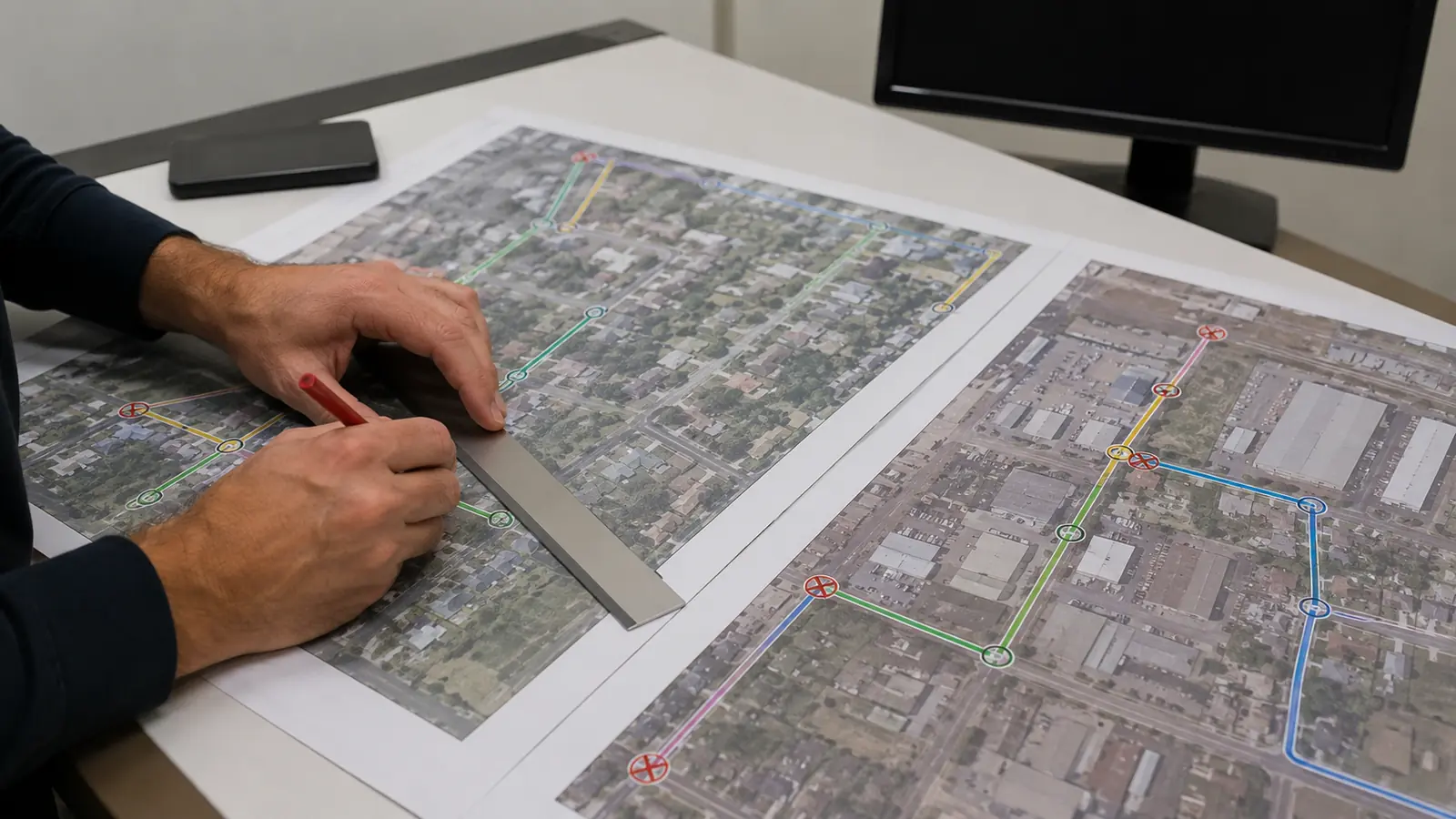
A rate without a deliverable is not a useful comparison. Scope comes first. Telecom drafting can mean a redline conversion, an attributed GIS update, a permit set or a pole package or a construction-ready OSP design. If 2 proposals use the same label for different work, the lower total tells you almost nothing about final value.
This guide stays inside Draftech's approved pricing rules. It explains the published full-scope OSP engineering ranges, the separate pole-loading range, and why none of those figures should be mislabeled as a drafting-only rate. We then show how to normalize scope, inputs, revisions and acceptance plus change control before comparing quotes.
What Telecom Drafting Rates Mean in a 2026 Scope
Telecom drafting rates are pricing structures tied to defined CAD, GIS or permit or OSP deliverables. Draftech publishes 3 applicable engineering benchmarks: $1,162-$2,323 per rural mile, $2,800-$4,224 per urban mile, and pole loading at $45-$75 per pole. The per-mile bands cover full-scope OSP engineering, not drafting alone.
The label must match the boundary. Draftech's published OSP engineering pricing describes complete engineering from field survey through construction-ready design and documentation. Rural and urban ranges reflect that integrated scope. They are not permission to quote a CAD conversion, GIS cleanup, permit sheet, or one design phase at the full-scope band without defining what is included.
Pole loading is separate. The approved $45-$75 per-pole figure applies to pole loading analysis. It does not automatically include field survey, make-ready design, attachment applications, permit drafting or utility comment response or construction revisions. A proposal should state whether pole records and attachment data arrive ready for analysis, who resolves missing information, and which receiving utility format governs the report.
Drafting-Only Work Needs a Project Quote
Draftech does not present a public dollar band here for drafting-only work. That scope may be measured by sheet, route segment, asset, milestone, or controlled labor, but a number becomes useful only after input condition, output standard and review cycles plus acceptance are written. We would rather define those 4 boundaries and quote the real assignment than publish a false universal rate for work that changes with every owner's standards.
Our engineering and drafting are performed in-house. That keeps source interpretation, CAD production, GIS attribution, technical review, and comment response in one accountable design chain. Construction is a separate delivery track: Draftech offers full turnkey construction through managed subcontract crews under Draftech's QA/QC and safety oversight. We do not claim all physical work is self-performed, and we do not reduce turnkey delivery to management-only language.
Pricing caveat: never compare a drafting-only line item with a full-scope OSP engineering range. Normalize the work first, then compare the commercial model.
Telecom Drafting Rates Versus Approved Engineering Benchmarks
The 3 approved dollar ranges answer different questions. The rural and urban bands describe complete OSP engineering on a per-mile basis. The pole band describes pole loading analysis on a per-pole basis. Drafting-only, GIS-only, survey-only, permitting-only, and as-built-only work must be scoped rather than inferred by dividing a full-scope range into unsupported percentages.
The table is a scope map, not a menu of interchangeable rates. It uses only the approved figures and makes the unit and deliverable boundary plus common misreading explicit. Any proposal that uses one of these benchmarks should repeat the applicable label in the pricing schedule and statement of work plus acceptance section.
Scope labels must survive into invoicing. A proposal may describe full engineering correctly and then shorten the invoice line to drafting, which makes later reconciliation difficult. We keep the same workstream name, unit, and inclusion note from estimate through task authorization and acceptance. This gives the owner a clean record of what the approved benchmark covered and prevents an adjacent service from being charged or rejected under the wrong commercial label.
| Pricing reference | Approved figure | Correct scope label | Do not assume |
|---|---|---|---|
| Rural route | $1,162-$2,323 per mile | Full-scope OSP engineering on rural routes | Drafting-only price or construction price |
| Urban route | $2,800-$4,224 per mile | Full-scope OSP engineering on urban routes | Every urban mile has identical effort |
| Pole loading | $45-$75 per pole | Pole loading analysis | Make-ready, permits, or field data are included |
| CAD or GIS subset | Project-specific quote | Named deliverables and acceptance standard | A public dollar band exists for drafting alone |
| Mixed program | Scoped by workstream | Each workstream uses its own unit and boundary | One blended unit exposes every exclusion |
Rural does not mean easy. The approved rural full-scope engineering range is a route category, not a promise that every rural mile lands at one point within the band. Pole density, field access, aerial and underground mix, route crossings, utility data, permitting and owner standards plus deliverable depth still shape the final scope. The proposal should state its basis rather than asking the category name to carry every assumption.
Urban does not mean drafting inflation. The approved urban full-scope engineering band reflects an integrated engineering context where dense utilities, constrained rights-of-way, permitting interfaces and restoration requirements plus GIS detail can increase effort. It remains a full-scope engineering band. Calling it an urban drafting rate would erase survey, coordination, design, QA/QC, and documentation included in the actual benchmark.
Define Inputs, Deliverables, and Acceptance Before Price
Inputs decide how much investigation sits inside production. We inventory field records, owner GIS, redlines, pole data, aerial imagery, prior drawings, permits and equipment cut sheets plus design criteria. Each source gets a date, coordinate reference and revision plus confidence note. Missing or conflicting information is assigned for field verification or owner decision or documented assumption. A folder full of files is not the same as an accepted input package.
Deliverables must name both content and format. A request for CAD drawings should identify sheet types, scale basis, title block, layers, symbology, units, native version, plot format and external references plus attribute handoff. A GIS request should identify feature classes, fields, domains, coordinate reference system, metadata and topology checks plus export formats. Otherwise bidders can price visually similar outputs with very different reuse value.
Treat Metadata as Part of the Deliverable
The Federal Geographic Data Committee maintains the Content Standard for Digital Geospatial Metadata. An owner may require another profile or schema, but the procurement lesson is stable: identify the required metadata standard rather than asking for GIS files with no lineage or definitions or source record. We price the named handoff, not an undefined idea of a map.
Acceptance has to be reproducible. We define completeness, standard conformance, coordinate handling, attribute rules, drawing-to-database consistency and unresolved-exception limits plus comment closure. A reviewer should be able to select a sample from source through drawing and GIS output and reach the same result. If acceptance depends on whether a PDF looks finished, the quote cannot distinguish production from rework.
Quantity baselines need a date. Route miles, poles, sheets and sites plus records can change while engineering proceeds. We identify who owns the baseline, how additions and removals are counted and when quantity is frozen for each milestone plus how a reclassified unit is handled. A per-mile quote cannot stay controlled if one party measures centerline, another measures cable path, and neither records the approved revision behind the count.
For buyers refining this package, our GIS mapping services and CAD and GIS documentation practice show the service boundary. The companion guides on telecom CAD drafting deliverables, CAD and GIS documentation standards, and hiring a telecom drafter cover quality and vendor review beyond the rate itself.
Choose a Commercial Model That Matches Scope Certainty
Fixed fee works when the boundary is fixed. The owner and provider need an agreed input baseline, deliverable list, production quantity, review allowance and schedule plus acceptance test. If any of those remain open, the fixed fee either carries a large risk allowance or becomes dependent on exclusions. We use fixed milestones where the package can be objectively accepted, not merely where procurement prefers one total.
Quote-control rule: put included review cycles and owner response time plus change triggers beside the price. Those 3 terms explain more about final cost control than a low headline unit with vague exclusions.
Unit pricing works when the unit is stable. Per mile, pole, sheet, asset, or site can all be reasonable, but the unit definition must include complexity rules and quantity ownership. A sheet is not stable if scale and content can change. A mile is not stable if corridor types are mixed without classification. A pole is not stable if fielding and missing attachment data are handled differently by each bidder.
Use Controlled Labor for Unresolved Investigation
Open-ended legacy cleanup, source reconciliation, and comment investigation may be better handled through controlled labor with a task authorization, estimate and approval threshold plus evidence log. That is not a license for an unbounded invoice. It is a way to keep unknown work visible until the project can convert it into a repeatable unit or fixed deliverable. We separate investigation from production so neither one hides the other's performance.
Change control protects both parties. A change record should identify the request, reason, affected quantity, impacted deliverables, schedule effect, commercial treatment and approval plus resulting revision. We distinguish correction of nonconforming work from owner-directed scope change and from new information that invalidates the original basis. Without those categories, every comment becomes an argument about who should absorb it.
Review comments need classification too. We sort them into correction, clarification, owner preference, new requirement and source-data change plus field-condition change. The classification does not replace discussion, but it creates a factual starting point for scope treatment. We also link each accepted comment to the drawing, GIS feature or calculation or exception it changed. A comment log that ends at resolved without showing the output is not a reliable acceptance record.
Proposal comparison needs a common recast. We place each bid into the same workstreams, units, quantities, deliverables, review assumptions and exclusions plus acceptance gates. A low total with field verification, permit response, GIS attribution, or native files excluded is not directly comparable with a full package. The recast should show both priced work and owner-retained work so the procurement decision reflects the complete delivery model.
The recast should also identify dependencies between workstreams. Drafting may depend on an accepted survey, pole analysis may depend on complete attachment records, and permit sheets may depend on agency comments that arrive after the first issue. We show those handoffs and state who carries the coordination effort. Otherwise a bidder can exclude the connecting work while still appearing to include every named deliverable in isolation. The missing coordination returns later as delay or change.
Make the Telecom Drafting Rates Decision on Equal Scope
Our recommendation is unhedged. For a complete rural OSP package: use the approved rural engineering band only after confirming full-scope boundaries. For a complete urban OSP package: use the urban engineering band with corridor assumptions stated. For pole loading: use the approved per-pole band and list adjacent exclusions. For CAD or GIS subsets: request a project quote against named inputs, outputs and revisions plus acceptance.
For steady repeatable production: a defined unit model can work. For a clean bounded package: fixed milestones can work. For unresolved records: authorize investigation separately, then convert stable work into a production model. Do not force one commercial structure across workstreams with different certainty. The appearance of simplicity at award becomes confusion in change control. Scope beats a headline rate. Acceptance controls value.
Before award, ask each bidder to return a marked scope matrix rather than only narrative qualifications. The matrix should acknowledge every input, output, standard, review role, quantity and exception plus acceptance test. We then carry agreed clarifications into the contract instead of leaving them in interview notes. This final discipline is simple, but it keeps the technical promise and the commercial promise in the same document when production begins.
Our limitation is candid: we do not publish a universal drafting-only rate because source condition and acceptance can change the assignment materially. The problem-to-service bridge is exact: unclear inputs, mismatched units, undefined review cycles, and subjective acceptance are the reasons drafting quotes drift. Our in-house GIS and drafting team turns those items into one controlled scope, with source lineage, production standards, QA/QC, comment closure, and a handoff that matches what the owner actually needs. Our delivery model keeps the technical and commercial boundary accountable.
If you need a telecom drafting or engineering quote and want the approved benchmarks applied to the correct scope, reach out at info@draftech.com. Send the sample inputs, deliverable standard, estimated quantities and review roles plus required formats. We will identify what belongs in full-scope engineering and what should remain a separately quoted subset.
Ask for a scope-normalized telecom drafting quote. We will map inputs, outputs, units, reviews, exclusions, and acceptance before attaching a number to the work.