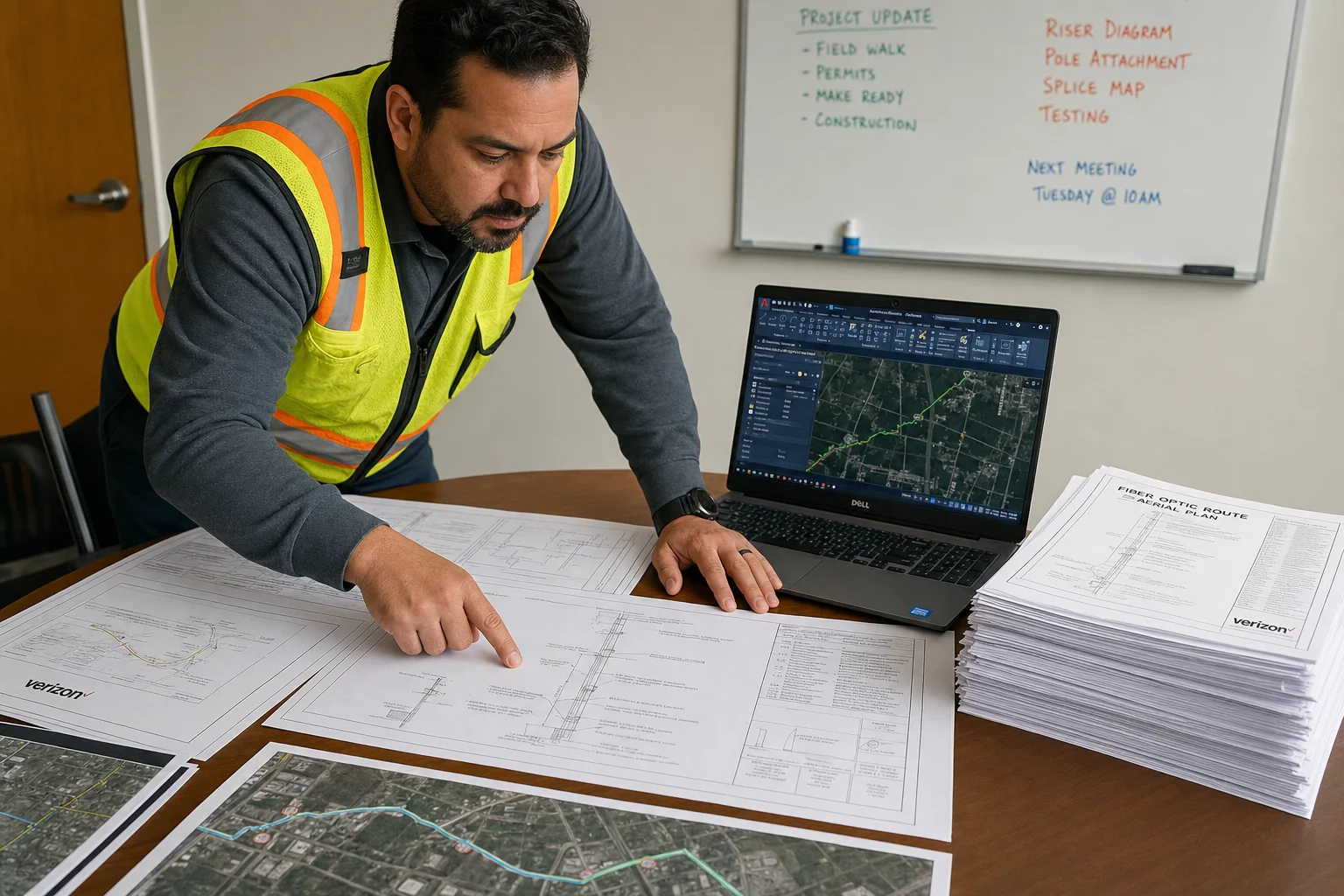
The quote isn't the decision. That's the thing most project managers get wrong when they're looking to hire a telecom drafter or an OSP drafting contractor. They compare line items, pick the number that doesn't embarrass them in a budget meeting, and sign. Then the revision comments start rolling in (11, 14, 23 of them) and suddenly the "cheaper" firm is costing them $4,000 more than the one they passed on.
I've been running OSP engineering teams for 17 years. I've seen this play out in every corner of the country, from rural Texas co-ops trying to hit BEAD deadlines to mid-Atlantic ISPs expanding into dense suburban corridors. The quality gap between a drafter who knows what they're doing and one who doesn't is enormous. And almost none of that gap is visible in a proposal.
This is what I look for. If you're trying to hire a telecom drafting firm, or evaluate the one you're already using, these are the questions, the red flags, and the standards that actually matter.
Why the Hiring Decision Matters More Than the Quote
Bad drafting doesn't announce itself. It shows up 6 weeks into a build when a permit reviewer sends back your plan set, or when a lineman calls from the field because the drawings show 37 poles and there are 41 physical poles on the route. By then you're not just dealing with a CAD problem: you're dealing with a schedule problem, a crew cost problem, and sometimes a permit re-submission problem.
Here's a specific example. We took over a project in rural west Texas (a 14-mile aerial route through Brewster County) from a drafter who'd delivered a "complete" plan set. The ISP's project manager had accepted the PDF. It looked clean. But when we opened the DWG to verify before permit submission, we found 23 revision comments' worth of problems. Clearance violations on 9 spans. Pole IDs that didn't match the utility's NJUNS database. Mid-span sag calculations that ignored the 105°F ambient temperature standard for that region. The drafter had never worked NESC clearance requirements for a high-temperature climate. He didn't know what Table 232-1 required for those conductor classes.
That plan set needed a near-complete redraw. Crew was already mobilized. Every half-day standdown for a 4-person aerial crew with a bucket truck runs over $1,300. Two standdowns (waiting for revised drawings, waiting for re-permit) and you've spent more than you saved by hiring the cheaper firm in the first place.
The decision isn't really about the drafter's rate. It's about whether you can afford to absorb revision cycles, permit delays, and crew standdowns. Most ISPs can't, especially on BEAD-funded builds with construction completion deadlines baked into grant agreements.
The Core Skills a Qualified Telecom Drafter Must Have
AutoCAD proficiency is table stakes. If a firm lists "AutoCAD" as a capability and can't tell you what version they're on or describe their layer schema, that's not a qualification: it's a checkbox. A drafter working on telecom CAD drafting for aerial OSP needs Civil 3D fluency specifically, because that's where you're managing horizontal alignment, surface data integration, and the automated drafting workflows that make production-scale output possible.
NESC knowledge isn't optional. I mean actual working knowledge, not "I know what NESC stands for." Table 232-1 specifies minimum vertical clearance requirements for communications attachments based on the voltage class of conductors above and below. A drafter who can't walk you through those clearance requirements by voltage class, who doesn't know how mid-span sag changes with conductor temperature, and who hasn't dealt with pole attachment geometry for joint-use attachments in a congested right-of-way is going to produce drawings that fail permit review. It's not a matter of if. It's when.
Beyond NESC, look for:
- NJUNS and pole attachment database experience. Make-ready coordination runs through NJUNS. A drafter who doesn't know how to cross-reference pole IDs against a utility's pole database is going to produce pole schedules that don't match field conditions, and that's a permit rejection waiting to happen.
- Ability to read and flag field survey data issues. Field survey data accuracy problems (wrong pole IDs, GPS readings with 4-meter errors, heights estimated rather than measured) have to be caught before drafting starts. A qualified drafter flags those discrepancies. An unqualified one drafts straight from bad data and delivers bad drawings.
- Native GIS output capability. Shapefiles and GeoJSON, not just PDF exports. A drafter who can only deliver a PDF can't feed a network operator's GIS database directly. Someone has to manually digitize from that PDF. That's your problem, not theirs, and it costs you time and introduces data drift from day one. ESRI File Geodatabase capability is the mark of a team with actual GIS infrastructure behind the CAD workflow, the same discipline our own GIS mapping services team applies to every deliverable.
The telecom drafter qualifications that matter aren't on a resume. They come out in a technical conversation, or they don't come out at all, which is its own kind of answer.
Portfolio Red Flags That Most Clients Miss
Don't evaluate a firm's portfolio from their PDF samples. That's not their deliverable. That's their marketing. Ask for a DWG.
When you open that DWG, here's what you're checking:
Layer schema. A production-quality DWG has a structured layer schema: separate layers for existing utilities, proposed fiber route, pole IDs and labels, span annotations, ROW boundaries, parcel lines, construction notes. If the file has everything on two or three layers, or if it uses default AutoCAD layers (Layer 0, Defpoints), the firm doesn't have a disciplined production workflow. That's not a minor issue. Unstructured layer management correlates strongly with other quality problems: missing annotations, inconsistent linework, title block fields that weren't updated from a template.
No coordinate datum in the title block. Drawings that don't explicitly state the coordinate reference system (NAD83, WGS84, with the EPSG code) can't be reliably georeferenced downstream. Some smaller shops draft in local coordinate space, or worse, in a coordinate space they can't even describe. That drawing can't be integrated with a utility GIS system, can't feed a network management platform, and in some jurisdictions can't be accepted by the permit reviewer.
Inconsistencies between drawing sheets. Pull the pole schedule and the plan view. Do the pole IDs match, feature for feature, across every sheet? Does the splice point location shown on the route map match the splice detail sheet? Is the cable type in the notes consistent with the bill of materials? Inconsistencies here are how you know the firm doesn't run a QC gate before delivery. These errors, the kind a proper LLD quality control checklist would catch, are exactly what permit reviewers find. And they're what field crews argue about when there's a discrepancy between what the drawing says and what's actually on the pole.
A real stat worth keeping in mind: over 60% of first-submission plan set rejections come from drawings that looked acceptable in PDF review. The problems are in the DWG. That's where you have to look.
One more red flag: a firm that won't show you a DWG file at all, citing client confidentiality or proprietary workflows. A reasonable firm can show you a sample DWG with sensitive client information redacted. If they won't, ask yourself what they're protecting you from seeing.
What to Ask in the Technical Interview
A short technical conversation filters firms faster than any portfolio review. Ask these questions, and listen carefully to whether you're getting specific answers or vague reassurances.
"What's your average revision count per 10-mile project?" A well-run team on standard aerial builds should average 1.8 to 2.5 revision cycles per project. More than 4 revision cycles is a red flag: it means QC is weak or the survey-to-drafting handoff is broken. If they won't give you a number, that's informative. Production teams know their numbers.
"Can you show me your layer schema for a recent DWG?" A drafter who can't describe their layer schema (immediately, specifically) doesn't have one. They're producing drawings in an ad hoc way. That's not a skill-level problem; it's a workflow discipline problem, and it'll show up in your deliverables.
"How do you handle a discrepancy between survey data and field conditions?" The right answer: they flag it before drafting, document the discrepancy, and get a client decision on how to resolve it. The wrong answer: they make a judgment call and draft around it without telling you. Undocumented judgment calls in OSP drawings are how you end up with construction crews arguing with field conditions at $127/ft of aerial strand.
"Do you deliver GIS exports natively, and in what format and CRS?" The answer should include the specific format (Shapefile minimum, File Geodatabase preferred) and the EPSG code for the coordinate reference system they default to. A firm that says "yes, we do GIS" but can't tell you the EPSG code is not actually delivering production-quality GIS. They're probably exporting a shapefile from an AutoCAD plugin and calling it GIS work.
"What QC checklist do you use before delivery?" Ask to see it. A mature production operation has a documented cross-reference checklist: pole schedule vs. plan view, clearance dimensions vs. NESC Table 232-1, CRS documentation vs. title block requirements. If they don't have a written checklist, you're absorbing their QC cost on the back end. That's expensive.
These questions sort firms fast. And a drafter who's genuinely qualified won't be bothered by any of them: they'll answer without hesitation, because they know exactly what they're doing.
Evaluating Turnaround, Revision Policy, and GIS Capability
Turnaround matters on active builds. It doesn't matter abstractly: it matters when you've got a crew staging equipment and the permit-ready plan set isn't done.
The standard I hold our team to: 10 plan sheets in 3 to 4 business days from the moment clean survey data is confirmed in hand. That's for a standard aerial build on a defined route with no unusual complications. More than 7 business days for 10 sheets is too slow for an active build: it means the team either doesn't have enough drafters on rotation or doesn't have the workflow discipline to hit a production rate. A firm that quotes 10 to 15 business days for 10 sheets is operating at a pace that's going to put you behind schedule on anything with a construction start date.
Revision policy is where a lot of firms get vague, and vague is expensive. There are two kinds of revisions: error-correction revisions (the drafter got something wrong) and scope-change revisions (you changed the route, changed the cable spec, or changed the permit jurisdiction's requirements). These should be handled completely differently.
Error-correction revisions should be included in the base engagement and turned around within 24 hours of notification. Full stop. A firm that charges for error-correction is essentially charging you for their own mistakes. Scope-change revisions are legitimate billable work: they should be separately quoted with a turnaround commitment, not bundled into a vague "revision allowance" that runs out at the worst possible moment.
GIS capability is where the biggest quality gap shows up in 2026. The CAD/GIS documentation standards for OSP fiber networks have moved well past PDF-only deliverables. If a firm is still treating the PDF as the final output, they're not a production-quality partner for a network operator who needs to maintain a spatial asset database. Here's the minimum:
- Shapefiles: minimum acceptable format, with attributes fully populated (not just geometry).
- ESRI File Geodatabase: preferred for any engagement that feeds into ArcGIS or a network management platform.
- Documented EPSG code: NAD83 (EPSG:4269) or WGS84 (EPSG:4326) are standard. Some utility GIS systems require a specific state plane CRS. Know what you need before drafting starts, and confirm the firm can match it.
Anything delivered as PDF-only is not production-quality in 2026. I don't say that to be harsh. I say it because network operators who accept PDF-only deliverables end up manually digitizing their own plant into their GIS, which introduces errors and costs real money over the life of the network. Proper GIS fiber network planning is an investment that pays back in every future expansion, upgrade, and network analysis you run.
Real-world insight: On a 19-mile aerial build in rural southeastern Ohio (a mix of existing NRECA distribution poles and new single-pole installations), the OSP drafting contractor the ISP had originally hired delivered a "GIS export" that turned out to be a single shapefile with no attribute data beyond a sequence number. No cable type, no fiber count, no attachment height, no pole owner. Technically it was a shapefile. But it was completely unusable for network management or future make-ready planning. When we took over, we had to reconstruct the attribute data from the PDF plan set by hand: 187 poles, pole by pole. That's 187 data entry operations that should have been automated outputs from a properly structured DWG. The original contract hadn't specified attribute requirements. Specify them.
How Draftech Structures Its CAD/GIS Team
Here's how we actually operate, not a marketing pitch, just what we do and how it's structured.
Our CAD/GIS team works in AutoCAD and Civil 3D for plan set production. Every engagement includes a structured DWG with our full layer schema, not a simplified version, the same schema we use on every project, which means any drafter on our team can pick up any file and know exactly where to find every feature class. GIS outputs are standard, not optional: ESRI File Geodatabase with all attributes populated and EPSG code documented in both the title block and the geodatabase metadata.
We run a QC gate before every delivery. That means a second drafter, not the one who produced the drawings, runs a cross-reference check against our standard checklist: pole schedule vs. plan view, clearance dimensions vs. NESC Table 232-1, CRS documentation, title block completeness, and consistency between all plan sheets. This isn't a speed bump. It's what keeps our first-submission permit approval rate where it is.
Our standard turnaround for a 10-sheet aerial block is 3 business days from confirmed clean survey data. For a rush build (mobilization in 5 days, plan set needed before that), we can compress to 1.5 days on a 10-sheet block, but that's a premium service and we'll tell you upfront what the tradeoff looks like. Error-correction revisions turn around in under 24 hours, included in the base engagement. Scope changes are quoted separately within 4 hours of the change request.
The OSP engineering integration is where clients see the biggest reduction in total revision cycles. When the engineer who designed the route is also reviewing the drawings, discrepancies between design intent and CAD output get caught internally, before they become your problem on a permit re-submission. That integration is available for clients who want a single team handling route engineering, make-ready coordination, and construction deliverables end to end.
Active in 24 states. Available across all 50 U.S. states. Projects range from 4-mile rural aerial taps to 90-mile regional backbone routes. If you're evaluating whether your current CAD deliverables meet production standards, or if you've got a plan set that's already in permit review and you're not confident in what's in it, reach out at info@draftech.com. We can review a sample package, tell you specifically what's missing or wrong, and give you a realistic picture of what a corrected deliverable requires.
Don't wait for the permit rejection to find out.