IN THIS ARTICLE
A bore profile can look workable while the crossing beneath it remains unresolved. Surface paint gives the design team a place to investigate, but a drill operator needs the utility's position relative to the proposed bore. We treat that gap as a construction-readiness question that must be answered before the crossing proceeds.
This guide follows the work from locating through closeout. We compare air and hydro excavation and explain how field observations return to engineering. The emphasis is on decisions a project manager can review before authorizing work near existing plant.
What potholing utilities confirms before a bore
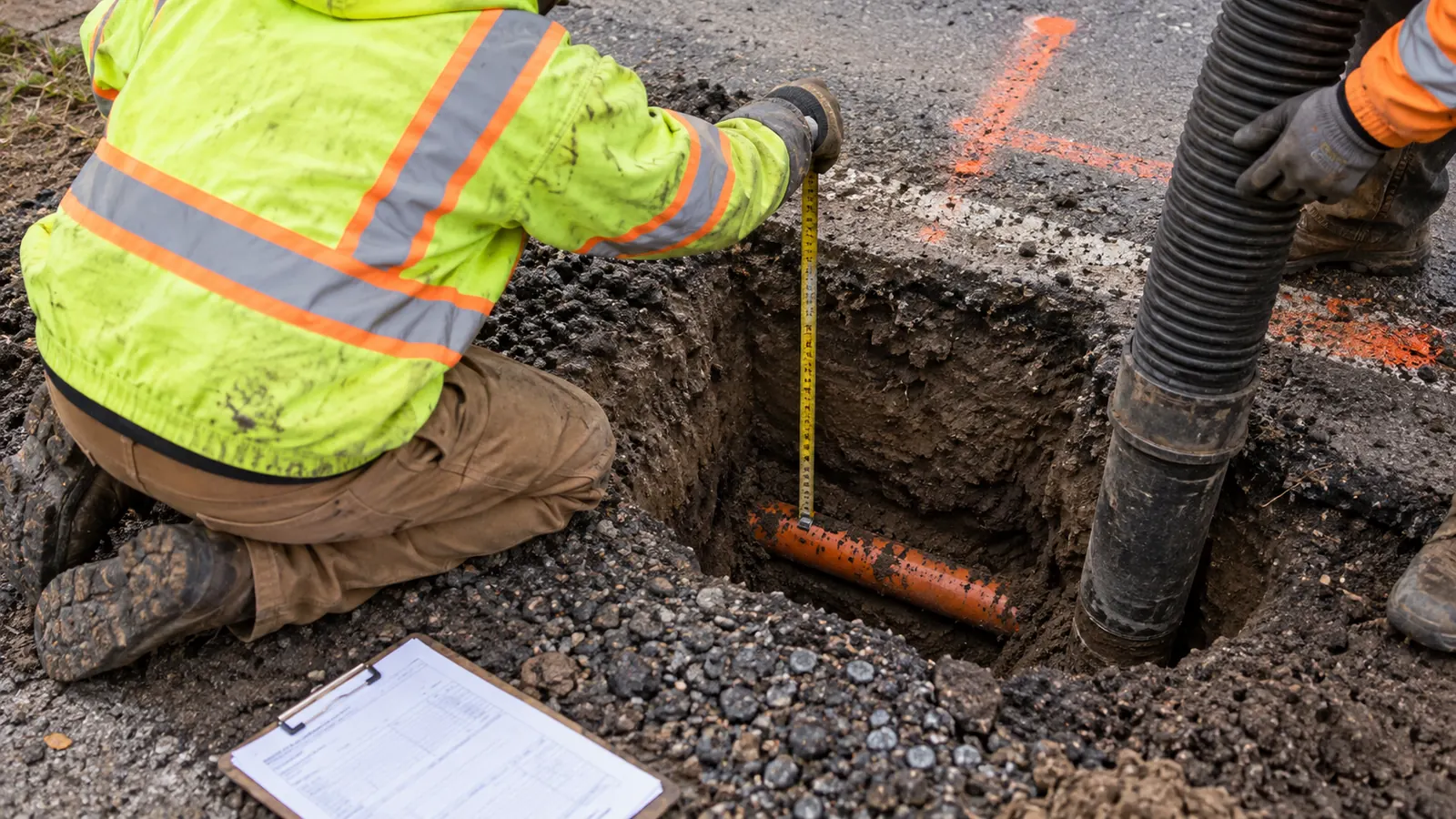
The work called potholing utilities uses small vacuum-excavated test holes to expose existing buried lines and verify their position at a planned conflict. It follows the 811 locate process and supplies measured depth, visible size, and material observations that engineers use to review a directional bore before construction proceeds.
The crossing governs the exposure. We want the test hole to answer a particular design question: where does the existing facility sit relative to the space the proposed installation needs? A hole beside a convenient patch of pavement may reveal the correct utility yet miss the actual crossing. Its usefulness depends on its relationship to the proposed alignment.
Daylight the conflict, not merely the paint
When the field team exposes a conduit, our next question is whether it stands alone or belongs to a wider duct bank. Ask them to document what they can see and where the exposure ends. Adjacent ducts may still be buried beneath pavement, leaving the bank's full extent unknown even though its outer conduit is visible.
Depth also needs a reference. A measurement to the top of a pipe from existing pavement answers a different question from an elevation tied to the project's survey datum. We specify the required reference before the excavation contractor mobilizes so the measurement can be placed in the profile without someone guessing which surface the field note used.
One limitation of potholing is that an exposure confirms a local condition, while the utility can change direction or elevation beyond the opening. We keep that boundary visible in the design record. Connecting exposed points with an uninterrupted line can suggest certainty the observations never established, particularly where branches or changes in grade remain possible between them.
Include the reamer in the clearance review
OSHA's Safety and Health Information Bulletin, Avoiding Underground Utilities during Horizontal Directional Drilling Operations, SHIB 03-13-2018, published March 13, 2018, recommends visual verification through potholing and observation of both the drill stem and back reamer near utilities. Its advice addresses the installation operation, not just the initial pilot pass. We carry that distinction into the crossing review.
Enlargement and pullback occupy more space than the pilot pass. Even after a successful pass, we still need to check the geometry for those operations. Our HDD boring and fiber installation guide connects utility exposure with bore geometry and construction controls. For the potholing package, we want the reviewed crossing to identify the proposed bore envelope and the applicable separation requirement rather than leave those decisions to a depth annotation.
Connect the 811 locate to the exposure plan
The 811 ticket belongs at the start of the excavation process. The Common Ground Alliance's Before You Dig guidance calls for requesting marks and confirming utility responses before digging. Those marks indicate approximate locations. We use them with available records and the site walk to define where more information is needed; the ticket does not supply a complete bore profile.
Resolve missing responses and private facilities
The project team should establish who owns each response before vacuum excavation begins. Check the ticket limits against the proposed work area. Where responses conflict with visible features or expected facilities, we recommend resolving the discrepancy through the applicable notification process and facility owner rather than interpreting silence as permission to proceed into an uncertain crossing.
Private facilities deserve a separate review. OHIO811's Private Utility Locating guidance distinguishes privately owned lines from member facilities covered by the notification system. For each project, we therefore ask who will address owner-side plant and whether the proposed exposure scope covers it. We do not assume an 811 request identifies every buried line on a property.
A weathered pipe or disconnected-looking conduit may appear abandoned, but we keep its status unresolved until the responsible owner establishes it. Record the visible condition separately from that ownership determination. Otherwise, another crew may rely on an unsupported ?abandoned? label carried into the construction drawing from someone's impression at the opening.
Place exposures where they can change a decision
Conflicts affecting the bore alignment or observation of installation near existing plant take priority in our exposure plan. Changes in the proposed route can change those locations. The project team should review exposure positions against the current drawing revision, especially when access restrictions move a planned opening away from the intersection the designer originally intended to verify.
Before setting the excavation sequence, we check local notification requirements and facility-owner instructions. Ticket validity, waiting periods and tolerance-zone widths vary, and the clearance requirements need confirmation for the specific project. The construction package should identify the applicable requirements and assign responsibility for keeping marks and responses current through excavation and drilling.
Choose hydro or air vacuum excavation
Hydro excavation loosens soil with water, while air excavation uses compressed air before vacuum removal. Vermeer's Potholing best practices: daylighting buried utilities with a vacuum excavator, published September 7, 2026, describes water as effective in compacted ground and clay, with air offering dry-spoil advantages where conditions permit. Method selection still belongs to the site-specific work plan.
| Decision | Hydro excavation | Air excavation | Project review |
|---|---|---|---|
| Ground response | Water helps break cohesive or compacted soil | Air can suit ground that breaks apart readily | Confirm the method against actual conditions |
| Spoil handling | Produces wet excavated material | Can preserve dry excavated material | Define handling and disposal arrangements |
| Utility protection | Requires controlled water application | Requires controlled air application | Follow facility and equipment restrictions |
| Restoration | Plan suitable replacement backfill | Evaluate recovered material before reuse | Meet the specified restoration requirements |
Ground response: match the excavation to the soil
Before accepting a method, we ask the excavation contractor how it will work in the anticipated ground and which conditions would prompt a change. A method suitable for loose fill can behave differently in compacted clay. The equipment proposal should support the required exposure geometry without assuming that every crossing along the route will excavate the same way.
When groundwater or unstable soil prevents a useful observation, the contractor needs to reassess the excavation controls before continuing. An incomplete exposure belongs in our records with its limitations stated plainly. Entering a guessed depth as measured data hides the uncertainty, and that entry can survive subsequent drawing reviews long after the opening has been closed.
Spoil handling: decide where the material goes
The spoil stream differs between the methods: hydro excavation adds water, while air excavation can leave the material dry. Vermeer notes that these differences affect handling and potential reuse, but we recommend treating the disposal or backfill decision as a project requirement rather than a benefit automatically attached to either machine. Material condition and the receiving site's rules still matter.
The staging plan should make room for removal operations without blocking the observation point or forcing hoses through an uncontrolled work area. We include this in the construction coordination discussion. A truck position that works for excavation may conflict with the drill setup, so the sequence needs to be checked against the equipment footprint before field work starts.
Utility protection: control the tool at the exposure
Vacuum excavation still requires trained operation. OSHA's interpretation issued October 23, 2003 and reviewed November 22, 2017, Use of hydro-vacuum excavation equipment and other acceptable means to locate underground utility installations, recognizes hydro-vacuum excavation as potentially acceptable subject to appropriate precautions. We reject the assumption that a vacuum method makes utility damage impossible or removes the need for the facility owner's excavation instructions.
Give operators the approved equipment settings and approach restrictions for the facility they will expose, so they have those instructions in hand instead of guessing at the opening. Any discrepancy or suspected damage triggers our requirement to use the site's stop-work and notification process. The affected work stays on hold until the responsible parties resolve the condition and authorize safe continuation under the project procedures.
Restoration: close the opening under the project specification
The restoration requirement should be known before the opening is made. Dry spoil may still be unsuitable for reuse, and a pavement opening may require a different reinstatement detail from an exposure in an unpaved shoulder. We ask the contractor to identify the applicable detail and the inspection needed before the opening is covered.
Keep the observation available for its intended purpose. Where the approved work plan calls for viewing the crossing during drilling, premature backfill defeats that control. Draftech International provides full turnkey utility construction through Draftech-managed subcontract crews under our QA/QC and safety program, with exposure and restoration coordinated as parts of the same build.
Turn potholing utilities data into a bore decision
A field photograph alone rarely answers the design question. We need a record that can be located on the drawing and interpreted without calling the person who took it. Agree on the record format before excavation so the field team knows which observations engineering needs and how to label information that could not be confirmed.
Record depth with its reference and utility dimensions
Start with a unique exposure identifier. Tie that identifier to the crossing station or surveyed position, and carry it into the photo names. With consistent labels, our engineer can find the same opening in the field sheet and the profile. State the units beside each measurement as well; a bare number leaves the reader to infer something the field team could have recorded explicitly.
The depth entry should state the measured surface and the point on the utility used for the reading. Top-of-utility cover is common, but it does not describe the lower edge needed for an undercrossing unless the utility's vertical extent is also known. We record measured dimensions separately from nominal sizes taken from owner records.
Material observations need similar discipline. A visible plastic conduit does not establish what cable it carries, and an exposed casing does not reveal the carrier pipe's position inside it. For concealed characteristics, our field entry stays unconfirmed and references the owner information used for design wherever direct observation cannot establish the required fact.
Photograph the measurement reference. Include enough context to show where the depth reading begins and which exposed surface it reaches. That context helps us interpret the field entry when pavement or grading has changed by the time the as-built package is prepared.
Review the bore envelope before releasing the crossing
Our engineering team checks the measured utility position against the proposed installation envelope in the same coordinate and elevation system. Engineering is 100% in-house at Draftech International. The partner and delivery team provides the accountability behind that review; a field discovery still needs a documented engineering disposition when it changes the construction design.
If a conflict requires a revised profile or a different alignment, we follow the change beyond the opening. Moving deeper can alter the approach geometry outside the immediate crossing. Review that transition against adjacent constraints and the proposed equipment and product limits before accepting the revision; changing a single elevation leaves the rest of the bore's buildability unchecked.
Document the decision on the current issue set and withdraw superseded instructions from field use. Our fiber construction RFI workflow explains how questions and responses move back into controlled drawings. For an exposed conflict, the response should identify what changed and who released the revised crossing, leaving the crew with an executable instruction.
An unresolved measurement holds the affected work. We ask for clarification while the opening can still be checked, particularly when the stated depth conflicts with its photograph or the utility extends beyond the recorded dimensions. A completed form does not settle that discrepancy. The reviewer must be able to explain the crossing from the evidence it contains.
Carry exposure records into the as-builts
In our closeout package, the exposure identifier stays attached to the existing utility observed during potholing. The installation record describes the new conduit and completed bore. Keeping those records distinct lets the reviewer trace each measurement to the work that produced it and helps prevent a design assumption from being carried into the as-builts as a field measurement.
Separate observed plant from the installed route
Link the final drawing to the original exposure sheet and the relevant construction revision. If the approved alignment changed after potholing, show how the observation relates to the installed route. Retaining the original measurements and reference information lets us trace the drawing back to the field record; a cleaned-up depth without that history breaks the connection.
Where grades have changed, we identify whether each annotation describes depth below the pavement at excavation or cover below the finished surface. Those measurements may differ. The as-built reviewer also needs to see whether a final measurement supports the annotation. Surface restoration should not erase the reference needed to interpret the earlier exposure correctly.
Consistent attribute labels in CAD and GIS help us distinguish directly measured positions from those carried forward from owner records. A drawing can connect observed points to depict continuity, provided the inferred connections remain identifiable. Later maintenance decisions may depend on that distinction, particularly at a location where the utility was never exposed.
An investigation that found no utility still belongs in the closeout package. Retain the test hole's searched extent and unresolved result, and link the follow-up and disposition to that entry. We need the next reviewer to see where the expected facility was sought, even when the investigation produced no utility coordinate to plot.
Set the release criteria for your build
For fiber owners and project managers: require an exposure plan tied to the current crossing design before releasing HDD work near existing facilities. Assign the person who accepts the field evidence and the person who authorizes a design change. Clear responsibility matters most when the opening reveals a condition different from the issued drawing.
For designers and construction reviewers: specify the measurement references before the contractor starts. Review the proposed bore envelope against the exposed utility's extent, and retain unresolved observations in the design record. Bring missing evidence to our attention while the crossing is accessible and the measurement can still be checked against the physical facility.
For construction leads: keep the approved crossing instructions available to the operator and tracker. Match the observation arrangements to the installation sequence. We expect Draftech-managed crews to work under our QA/QC controls, with engineering questions routed back to our in-house team when field conditions require a design decision.
Draftech International delivers turnkey telecom and power infrastructure from fielding and planning through construction drawings, permits and agency coordination, followed by construction, as-builts and closeout. Our role connects the measured crossing to the drawing used in the field and the record accepted at handover. Discuss unresolved crossing requirements through our project contact page or at info@draftech.com.
For a qualifying route, our free engineering offer covers the first 20,000 linear feet at no cost, from feasibility and field survey through permit approval. The owner reviews each request before Draftech commits the package. That review gives us a place to address the route's crossing questions before they become unresolved instructions in a construction set.