- What "Last Mile" Actually Means in Fiber Network Design
- Feeder Route Design: Backbone to Distribution Points
- Distribution Segment Engineering: Splitting and Serving Areas
- Drop Design: From Tap to Premises
- Aerial vs. Underground Last Mile: Cost and Construction Trade-Offs
- How BEAD Funding Changes Last Mile Design Requirements
Most of the money in a fiber build lives in the last mile. Not in the backbone. Not in the hub equipment. In the segment between your distribution point and the subscriber's ONT: the feeder routes, the splitting architecture, the drops. That's where project costs are either controlled or lost, and it's where design decisions made on paper have the most direct consequences in the field.
I've been doing fiber network design for 17 years. I've watched ISPs with solid spectrum strategy and adequate capitalization still run into trouble because nobody modeled the last mile carefully enough before the project kicked off. Splice point locations chosen for convenience instead of serviceability. Distribution routes that look efficient on a map but require double the make-ready of an alternative alignment. Drop designs that work in flat subdivisions and completely fall apart in rural terrain with 400-foot lot depths.
This article breaks down last mile OSP engineering segment by segment: what decisions get made, what drives cost, and where the engineering choices that look minor on paper turn into expensive field problems. Whether you're designing FTTH for a rural co-op, building out a BEAD-funded network, or evaluating a design package before construction, this is the framework that matters.
What "Last Mile" Actually Means in Fiber Network Design
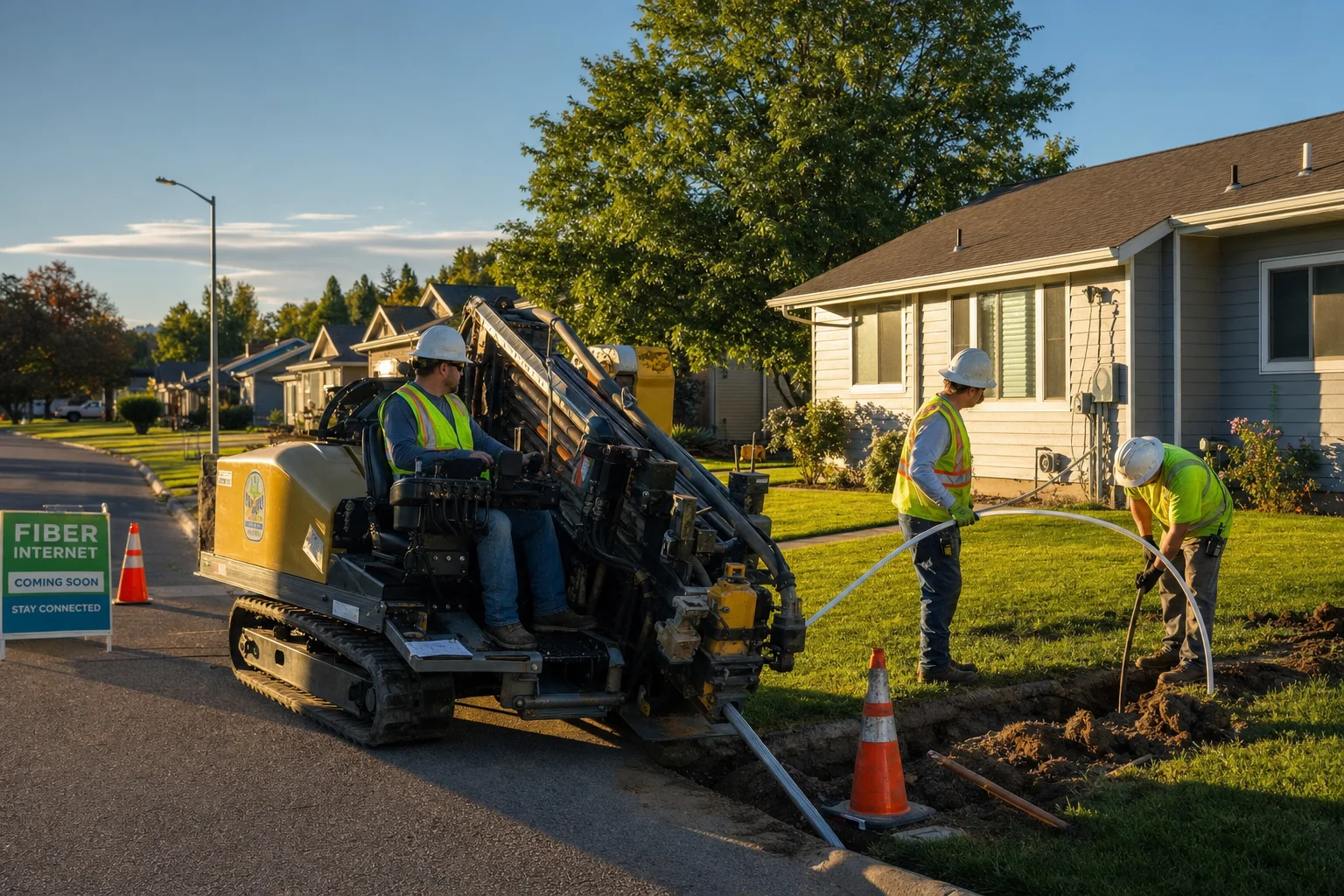
The term "last mile" is used loosely in the industry and that looseness causes real confusion in project scoping. In fiber network design, the last mile refers specifically to the access segment: everything from the hub or node site to the subscriber premises. It is not a distance measurement. A last mile segment in a dense urban deployment might be 800 feet. On a rural route in the Great Plains, it might be 6 miles of single-family homes strung along a county road.
Within that access segment, there are three distinct design layers. The feeder carries high-strand-count backbone fiber from the hub to the edge of each distribution area. The distribution segment is the branching architecture that takes the feeder capacity and splits it across a serving area. This is where your splitter placement, tap locations, and service area boundaries are defined. The drop is the individual connection from a distribution tap or enclosure to each subscriber's premises.
Each layer has different engineering requirements, different cost drivers, and different failure modes. Design errors in the feeder tend to surface at commissioning when capacity calculations fall apart. Distribution design errors show up during make-ready when the planned route conflicts with infrastructure that wasn't assessed. Drop design errors show up on the first service call (or the second, or the fifth) when field techs discover that the standard drop template doesn't fit the actual site conditions.
Treating all three as a single undifferentiated "last mile" is how projects get into trouble. The engineering discipline of last mile design is the discipline of managing all three layers simultaneously, with clear cost and operational tradeoffs documented at each decision point.
Feeder Route Design: Backbone to Distribution Points
The feeder route is the spine of your last mile network. It runs from the hub or central office to the hand-off point for each distribution area, typically a fiber distribution hub (FDH), a pedestal, or a splice vault. The design decisions at the feeder level set the capacity ceiling for everything downstream.
Feeder cable selection is the first consequential decision. Most FTTH networks designed today use 144- to 288-strand single-mode feeder cables on routes serving up to 500 homes, scaling to 432 strands for routes serving larger areas or requiring redundant capacity. Over-engineering the feeder is expensive in material cost but under-engineering it is far more expensive: pulling a replacement feeder cable after construction is complete adds cost that depends on plant type and access conditions.
Route alignment for the feeder follows a different logic than distribution. The feeder should follow the most direct, lowest-make-ready path from hub to distribution hand-off point. On aerial plant, that means staying on the primary utility corridor wherever possible and minimizing the number of poles that require additional make-ready. Underground feeder routes should follow existing conduit banks or avoid crossing pavement where alternatives exist.
Splice point placement on the feeder is a decision that affects every downstream maintenance event. A feeder splice that's accessible (at a road crossing, near a structure, in a marked vault) saves 2 to 4 hours on every future fault location event. A splice buried mid-span in a remote location to save 200 feet of cable is a maintenance liability for the life of the network. We document splice accessibility as a standard design attribute on every feeder route we engineer.
Redundancy is worth addressing at the feeder stage even for networks that don't launch with diverse routing. If your feeder route has a single point of failure (a road crossing, a bridge attachment, a conduit run under a rail line), document it, flag it in the LLD, and ensure the hub design accommodates a future redundant path. Adding redundancy at construction is 60 to 70 percent cheaper than adding it post-build.
Distribution Segment Engineering: Splitting and Serving Areas
The distribution segment is where last mile engineering gets complex fast. This is the layer that determines how many subscribers each feeder fiber serves, where the signal gets split, and how your service area is subdivided into logical, serviceable units. Get it right and your network is maintainable and scalable for 20 years. Get it wrong and you're re-engineering serving area boundaries every time a neighborhood phase gets added.
The central decision in distribution design is split ratio and split location. Most FTTH networks use either a 1:32 or 1:64 passive optical split. Where that split happens, at a single central location or distributed across multiple points, affects both cost and serviceability. A centralized split at the FDH minimizes splice count but concentrates all subscribers for a given feeder fiber in one physical location; a fault at that FDH takes down the whole group. A distributed split architecture pushes the split points closer to the subscribers, which reduces the impact of any single failure and allows incremental deployment as homes are added, but it increases splitter count and passive component costs.
Serving area boundary design is how you divide the distribution footprint into discrete units. Each serving area should be sized to match one feeder fiber or one splitter port group. In practice, that means designing serving areas of 32 to 64 homes for a 1:32 system, or 64 to 128 homes for a 1:64 system, with clean geographic boundaries that don't require crossing primary feeder routes. Serving areas that follow natural terrain or road network boundaries are more maintainable than those that follow arbitrary count targets.
Tap placement on the distribution cable is the granular engineering task that consumes the most time in FTTH distribution design. Every tap needs a verified subscriber count, confirmed lot access, and a placement location that's accessible for future splicing without traffic control or special equipment. In our FTTH design services, tap placement is done against verified address data, not estimated household counts from GIS layers, because rural address data is frequently inaccurate enough to change the tap placement logic on 15 to 20 percent of locations.
Drop Design: From Tap to Premises
The drop is the last segment, the connection from a distribution tap or terminal to the subscriber's network interface device or ONT. It's the shortest segment in the network and, on a per-unit basis, one of the highest-cost elements of the build because every single subscriber requires one.
Drop design is where last mile cost models go wrong most often. ISPs budget for an average drop length based on a rough lot depth estimate, then discover in the field that 30 percent of their drops require non-standard construction. A flat subdivision in the Midwest with 90-foot average lot depths has a completely different drop cost profile than a rural route in Appalachian terrain where lots are 400 to 600 feet deep, driveways are unpaved, and aerial clearances require custom attachment heights at the house entry point.
The design decisions for drops fall into three areas. First, tap-to-NID routing: the physical path from the distribution tap to the point of entry at the premises. This needs to be verified against the actual lot configuration, not assumed from a parcel map. Obstacles like driveways, outbuildings, tree lines, and fence lines all affect whether a standard aerial drop works or whether a different approach is needed. Second, drop cable specification: single-mode drop cable for FTTH is standard, but the sheath type, count, and messenger size vary by span length and attachment conditions. A 200-foot aerial drop in an ice-loading zone requires different cable spec than a 50-foot underground bore in the same project area. Third, NID/ONT placement: the physical mounting location at the premises needs to be documented, not assumed. A utility room entry that works for 80 percent of a rural subdivision may be inaccessible on the 20 percent with finished basements, attached garages, or non-standard construction.
Drop design at the LLD stage should produce a per-premises design record, not a uniform template applied to all addresses. On a 500-home FTTH project, we typically flag 60 to 90 addresses as requiring custom drop design due to lot configuration, span length, or access conditions. Those flags drive the cost model and the construction package. Missing them means field crews encounter problems they weren't equipped or authorized to solve, which means service delays and extra dispatches.
Aerial vs. Underground Last Mile: Cost and Construction Trade-Offs
Plant type selection, aerial vs. underground, is one of the highest-leverage decisions in last mile design. It affects not just construction cost but permitting timeline, make-ready scope, long-term maintenance cost, and BEAD program eligibility in some state-specific program rules. It also affects design complexity: aerial plant requires pole loading analysis, make-ready engineering, and utility coordination; underground requires bore path engineering, utility conflict mapping, and restoration documentation.
The general cost relationship holds in almost every market: aerial construction costs less than underground in comparable terrain. A standard aerial last mile build in rural conditions has a lower installed cost than underground direct-bury or conduit. Underground costs rise further if bedrock, high water table, or paved surface crossings are involved. In suburban environments with existing conduit infrastructure, underground can narrow that gap significantly, but greenfield underground in any condition is a more expensive baseline than aerial.
That cost differential doesn't mean aerial is always the right answer. Underground plant has a longer service life, lower long-term maintenance cost, and no exposure to aerial damage from ice loading, wind, or vehicle strikes. For a network designed to serve customers for 30 years with minimal active maintenance, the higher upfront cost of underground construction can be justified on a lifecycle basis, particularly for distribution routes in high-traffic or storm-prone areas. You can read a detailed breakdown of those tradeoffs in our analysis of aerial vs. underground fiber construction costs.
Mixed-plant last mile design (aerial feeder with underground distribution, or aerial distribution with underground drops in high-traffic areas) is common and often the most cost-effective approach. It requires careful documentation of plant-type transition points and makes the construction package more complex, but the cost savings on the feeder route frequently justify the added engineering effort on the distribution and drop segments.
Last mile design is where most of the project cost lives. Draftech designs feeder-to-drop fiber networks for ISPs and co-ops across 24 states. First 20,000 LF free. → draftech.com/free-design
Last Mile Segment Comparison
| Segment | Typical Span | Cable Type | Design Consideration | Cost Driver |
|---|---|---|---|---|
| Feeder (backbone) | 1 to 6 miles | 144 to 432 strand single-mode, OSP rated | Route alignment, splice accessibility, capacity headroom for future phases | Cable material cost; make-ready on primary corridor; conduit cost if underground |
| Distribution | 0.25 to 2 miles per branch | 12 to 96 strand single-mode; splitter enclosures at tap points | Split ratio selection, serving area sizing, tap placement against verified address data | Passive component count (splitters, enclosures); pole make-ready on distribution arms |
| Service Drop (aerial) | 50 to 350 ft | 2 to 6 strand figure-8 aerial drop cable with integrated messenger | Lot depth verification, clearance at road and driveway crossings, attachment height at premises | Labor per drop; non-standard lots requiring custom routing; ice-loading cable upgrades |
| Service Drop (underground) | 50 to 600 ft | 2 to 6 strand armored or direct-bury rated single-mode | Bore path engineering, utility conflict clearance, restoration documentation | Bore cost per foot; pavement crossing surcharges; conduit requirement in municipal ROW |
How BEAD Funding Changes Last Mile Design Requirements
BEAD fundamentally changes the documentation and compliance requirements for last mile fiber design, not the engineering itself, but the evidentiary record that has to accompany every design decision. ISPs and co-ops who treat BEAD projects as standard commercial builds and add documentation at closeout are consistently the ones who fail grant audits or face clawback risk.
The core BEAD requirement that affects last mile design most directly is the technology scalability mandate. BEAD-funded networks must be designed to deliver gigabit-capable service to every funded location. That means your fiber counts, splitter ratios, and electronics capacity must be engineered to support symmetric 1 Gbps from day one, or your LLD must document a clear, cost-supported upgrade path. A 1:64 PON architecture that delivers 500/500 Mbps at launch with a documented path to 2.5G XGS-PON is acceptable. An architecture that requires cable replacement to scale to gigabit is not. Full details on what satisfies those requirements are in our breakdown of BEAD engineering requirements.
Last mile design packages for BEAD projects also need to include cost per location documentation that supports the program's cost reasonableness review. That means your LLD needs per-address line items, not just aggregate per-mile costs, with sufficient detail to justify the design choices. A distribution route alignment that adds 800 feet to avoid a wetland crossing needs to show that alternative routing was evaluated and rejected on documented grounds. A drop design that specifies armored cable where standard drop cable is the regional norm needs a cost justification in the design record.
As-built documentation requirements under BEAD are also more demanding than commercial project closeouts. Every funded location needs a verified as-built record showing the actual installed route, the splice points, and the equipment at each premises. That requirement should be designed into your field workflow before construction starts, not assembled from field notes after the fact. Projects that plan their as-built documentation protocol at the LLD stage consistently close out on time; projects that treat it as an afterthought spend 60 to 90 days in closeout rework.
On the rural last mile specifically, which is where the bulk of BEAD-funded builds are concentrated, there's an additional terrain and access complexity that BEAD cost models often underestimate. Rural FTTH last mile design in mountainous terrain, flood-prone areas, or regions with limited utility pole coverage requires a different set of engineering tools than flat rural deployment. Cost per mile on rural last mile in those conditions frequently runs 40 to 80 percent above standard rural estimates. Getting those cost estimates right at the design stage, with supporting field data, is what separates a fundable BEAD application from one that gets questioned during state program review.
If you're working on a BEAD-funded last mile project, or any ISP build where the feeder-to-drop engineering needs to be done right before construction kicks off, that's what we do. Draftech has delivered last mile design packages across 24 states, from 200-home rural FTTH builds to multi-county BEAD deployments covering 4,000 or more locations. The free first 20,000 LF offer is a real starting point: no obligation, just design work you can evaluate before committing to a full engagement. Start at draftech.com/free-design.