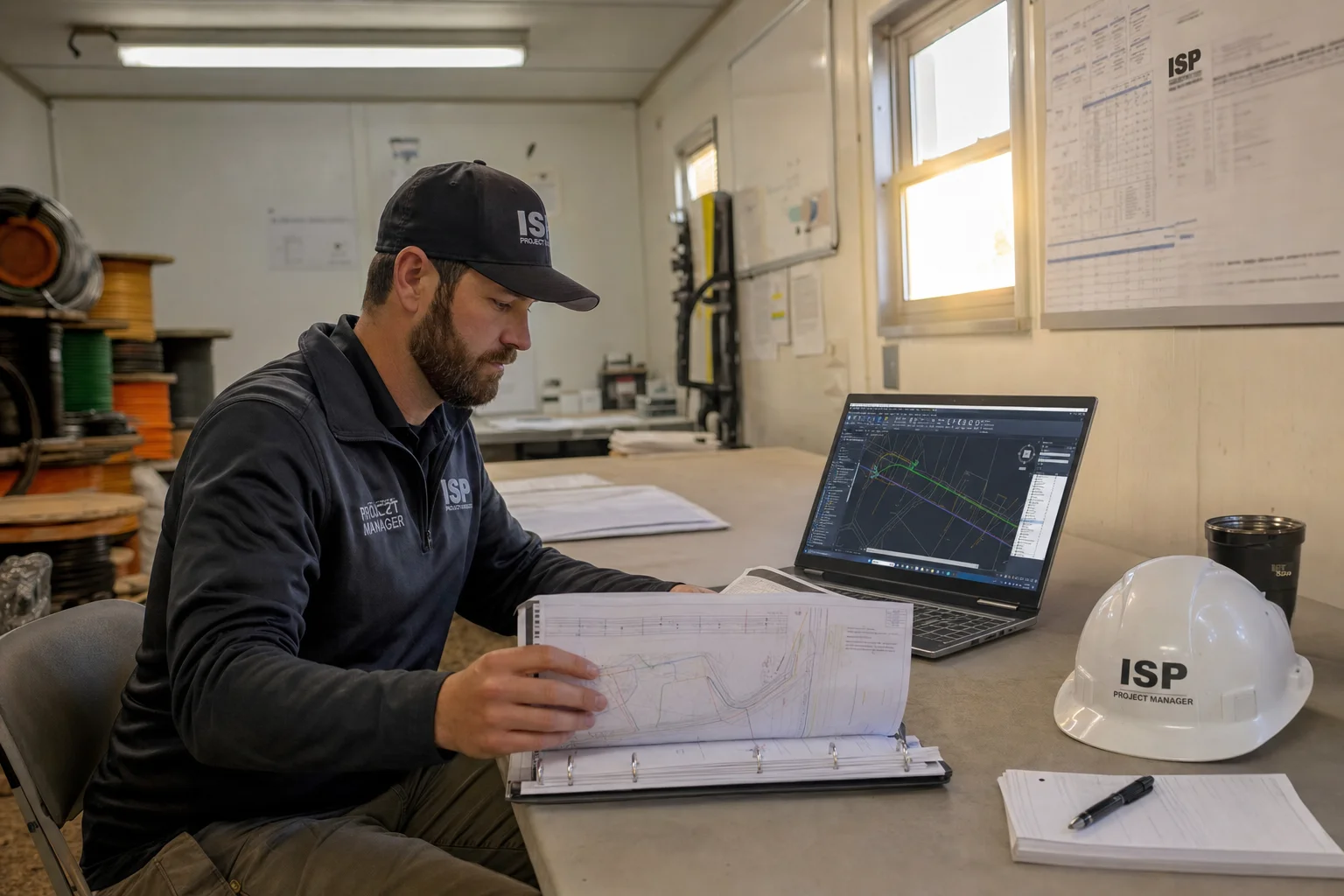
I run a firm with 600 engineers. We've designed fiber routes in 24 states: rural broadband, BEAD, municipal ISP, commercial operator deployments. And I still see ISPs waste months and real money making the same hiring mistakes. They either bring on someone with a CAD certificate and call them a fiber design engineer, or they outsource to a firm that's never produced a construction-ready permit package in their life.
So let's fix that.
This isn't a recruiter's guide. It's what I'd tell you if we were standing in a site trailer and you asked me how to build your design team without getting burned.
What a Fiber Design Engineer Actually Does
The title gets thrown around loosely. "Fiber design engineer" can mean someone who colors routes on a Google Maps screenshot or someone who produces stamped, permit-ready construction drawings that a crew can actually build from. Those are not the same job. Not even close.
Field Work Comes First
Real fiber design starts outside. Before any drawing gets made, someone has to walk or drive the route, documenting every pole, span length, existing attachment, ground clearance, and structural condition. That field data is what everything else is built on. A design produced without a fresh field survey is a guess dressed up in CAD.
Field survey for a 10-mile aerial route can mean documenting 400-plus poles, recording attachment heights to the half-inch, measuring spans between poles, noting guy wire condition, and logging every tree conflict and road crossing. That's days of physical work. Engineers who've only ever sat at a desk don't know what they're looking at when you put them in the field, and that gap costs you on every project downstream.
Route Design and Permit Drawings
Once you have solid field data, the actual design work involves route optimization: choosing the path that minimizes pole loading conflicts, avoids permitting complications, and gets the cable where it needs to go at the lowest construction cost. Then comes the permit drawing set: plan-and-profile sheets, lashing specifications, attachment detail sheets, and all the utility coordination documentation that has to go into the permit package.
This is where software fluency matters. A good engineer can produce drawings in AutoCAD or MicroStation that a municipality, utility, or DOT will actually accept, not just drawings that look right on screen. Getting a permit package rejected because the drawings don't meet the utility's format standards is a 6-to-12-week delay you don't want. Understanding the make-ready engineering timeline is part of producing a permit package that accounts for realistic approval windows.
Pole Loading Analysis and Construction-Ready Deliverables
Every aerial attachment on a utility pole requires a structural analysis showing the pole can handle the added load (new fiber strand, lashing wire, and all existing attachments) without violating NESC clearance requirements. That means running pole loading analysis in O-Calc Pro or SPIDAcalc for each attachment point, then producing the documentation the utility needs to approve the attachment permit.
Construction-ready deliverables aren't just permit drawings. A complete package includes splice placement plans, terminal locations, strand specifications, material takeoffs, construction notes, and enough detail that a crew can build the route without calling the engineer every hour. If a designer can't tell you what goes into a fiber construction package deliverables, they haven't produced one.
Staff Hire vs. Engineering Firm: Which Makes Sense for Your Project
This is the question I get most often. And the honest answer is: it depends on what you're actually building and over what timeframe.
The Real Cost Comparison
A staff fiber design engineer (fully loaded, meaning salary, benefits, PTO, office overhead, software licensing, and training) runs somewhere between $85,000 and $120,000 per year. That's not a junior technician; that's a qualified OSP engineer who can own a design from field survey to construction package.
Outsourcing to an engineering firm runs $65 to $95 per hour depending on scope and the firm's location. On a typical 20,000 LF project that takes 8 weeks of engineering time, you're looking at roughly $26,000 to $38,000 in direct design cost: no benefits, no PTO liability, no software seats to buy, and no engineer sitting idle between projects.
The table below captures how these two models actually compare across the factors that matter most:
| Factor | Staff Hire | Engineering Firm |
|---|---|---|
| Avg Annual Cost | $85,000 to $120,000 loaded FTE | $65 to $95/hr, project-based |
| Time to Deploy | 60 to 90 days to hire + onboard | 1 to 2 weeks to mobilize |
| Surge Capacity | Limited to headcount; hard to scale | Scales with project volume on demand |
| BEAD Compliance Support | Depends on individual experience | Firm-level BEAD documentation expertise |
| Revision Cycles | Internal; faster iteration possible | SOW-defined; managed via QA process |
| Contract Flexibility | Low: employment relationship | High: project or retainer basis |
When Staff Hire Makes Sense
If you're building a multi-year deployment program with consistent design volume (say, 50,000-plus LF per quarter, ongoing), a staff engineer starts to make economic sense. You get institutional knowledge, faster internal iteration, and an engineer who understands your specific network topology and utility relationships. The breakeven is roughly 18 months of active project volume, assuming you can hire someone who actually knows what they're doing.
When Outsourcing Wins
BEAD-funded projects almost always favor outsourcing. The BEAD engineering requirements are specific (NTIA documentation formats, cost certification support, as-built data standards), and most staff engineers haven't navigated them before. You don't want your first BEAD engineering cycle to also be your engineer's first BEAD project. The revision cycles that result from that combination are expensive and slow. For surge capacity, for new state entries, and for any project where speed to construction matters, outsourcing is the faster and usually cheaper path.
Key Qualifications to Look For
This is where most hiring goes wrong. People filter on credentials and software names without asking whether the candidate has actually produced deliverables that worked in the real world.
Software Proficiency That Actually Matters
AutoCAD and MicroStation are the two dominant CAD platforms in OSP design. Your engineer needs to be proficient in whichever platform your utility partners and municipalities require, and ideally both, because you won't always get to choose. For GIS: ArcGIS is the standard, but QField for field data collection and QGIS for some analysis workflows are increasingly common. Someone who can only work in one CAD environment is a bottleneck.
O-Calc Pro and SPIDAcalc for pole loading analysis: this is non-negotiable for aerial work. Different utilities prefer different tools; some won't accept SPIDAcalc output, others require it. Your engineer should know both platforms and understand what each utility in your market accepts.
NESC Knowledge and BEAD Experience
NESC, the National Electrical Safety Code, governs clearance requirements, loading grades, and structural standards for utility pole attachments. An engineer who doesn't know NESC shouldn't be signing off on pole loading analysis. Ask specifically: what NESC loading grade do you apply in Zone III? What's the minimum vertical clearance for fiber strand over a railroad? If they hesitate, they're not the right person.
For BEAD projects specifically, ask for samples. Real, completed BEAD as-built packages. Not a description of what BEAD is. Actual documentation they've produced that a state program office has accepted. If they can't show you one, they haven't done one.
Field Experience, Not Just Desktop
This is the qualification that separates engineers who can produce deployable designs from those who produce paper exercises. OSP field experience means they've done field surveys, they know what conditions look like in reality vs. in GIS, and they understand how construction crews actually build what's on the drawings. Ask: what's the most unexpected thing you've found doing a field survey that changed the design? A real answer to that question tells you everything. A vague answer means they haven't been in the field much.
Red Flags When Evaluating Candidates or Firms
I've interviewed hundreds of engineers and evaluated dozens of subcontracting firms. The red flags are consistent.
No Real OSP Field Experience
A candidate who's only ever done desktop design (no field surveys, no utility pole coordination, no construction observation) is going to produce designs that look right on paper and cause problems in the field. Span lengths that don't match reality. Loading analyses based on attachment counts from GIS that don't reflect what's actually on the pole. Missing clearance conflicts with trees or structures that a field survey would have caught.
Ask for specific project examples. Where was the route? How many poles? What was the pole loading result on the most loaded pole in the design? What make-ready was required? A real field engineer can answer all of these without pausing. Vague answers to specific questions are a reliable signal.
Single-Platform Dependency and No BEAD Experience
Engineers who only work in AutoCAD and have never touched MicroStation, or vice versa, are a problem the moment you hit a utility that requires the other platform. Same with GIS: if they can't work in ArcGIS, they can't support you on projects where the utility requires GIS-referenced deliverables, which is increasingly common.
No BEAD as-built experience is a real gap in 2026. BEAD isn't going away, and the documentation requirements aren't optional. If a firm tells you they're "familiar with BEAD" but can't show you a completed as-built package, that's not experience. That's marketing. For a good overview of how to evaluate partner firms overall, the guide on how to choose an OSP engineering partner goes deeper on the evaluation criteria.
Can't Show Permit Package Samples and Vague on Turnaround
Any legitimate fiber design engineer or firm should be able to show you a sanitized permit package sample: plan-and-profile sheets, loading analysis report, utility coordination letter, the works. If they can't produce a sample, they haven't produced one recently. That's not who you want designing your network.
Vague on turnaround is a matching red flag. "It depends" is not a timeline. A real engineer can tell you: for a 15,000 LF aerial route with 43 poles requiring pole loading analysis, field survey to permit-ready drawings takes approximately 7 weeks. If they can't give you that kind of specificity, they don't have a real process.
How to Structure the Engagement
Getting the right engineer or firm is half the battle. Structuring the engagement so you actually get what you paid for is the other half.
SOW Basics That Protect You
Your Statement of Work needs to define deliverables precisely, not "design drawings" but: plan-and-profile permit sheets at 1:200 scale, O-Calc Pro loading reports for all 43 poles with attachment point documentation, make-ready engineering summary, and utility coordination letters for each pole owner. List every deliverable. Define the format. Define what "complete" means before work starts.
Milestone-based payment is standard for good reason. You don't pay for the full project until you've seen field survey data, reviewed interim drawings, and accepted the final permit package. Typical milestones: 25% at field survey completion, 50% at 60% design review, 25% at final permit-ready deliverable acceptance. Don't pay 100% upfront for a project that hasn't started. I don't care how reputable the firm seems.
QA/Revision Cycles and What Good Deliverables Look Like
Build a 60% design review into your SOW. That's the point where you catch structural issues in the approach before they become fully drawn permit packages that need to be redone. A competent firm will expect this checkpoint. It protects both sides. Specify two revision rounds in the contract; anything beyond that is a change order.
Good deliverables have specific characteristics. The LLD quality control process matters here: drawings that pass internal QA before they hit your desk will have consistent labeling, no missing clearance notes, correct NESC loading grade applied, and pole loading results that match the field-documented conditions. If the drawings you receive have 6.2 dB discrepancies between the loading model and what's documented in the field survey, the QA process broke down.
What the Final Package Should Include
A production-ready construction package isn't just permit drawings. It's the full set of documents a construction crew needs to build the route without improvisation. That means: field survey documentation, plan-and-profile sheets, pole loading reports, make-ready engineering summary, splice placement plans, terminal location drawings, strand and lashing specifications, material takeoff list, construction notes, and as-built documentation templates. If an engineer tells you the drawings are the deliverable, push back. Drawings are part of the deliverable.
What Draftech Brings to the Table
I started Draftech because I'd seen too many ISPs get burned by firms that couldn't actually deliver construction-ready packages. We built the operation around that specific gap: engineers with real field experience, not just CAD seat hours.
Scale, Coverage, and Certification
We're currently active in 24 states and can deploy across all 50 U.S. states. That's not a marketing claim: it means we have engineers with existing utility relationships, permit format knowledge, and field survey crews in those markets. Getting a permit accepted in rural Tennessee is different from getting one accepted in central Florida. Local relationship knowledge matters, and we've built it over 17 years.
Draftech is a certified Minority Business Enterprise (Florida Office of Supplier Development, since 2024). The certification is issued by the Florida Department of Management Services under sections 287 and 295.187, Florida Statutes. Clients across the country count their work with Draftech toward their supplier-diversity goals. That's a real administrative advantage on complex funding stacks.
What 600 Engineers Gets You
Surge capacity. We can staff a project in days, not months. If you win a BEAD grant in March and need design work started in April, we don't have a hiring lag: we have engineers ready to mobilize. That's the operational difference between a small shop and a firm with real depth. We've run concurrent design programs across 8 states simultaneously. That's not theoretical capacity; that's what we do.
Draftech offers the first 20,000 LF design project free, no commitment. Active in 24 states. Available across all 50 U.S. states. See what a production-ready fiber construction package actually looks like before you decide anything.
Claim Your Free Design ProjectOur process is built around the same quality control checks we use internally. Every design goes through a structured review against the LLD quality control checklist before it leaves our desk. You don't get drawings that pass our internal review and fail at the utility.