- What a Pole Loading Engagement Actually Looks Like
- Questions to Ask Before You Hire Anyone
- What Separates Firms That Get Permits Approved
- SPIDAcalc vs O-Calc — Does It Matter Which the Firm Uses?
- Red Flags That Tell You to Keep Shopping
- Understanding Make-Ready Engineering Timelines and Costs
- What Draftech Delivers and How to Reach Us
You've already made the decision. You need pole loading analysis done — probably because a utility told you it's required before they'll process your make-ready application, or because your fiber build hits enough poles that doing it in-house doesn't make sense. The question now is which firm you're going to trust with it.
That's not a trivial question. A bad pole loading submittal doesn't just get rejected — it starts a clock. Utilities don't rush their review cycles for resubmittals. On projects we've seen in North Carolina and Indiana, a first-submission rejection added between 47 and 61 days to the permitting timeline. Multiply that by multiple batches and you're talking about real schedule damage that flows straight into your fiber deployment timeline and budget.
This guide covers what a pole loading engagement actually looks like, what to ask before you sign anything, what separates firms that get permits approved from firms that burn your schedule, and what red flags should send you back to the search.
What a Pole Loading Engagement Actually Looks Like
Scope, deliverables, and timeline — these three things are where most ISPs and project managers have the least visibility before their first pole loading engagement. Let's make them concrete.
A standard engagement starts with field data. Either you supply it — typically from a field survey or Katapult data collection — or the firm arranges collection as part of their scope. Without accurate field data, the analysis is fiction. An experienced firm will tell you this upfront. One that's just trying to close the contract won't.
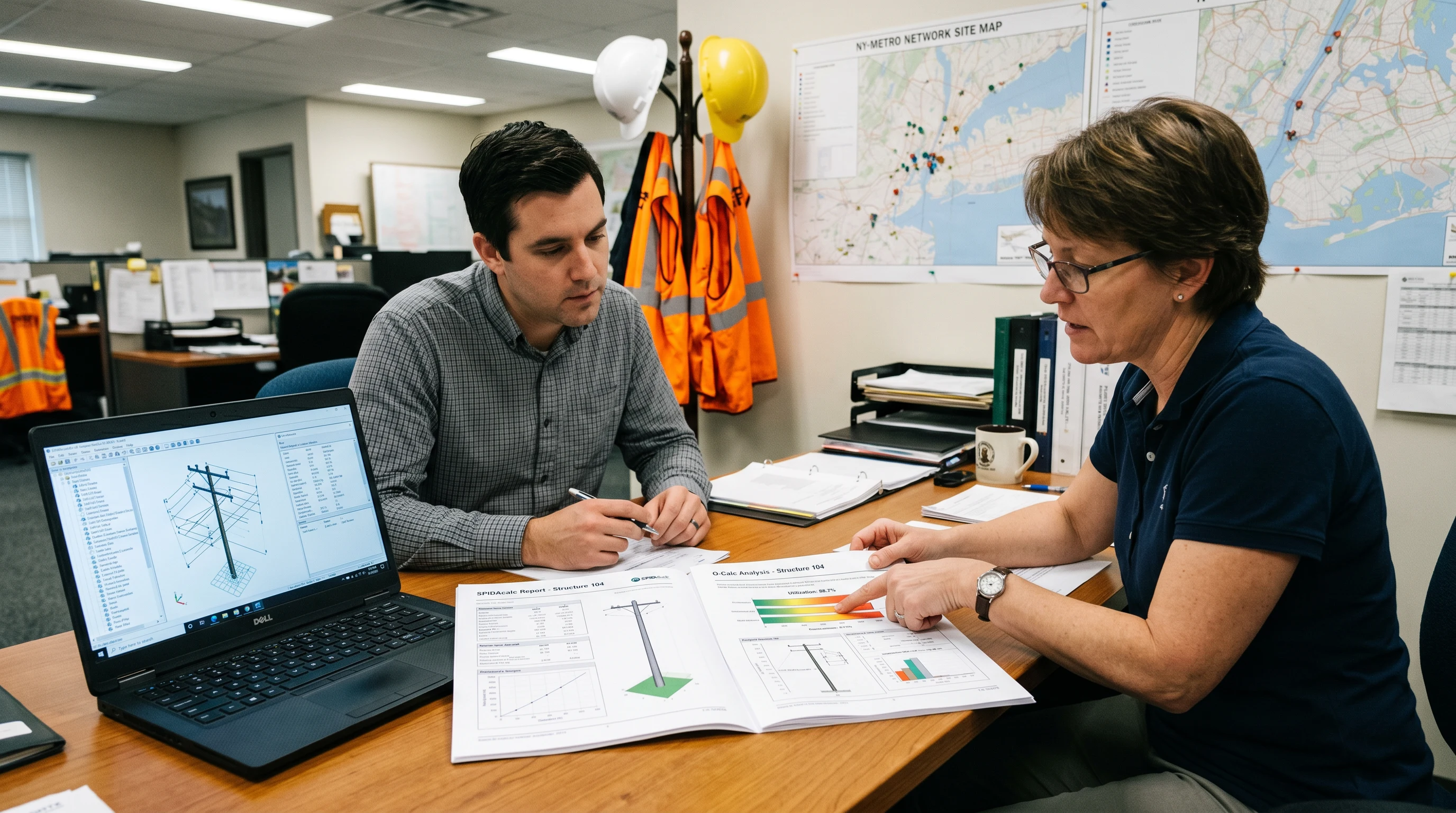
Once field data is in, the engineering team builds structural models for each pole — one model per structure — using software like SPIDAcalc or O-Calc Pro. Each model accounts for the existing attachments, the proposed new attachment, wind loading based on the NESC district for the project geography, and the pole's rated strength. The output is a pass/fail result with a utilization percentage — how close the pole is to its structural limit under the governing load case. Poles that fail require make-ready: either transfer or removal of existing attachments, or in some cases full pole replacement.
Deliverables from a qualified firm should include stamped PDF reports for each pole, the native model files (O-Calc .xml or SPIDAcalc .json — more on why the native files matter in a moment), and a summary spreadsheet with pole IDs, pass/fail status, utilization percentages, and recommended make-ready scope. Some utilities also require GIS outputs with pole coordinates and status attributes tagged to your network layer. Know what your utility requires before you finalize scope with the firm.
Timeline per batch — typically 40 to 60 poles at a time, though this varies by project — runs 3 to 5 business days from receipt of clean, complete field data to delivery of stamped reports. That's for straightforward aerial fiber attachment scenarios. Complex poles requiring replacement analysis, multi-party attachment coordination, or expedited turnaround will extend that window. Rush delivery — 48-hour turnaround — is possible but typically adds 30 to 50 percent to the per-pole cost. If a firm promises 24-hour turnaround on a 100-pole batch at standard pricing, that's a red flag, not a selling point.
Questions to Ask Before You Hire Anyone
These aren't hypothetical conversation starters. They're the actual questions that separate firms with real operational depth from firms that look good on a website.
What software do you use, and can you provide the native model files?
The answer to the native files question matters as much as the software answer. PDF reports are the human-readable output. But many utilities want to load your model in their own software and verify the inputs — especially on contested poles or poles that are borderline pass/fail. If the firm won't deliver native files, or if they say they can't because of proprietary data concerns, that's a constraint you need to understand before the project starts. Not a dealbreaker, but something that could cause friction during utility review. The O-Calc Pro vs SPIDAcalc comparison covers the technical differences between each tool's file format and interoperability in more detail.
Are your stamping engineers licensed in my project state?
This is non-negotiable. Engineering stamps are jurisdiction-specific. A PE licensed in Georgia can't stamp work in Virginia — it's that simple. Firms that have broad state coverage maintain licenses across multiple states, which is an ongoing investment. Ask for the specific PE's license number and verify it yourself through the state licensing board. It takes five minutes and it's worth doing.
What's your first-submission approval rate?
A good firm knows this number. It should be above 88 percent on first submission. Rates below that suggest systemic modeling errors, QC gaps, or insufficient familiarity with the receiving utility's specific requirements. Some variance by utility is expected — certain utilities have more demanding review standards or quirky submittal requirements. But if a firm can't give you a number, or gives you one that sounds suspiciously perfect, push them for specifics.
Have you worked with this utility before?
Utility-specific familiarity matters more than people expect. Every utility has its own joint-use tariff, its own preferred make-ready application format, its own quirks about what gets flagged during review. The NJUNS pole attachment application process, for example, has specific data requirements that vary by utility even within the same platform. A firm that's run analysis for Duke Energy Carolinas before knows what Duke's engineering team will push back on. That institutional knowledge is worth real money in avoided resubmittals.
What's your process when field data has gaps or inconsistencies?
It always does. Field data is never perfect. The question is whether the firm flags the gaps and resolves them before running analysis, or whether they make assumptions and bury them in the model. The good answer is: they have a defined QC process where incomplete or inconsistent field records are flagged to the client, with specific questions, before the model is built. The bad answer is: they just make conservative assumptions and run it. Conservative assumptions can generate unnecessary make-ready on poles that don't actually need it — and that cost falls on you.
What Separates Firms That Get Permits Approved
There's a difference between a firm that does pole loading analysis and a firm that gets pole loading analysis through utility review. The gap isn't always visible in the proposal stage. It shows up in the resubmittal queue.
Modeling rigor on existing attachments
The most common source of rejected analyses isn't wrong math. It's wrong inputs. Specifically: existing attachments that are modeled incorrectly or not at all. Utilities know their own infrastructure. If your analysis models a pole as having three existing attachments when the utility's records show five, the discrepancy gets flagged immediately. This is exactly why field data quality — and the firm's discipline in verifying field data against utility records where possible — determines first-submission outcomes more than software capability does.
The relationship between field data accuracy and analysis quality is the core reason that pole loading analysis with O-Calc Pro or any other platform only works as well as the upstream data collection process. Garbage in, garbage out — regardless of which tool's name is on the license.
Correct NESC loading district assignment
NESC loading districts — Heavy, Medium, Light, and Extreme Ice with Concurrent Wind — are geographically defined. The district determines the design wind speed, ice load, and temperature assumptions that drive the structural analysis. Getting this wrong doesn't just affect the math; it can result in analyses that pass poles that should fail, or fail poles that should pass. Both outcomes are bad. A misapplied loading district on a project in upstate New York — where Heavy loading applies — will produce analyses that systematically understate structural demand. That kind of systematic error can pass utility review initially and then cause problems when a storm event produces the loading conditions the analysis never accounted for.
Understanding NESC pole loading compliance for fiber attachments is non-negotiable for any firm doing this work seriously. Ask how they determine the loading district for a project, and verify that their answer matches the actual NESC geographic maps for your project area.
QC before stamping, not after
The PE stamp is the last step, not the only quality control step. Firms with real QC processes have an internal review layer before work reaches the stamping engineer — a senior engineer or QC lead who checks the model inputs against the field data, verifies the loading district, confirms the framing unit assignments, and reviews any borderline poles for consistency. Firms without that layer are relying on the stamping engineer to catch everything, which is too much to ask from one person reviewing a 60-pole package under time pressure.
SPIDAcalc vs O-Calc — Does It Matter Which the Firm Uses?
For most standard telecom fiber attachment work, it doesn't matter much — provided the firm is genuinely proficient with whichever tool they use and the output format is acceptable to your utility. Both SPIDAcalc and O-Calc Pro implement NESC loading calculations correctly. Both produce reports that major utilities accept. The engineering math isn't different.
It matters in two specific cases. First: if the utility specifies which software they'll accept, or if they want to verify models in their own software instance. Some utilities — particularly in the Midwest and Pacific Northwest, where SPIDAcalc has deeper penetration in utility engineering departments — explicitly require SPIDAcalc deliverables for certain project types. Check the utility's joint-use tariff before assuming your firm's preferred tool will work. Second: if your project involves pole replacement analysis where multi-pole line section interactions affect the structural conclusion, SPIDAcalc's line-design architecture is better suited to that analysis than O-Calc's single-pole model.
For the full technical breakdown of where each tool fits, see our O-Calc Pro vs SPIDAcalc comparison. The short version: tool proficiency matters more than tool choice for the vast majority of telecom attachment work.
Red Flags That Tell You to Keep Shopping
Some of these are obvious. Some aren't.
- No PE on staff — work is "reviewed by" a PE externally. This is a liability structure that benefits the firm, not you. When something gets rejected or challenged, the accountability chain gets murky fast. You want the stamping PE to be employed by or formally contracted to the firm, with clear responsibility for the work product.
- They quote per-pole pricing without asking about project complexity first. Flat per-pole rates are a sign that the firm isn't thinking carefully about your specific project. A 45-foot wood distribution pole with one existing telecom attachment is not the same engineering problem as a 65-foot steel transmission adjacent structure with six existing attachments and a proposed overlash. Pricing should reflect that difference.
- They can't name a specific utility they've successfully submitted to in your state. Vague references to "extensive utility experience" don't help you. The question is specific: have you submitted to this utility, do you know their requirements, and what was your approval rate?
- Turnaround guarantees that aren't tied to field data quality conditions. Any firm guaranteeing 3-day turnaround without qualifying that guarantee against receipt of complete, clean field data is setting you up for disappointment. Or they're planning to make assumptions that will come back as resubmittals.
- They can't produce sample deliverables from a comparable project. This is the clearest test. Ask for a redacted sample report package from a project similar to yours — similar pole count, similar utility, similar project type. If they can't or won't produce one, that tells you something.
Cost of getting it wrong: Remediation after a rejected analysis — remodeling flagged poles, correcting stamped reports, resubmitting through the utility's queue — typically runs $340 to $580 per affected pole by the time you factor in engineering rework, administrative coordination, and the schedule cost of waiting through a second review cycle. On a batch where 23 poles need rework, that's $7,820 to $13,340 in direct cost, plus whatever delay-related costs your construction schedule absorbs.
Understanding Make-Ready Engineering Timelines and Costs
Pole loading analysis is one piece of a larger workflow. The analysis results determine what make-ready is required before your attachment is permitted — and the make-ready scope directly determines your project's timeline and cost.
A pole that fails structural analysis needs remediation before you can attach. That remediation might be as simple as a single transfer of an existing attachment to a lower height — a few hours of work. Or it might require a full pole replacement, which involves coordinating with the utility, potentially with other attachers on the pole, and scheduling a line crew. Full pole replacements typically take 60 to 90 days from identification to completion in utility-coordinated scenarios, and that timeline doesn't start until the analysis is complete and the make-ready application is approved.
This is why first-submission quality matters so much — and why make-ready engineering timelines for fiber deployment are so sensitive to analysis accuracy. An 8-week delay caused by resubmittals at the beginning of the process can push pole replacement work into weather windows that further extend the schedule. Understanding make-ready cost per pole in your project budget is essential before you finalize your deployment financial model.
The cost math compounds fast. Projects that underestimate make-ready scope — because the analysis was done quickly and conservatively, or because field data was incomplete — regularly come in 18 to 31 percent over their original make-ready budget. That's a meaningful number on a 400-pole build.
What Draftech Delivers and How to Reach Us
Our pole loading analysis services run both O-Calc Pro and SPIDAcalc. We match the tool to the project, the utility, and the deliverable format — not to whatever we happen to have open. We're currently active in 22 states and available to deploy across all 50 U.S. states.
Our stamping engineers are PE-licensed across multiple state jurisdictions, and we maintain active licenses in the states where we run the most volume. We don't farm out the stamping to a third-party reviewer — the PE is part of our team and is accountable for the work product from the model build through the final stamp.
Our first-submission approval rate across all utility jurisdictions in the past 12 months is 91.4 percent. On projects where we have prior utility-specific experience — Duke Energy, Dominion Energy Virginia, Ameren, Consumers Energy, among others — that rate is higher. On utilities we haven't worked with before, our first step is always to pull the utility's joint-use tariff and make-ready application requirements before we start modeling, not after the first rejection teaches us what they need.
We deliver native model files with every project — not just PDFs. If a utility reviewer wants to open your models and verify inputs, they can. We consider that transparency a baseline, not a premium offering.
For a project quote or to talk through scope and timeline, reach out at info@draftech.com. Tell us the utility, the state, the approximate pole count, and when you need to submit. That's enough for us to give you a realistic picture of timeline and cost without a long discovery process.