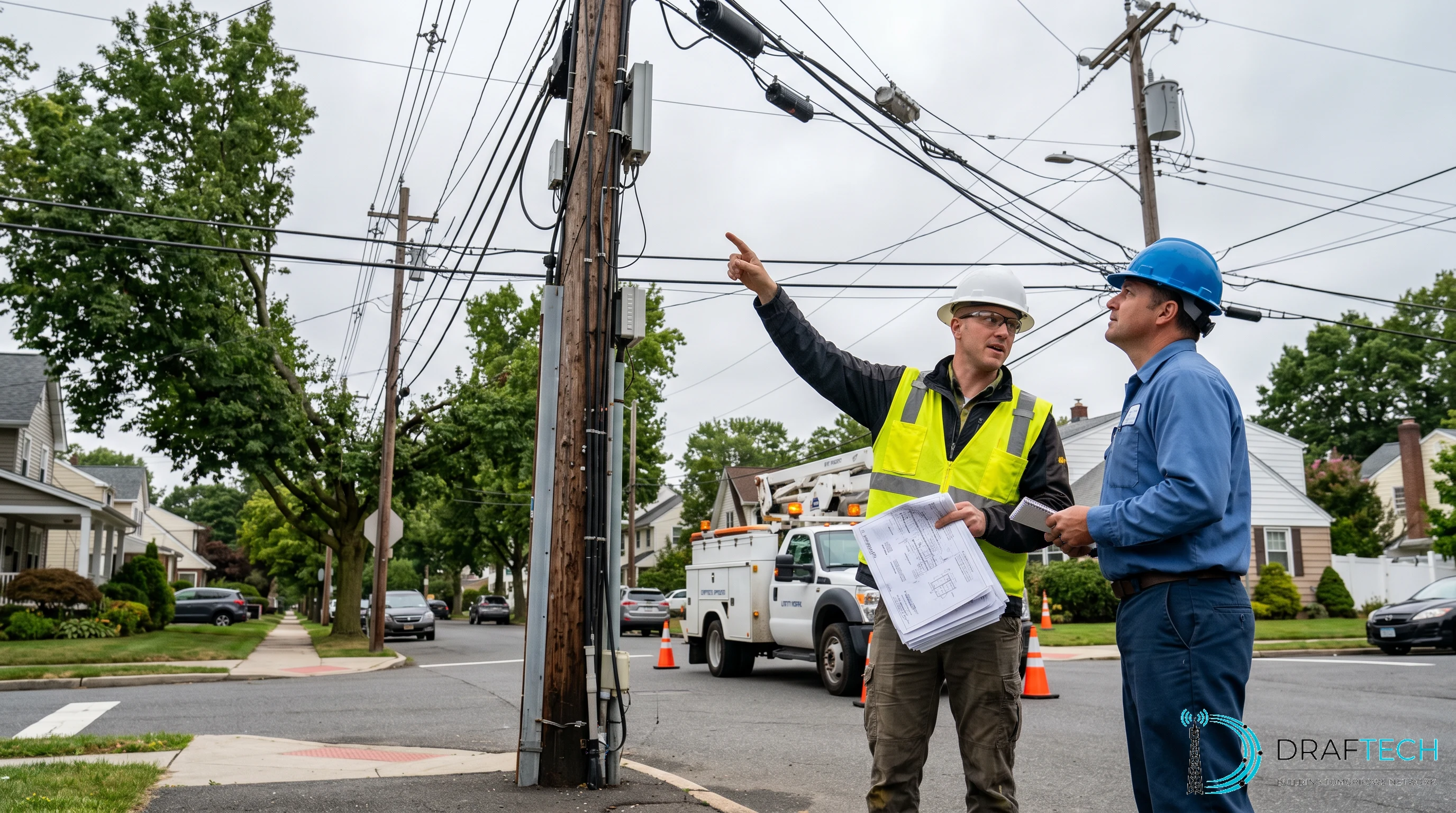
Utility coordination is the part of fiber construction that doesn't get talked about enough — until it stops a project cold. I've watched a well-planned 12-mile underground build get frozen for 6 weeks because a gas transmission company wouldn't respond to a conflict resolution request. The schedule showed that route as the critical path. Nobody had built in time for a non-responsive utility owner.
That's not an unusual story. It's close to a typical one for large underground fiber projects in mature metro markets where the subsurface is already dense with infrastructure from the last 80 years of utility construction.
Utility coordination for fiber isn't a box to check on a project checklist. Done right, it's an engineering discipline — one that directly determines whether your construction crews hit the ground on schedule or spend weeks waiting for a conflict to be resolved that should have been identified and addressed in design.
What Utility Coordination Actually Covers
The term means different things to different people. Contractors sometimes use it to mean "we called 811." That's the minimum floor. Real utility coordination on a fiber project covers four distinct domains:
Underground conflict identification — mapping every point where the proposed fiber route intersects existing underground infrastructure, determining horizontal and vertical clearances, and identifying where conflicts require route modification, protective measures, or formal utility agreements.
Overhead conflict identification — on aerial fiber routes, documenting every crossing and parallel run with electric lines, evaluating clearance compliance under NESC, and determining make-ready requirements before fiber can be attached. See our breakdown of NESC pole loading compliance for fiber attachments for what's required structurally on the aerial side.
Joint trench and joint build coordination — when another utility is opening a trench in the same timeframe, negotiating a cost-sharing arrangement to pull fiber while the trench is open. This can reduce underground fiber costs by 40–65% per linear foot on shared segments.
Formal conflict resolution — when the proposed route can't avoid a significant conflict, coordinating with the utility owner on the resolution method, who does the work, and who pays. This is where project schedules go to die if it isn't managed aggressively.
The utility coordination service our team provides covers all four domains, starting from design review through construction completion. That's important because conflicts discovered in the field — rather than in design — cost 4–8x more to resolve and add weeks to the construction timeline.
811 Locates — What They Tell You and What They Don't
Every state has a one-call system. Call before you dig. 811 is federal law under the Pipeline Safety Improvement Act, and state one-call laws add their own requirements and penalty structures. I'm not going to spend time on why you should call 811 — that's not where the interesting engineering problem is.
The interesting problem is understanding what 811 locates don't tell you. And the list is significant.
811 locates identify facility presence within an approximate horizontal zone — typically plus or minus 18 to 24 inches from the marked centerline under most state laws. They don't give you depth. They don't tell you whether two facilities cross each other at the same elevation. They don't flag facilities that were installed before the one-call system existed or by owners who aren't members of your state's one-call authority. And they expire — most states require re-notification if your ticket is more than 45 days old and you haven't started work.
In older urban markets, this last point matters a lot. We've worked on routes in downtown Philadelphia and Memphis where there were active gas distribution lines that weren't in the one-call database because they predated the one-call system and the owning utility had never registered them. The only way to know they exist is to review historical as-built records from the utility — which requires a formal request, not a 811 ticket.
Standard practice for underground fiber in dense urban areas: Request as-built records from every utility owner with facilities in the project corridor before design is finalized, not after. Most utilities have a formal records request process — it typically takes 2–3 weeks and costs nothing. Waiting until you're in the field to discover a 14-inch water main that wasn't marked is a change order and a delay you don't need.
For BEAD-funded projects specifically, the requirements go further. NTIA and most state broadband offices require documented utility coordination as part of the project closeout package. Treating it as a construction-phase activity rather than a design-phase activity creates a documentation gap that can delay grant disbursement. See our guide on BEAD engineering requirements for 2026 for the full compliance context.
Conflict Identification and the Conflict Matrix
Once you have locate data, as-built records, and field verification, the work of conflict identification begins. On a simple rural route through open land, this might be a 2-hour desktop exercise. On a 3.7-mile underground route through a Chicago suburb with 47 years of utility construction layered in the ROW, it takes a week of dedicated engineering review.
A conflict matrix is the standard deliverable from this process. It's not complicated — a spreadsheet or table that lists every conflict point with:
- Location (station number or coordinates)
- Conflicting utility type, owner, and estimated depth
- Conflict type (crossing, parallel, underclearance)
- Proposed clearance at designed depth
- Required clearance per NESC or applicable code
- Resolution method (reroute, bore, protection slab, depth increase, utility relocation)
- Responsible party for resolution work
- Status (open / in progress / resolved)
The matrix isn't just a design document — it's a coordination tracking tool that follows the project through construction. During construction, as conflicts are encountered and resolved in the field, the matrix gets updated. On projects with 30+ conflicts, the matrix is what keeps the project manager from losing track of which resolutions have been confirmed and which are still waiting for a utility owner response.
For projects under state DOT permits, a conflict matrix is typically a required submittal. Some state DOT offices have their own required formats — Florida DOT, TxDOT, and PennDOT each have specific utility conflict resolution documentation requirements. Not following the required format delays permit approval. It's a small thing that causes a disproportionate number of schedule problems.
What the Common Conflict Types Actually Look Like
Gas distribution crossings are the most common underground conflict on suburban fiber routes. The standard resolution is directional boring underneath, with a minimum 24-inch vertical clearance. Boring adds $8–$22 per linear foot versus open trench — not catastrophic, but it adds up when you have 37 gas crossings on a 5-mile route.
High-pressure gas transmission crossings are a different situation entirely. These aren't distribution lines — they're interstate or intrastate transmission pipelines operating at pressures up to 1,500 psi, with federal regulation under 49 CFR Part 192 and state PUC requirements on top. A crossing near a high-pressure gas transmission line requires a formal agreement with the pipeline operator, their engineering review and approval, and often a third-party inspection during the actual crossing. Timeline: 8–16 weeks minimum. Budget for it or plan around it.
Existing telecom duct banks in congested urban markets are a coordination challenge of a different kind. You're not trying to avoid them — you might be trying to use them, or at minimum run parallel to them with minimum separation. The conflict isn't safety-driven; it's about access rights, interference with existing service, and negotiating use of existing conduit capacity rather than trenching parallel. That's a business negotiation as much as an engineering one.
Joint Trench and Joint Build Agreements
Joint trench is one of the most underused tools in fiber deployment cost management. If a gas utility, electric cooperative, or water authority is opening a trench in the same corridor during the same construction window, sharing that trench drops your cost per linear foot dramatically. The economics are simple: trenching is 60–70% of underground fiber installation cost. If someone else is paying for the trench, your cost per foot drops to conduit, fiber, and labor for pulling and splicing.
I've seen joint trench agreements cut underground fiber costs from $68/foot to $19/foot on rural routes where an electric co-op was building a parallel distribution circuit. That's the kind of cost difference that changes the business case for an entire project.
But joint trench agreements don't happen automatically. They require proactive outreach to utility owners — ideally 6–9 months before you're ready to break ground — because the other utility's construction window needs to align with yours. You can't call a water authority in March and expect them to delay a sewer replacement project until your fiber schedule catches up in August.
The formal agreement needs to cover:
- Cost-sharing formula — who pays for trench, who pays for their own conduit and facilities
- Separation requirements and physical arrangement in the trench
- Access rights after construction — who can access the trench for repairs, and under what terms
- Liability allocation for damage to each party's facilities during and after construction
- Indemnification for third-party claims
The legal review alone takes 3–5 weeks. If you're planning a joint trench on a compressed schedule, start the agreement process before design is final.
Aerial Utility Coordination — The Overhead Side
Underground coordination gets more attention, but aerial coordination is equally important and often underestimated for projects with significant aerial fiber segments.
Aerial fiber that crosses or parallels electric transmission lines has NESC clearance requirements that govern not just the crossing height but the cable sag curve across the entire span. A clearance that passes at 60°F installation temperature may not pass under NESC Heavy loading at 0°F if the fiber cable sag increases significantly under ice load. Getting this right requires actual sag-tension calculations, not just checking the crossing height on a design drawing.
For aerial fiber alongside distribution electric lines on shared poles — which is the default configuration for FTTH builds on existing utility poles — the coordination challenge is make-ready engineering. Make-ready identifies and resolves the existing pole attachment issues that prevent fiber from attaching at the required height with required clearances. The pole loading component of that was covered in our O-Calc Pro pole loading analysis guide. The coordination component is where utility owner response times become the schedule driver.
Most electric utility owners require 45–90 days to perform their own make-ready work on poles where they need to move or adjust their own attachments. Some utilities in rural markets are responding in 120+ days. That timeline sits on the critical path of your fiber construction schedule — it can't be compressed unless the utility agrees to expedited crews, which they rarely do without premium fees.
Where make-ready delays compound: If the pole loading analysis identifies that 38 of 270 poles on a route need make-ready before fiber can attach, those 38 poles don't have to be consecutive to hold up the whole project. If they're distributed throughout the route — say, one every 1.3 miles on average — your construction crew can't operate efficiently between them. The wait for make-ready completion on the blocking poles creates a stop-start pattern that hurts productivity across the entire route.
How Utility Coordination Delays Kill Project Schedules
Let me be direct about this: utility coordination is the most common source of schedule overrun on underground fiber projects. Not design errors. Not construction problems. Utility conflicts that weren't identified early enough, or that were identified but not tracked and resolved proactively.
There are three patterns we see repeat themselves:
Pattern 1: Late conflict discovery. Design is completed and permitted without complete as-built records from utility owners. Construction begins. A crew hits a 20-inch water main at 48 inches depth — 6 inches shallower than what the locate showed — exactly where the fiber conduit is designed to run. Work stops. Emergency excavation to expose the conflict. Redesign of a 300-foot segment. New bore quote. Two weeks of delay minimum, $18,000–$45,000 in unplanned cost.
Pattern 2: Non-responsive utility owners. Conflict is identified in design. The utility owner is notified and asked to respond with resolution options or a relocation plan. They don't respond within 30 days. Then 60 days. Construction is approaching that segment. The project manager escalates. The utility owner's engineering department says they're backlogged. That segment gets built around if possible, or construction skips ahead to unaffected segments while the conflict sits. In the worst case, it becomes a dispute about who's responsible for the resolution cost and schedule impact.
Pattern 3: Utility relocation underestimated. A conflict requires the existing utility to be relocated. The utility owner agrees to relocate. Their crews arrive on site and discover that the relocation they agreed to is more complicated than the drawings showed — there's a service connection they didn't know about, or the pipe joint is in worse condition than expected. The relocation takes 3 weeks instead of 5 days. Construction has been scheduled around a 5-day window.
The way to mitigate all three patterns is the same: start utility coordination earlier than feels necessary, track every open item on the conflict matrix weekly, and push for written resolution commitments before mobilizing construction in each segment. Related scheduling challenges in permitting and right-of-way are covered in our guide to ROW permitting delays in fiber deployment — utility coordination and ROW permitting are separate tracks that often have overlapping bottlenecks.
On BEAD and rural broadband projects specifically, utility coordination complexity is often underestimated in grant applications. Rural routes may seem simpler, but agricultural irrigation systems, rural electric cooperative infrastructure, and aging municipal water systems in small towns often have the worst record-keeping of any market segment — which means the highest risk of late conflict discovery. Accurate as-built records are a luxury in rural America.
Our utility coordination services include conflict matrix development, utility owner outreach, joint trench negotiation, and construction-phase conflict tracking — for projects ranging from single-municipality FTTH builds to multi-state OSP programs. Reach us at info@draftech.com or through our OSP engineering services page.