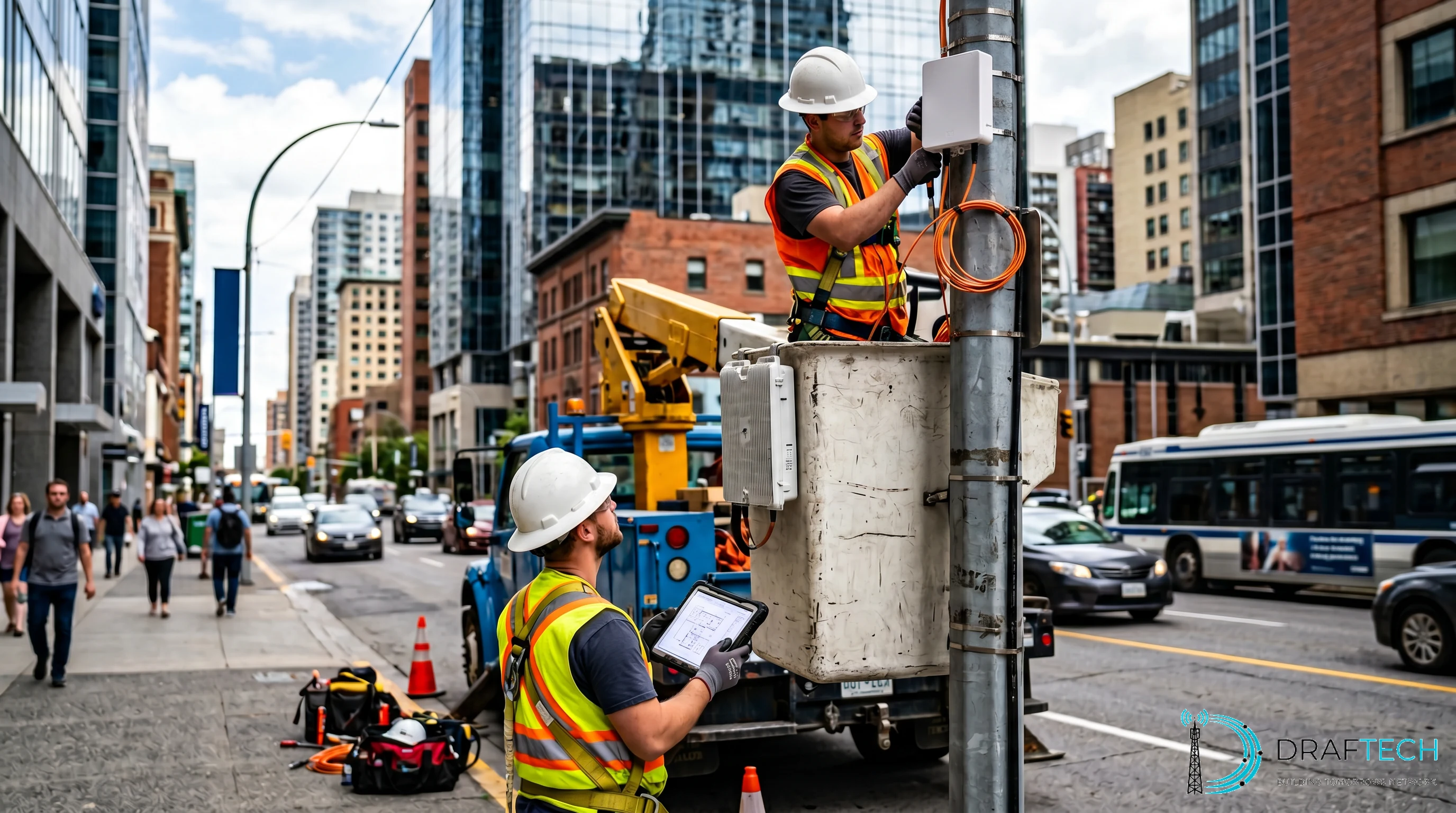
Small cell 5G fiber backhaul is one of those problems that sounds simple until you're trying to solve it in a real city. You've got 47 nodes in a 2.3-mile urban corridor. Each one needs fiber within 500 feet. Half the poles are municipal streetlights. A third of the block faces have no conduit — not in a conduit bank, not in an innerduct, nothing. And the carrier wants the whole route lit in 11 months.
That's not a hypothetical. That's the kind of project brief our small cell OSP engineering team works through regularly. The 5G densification wave that started rolling in 2019 hasn't slowed down — it's accelerated, and the fiber infrastructure behind it is where the real engineering complexity lives.
This isn't a marketing overview of 5G. You don't need another one of those. What you need is a field-tested breakdown of how small cell fiber backhaul design actually works — the routing decisions, the conduit strategy, the pole attachment requirements, and where projects consistently go wrong.
Fronthaul vs. Backhaul: Why the Distinction Matters for OSP Design
The terms get used interchangeably in RFPs. They're not interchangeable. Confusing them causes real design problems downstream.
Backhaul carries aggregated user traffic between the small cell base station and the carrier's transport network — typically a router or DWDM platform at a macro site or a carrier-neutral fiber hub. Bandwidth requirements are real but manageable. A single 5G NR small cell node on mid-band spectrum might generate 2–4 Gbps of backhaul traffic at peak. Latency requirements are modest by optical standards — under 10 milliseconds round-trip is typical.
Fronthaul is different. In distributed RAN architectures, the radio unit (RU or RRU) lives on the pole. The distributed unit (DU) or baseband unit (BBU) sits in a hub site — sometimes a building basement, sometimes a purpose-built edge data center. The fiber between them carries C-RAN fronthaul traffic, which has timing requirements that can be punishing. eCPRI fronthaul needs sub-100-microsecond one-way latency in many implementations. That's roughly 20 kilometers of fiber maximum, with no margin for unnecessary splices or fiber detours.
The OSP design implication: Fronthaul fiber routes must be short, direct, and splice-minimized. If your hub site is 6 kilometers from the edge of your small cell cluster, you're already using 60% of your fiber latency budget before you've installed a single node. Backhaul fiber has much more routing flexibility — you can loop it through an existing conduit system even if the path isn't direct. Fronthaul can't take that detour.
Many projects don't clarify which architecture they're deploying until the fiber design is half-done. Get that answer up front. It changes your routing constraints substantially.
Fiber Route Selection for Small Cell Networks
Route selection for small cell backhaul follows the same fundamentals as any OSP fiber design — but the scale and density add complications you don't see on a typical FTTH build. On a residential FTTH project, you're running fiber down a street and serving houses on both sides. On a dense urban small cell build, you might have 12 nodes within a 4-block area, each at a slightly different attachment point, with different conduit access situations, different pole owners, and different permitting requirements.
The first question is aerial versus underground. Where existing strand or aerial conduit exists and pole owners are cooperative, aerial lash is the fastest and cheapest path. Expect $18–$32 per foot for aerial fiber including strand, installation, and make-ready engineering. Underground in a city with existing telecom conduit runs $28–$55 per foot if you can get access. New trench in an urban core is $150–$450 per foot, sometimes higher in areas requiring saw-cutting or special backfill — which is why that option only makes sense when nothing else exists.
Most urban small cell builds end up as a hybrid. The main feeder route runs underground in existing conduit or via aerial where conduit is absent. Distribution from the main route to individual nodes goes aerial where possible, underground where the node location doesn't have an aerial path. Designing that hybrid cleanly — with clear splice point placement and consistent fiber management — is where the skill is.
For the small cell 5G engineering service, we plan the fiber route around three priorities in order: existing infrastructure that can be accessed, pole routes where make-ready is feasible without unusual structural challenges, and new trench as the last resort. In some cities, especially older Northeast markets, there is almost no usable existing conduit, and you're looking at microtrenching or conventional trench for the entire run. See our breakdown of microtrenching vs. traditional trenching for fiber for a detailed cost comparison.
Hub Site Selection Drives the Entire Network
Where you put your fiber hub or aggregation point determines your maximum backhaul distance and constrains your routing options. Carriers don't always choose hub sites with OSP engineering in mind. We've seen hub sites selected based on real estate availability, not fiber path practicality — resulting in routes that require 3 miles of new trench because the hub is on the wrong side of a rail yard or river that neither aerial nor existing conduit can cross easily.
If you have any influence on hub site selection early in a project, use it. A hub site 0.7 miles closer to the center of the node cluster can reduce total fiber trench by 40% and shave 6–8 weeks off the construction schedule.
Conduit Sizing and Fiber Count Strategy
Small cell backhaul conduit sizing is a place where overengineering the present causes under-engineering the future — and vice versa. There's real tension between minimizing upfront cost and not having to re-trench in 5 years when the carrier densifies again.
Our standard small cell conduit package for new trench is 2-inch HDPE with two 1-inch subducts. One subduct carries the initial fiber deployment. The second is reserved. This adds roughly $1.20 per foot to the trench cost and has saved clients from re-trenching in two projects I can recall off the top of my head — both in markets where 5G densification in year 3 required node counts that weren't anticipated at the original build.
Fiber count strategy depends on the network architecture:
- Point-to-point backhaul: 12-fiber per node is sufficient for current capacity. 24-fiber per node if the carrier anticipates adding a second sector or upgrading to multi-band in the same deployment window.
- Ring or aggregation topology: 96-fiber to 144-fiber on the trunk. The trunk serves multiple nodes, so fiber count needs to account for current assignments, redundancy paths, and growth capacity — typically 3x the current assignment minimum.
- C-RAN fronthaul: 24-fiber per node minimum. eCPRI fronthaul consumes fiber pairs fast — a 4T4R radio head uses 2 fiber pairs per sector, and some architectures require additional pairs for management and timing. Don't design fronthaul routes on 12-fiber; you'll run out before you finish a single cluster.
The fiber itself should be standard G.652.D single-mode throughout. Don't let anyone talk you into OM3 or OM4 multimode for small cell backhaul — the distances and transceivers being deployed today don't benefit from it, and multimode limits your upgrade path for higher-speed optics.
Pole Attachment and Structural Requirements for Small Cell Nodes
A small cell node isn't just a fiber termination point. It's a physical structure attached to a pole or streetlight — a radio unit, antenna, power supply, and often a fiber junction enclosure, all mounted at height, all subject to wind and ice loading. And that means the poles need to be evaluated structurally.
Small cell nodes can weigh anywhere from 28 to 85 pounds complete, with wind sail areas between 0.8 and 2.4 square feet depending on the equipment vendor and configuration. On a Class 4 wood pole already carrying electric conductors and existing telecom attachments, adding that load at 25 feet above ground can be the difference between a passing pole loading analysis and a make-ready requirement. See our guide on pole loading analysis with O-Calc Pro for the full structural evaluation methodology.
Municipal streetlight poles are a separate issue. They're typically steel and engineered to a different standard than wood utility poles — but that doesn't mean they have unlimited capacity. Many cities require a structural analysis from a licensed PE before approving small cell attachment to city-owned streetlight infrastructure. The analysis methodology is similar but uses the pole manufacturer's structural data rather than NESC wood pole tables. Budget 2–4 weeks for that process per municipality, and get the structural data from the city's public works department early — they sometimes can't find it.
One thing that catches carriers off guard: Municipal pole attachment agreements often don't allow the carrier's fiber to share the streetlight conduit that runs from the base of the pole to the underground power supply. That conduit is for power only. You need a separate riser conduit for fiber, which means a separate permit for the underground portion even if the aerial attachment is already approved. We've seen 3-week delays on individual nodes from this specific issue in Chicago and Dallas.
OTMR and Small Cell Make-Ready
One-Touch Make-Ready (OTMR) rules, where applicable, can significantly accelerate small cell deployment on existing utility poles by allowing the new attacher to perform rearrangements themselves rather than waiting for each existing attacher to schedule their own crews. But OTMR availability varies by state and utility owner — and the rules for what qualifies as OTMR work versus work that must be performed by the existing attacher aren't always clear. See our guide on One Touch Make-Ready for fiber for a detailed breakdown of what qualifies and what doesn't.
Permitting Timelines and Jurisdictional Complexity
Small cell permitting is where projects die. Not slowly — sometimes fast, when a municipality imposes a de facto moratorium by simply not responding to applications within the statutory shot clock period, then claims administrative difficulty.
The 2018 FCC Small Cell Order set 60-day shot clocks for applications involving attachment to existing infrastructure and 90-day shot clocks for new pole applications. States with their own streamlined siting laws — California AB 57, Texas SB 1004, Florida SB 596 — add additional layers. Some municipalities comply strictly. Others require litigation to enforce the clock. A project that looks like 11 months on paper can become 18 months when 6 of 47 nodes are stuck in a jurisdiction that won't process permits.
The way to manage this is to treat permitting as a parallel track from day one, not something that starts after design is complete. We submit permit applications as design packages are finalized, site by site, rather than batching the entire project. That way, while design is being completed on nodes 30–47, permits for nodes 1–15 are already running the shot clock. This approach typically saves 8–14 weeks on a 40+ node project.
This is closely connected to the broader fiber permitting and ROW services work our team handles — the small cell context just adds wireless-specific federal preemption layers on top of standard ROW permitting complexity. And the delays from permitting bottlenecks mirror what we cover in our breakdown of ROW permitting delays in fiber deployment.
Railroad and Highway Crossings
If any of your small cell fiber routes cross a railroad right-of-way or a state or federal highway, you're adding a separate permit track entirely. Railroad crossing permits for fiber typically take 90–180 days and require the railroad's engineering approval in addition to standard permits. Highway crossings under state DOT jurisdiction vary from 30 days to 6 months. We've had projects where a single railroad crossing was on the critical path for the entire network build. See our full guide on railroad crossing permits for fiber for the specific requirements by Class I railroad.
What Fiber Backhaul Actually Costs Per Node
The range is wide enough that quoting an average is almost useless. But I'll do it anyway, with the important context.
| Scenario | Fiber Access Method | Est. Cost Per Node |
|---|---|---|
| Existing conduit available, good condition | Pull new fiber in existing conduit | $8,000 – $18,000 |
| Aerial strand on shared route | Overlash on existing strand | $14,000 – $28,000 |
| No conduit, aerial feasible | New aerial, new strand | $22,000 – $42,000 |
| Urban underground, no conduit | Microtrenching or directional boring | $35,000 – $95,000 |
| Dense urban, full-depth trench | Open trench, restoration | $60,000 – $140,000 |
These numbers include fiber, conduit or strand, installation, splicing, and make-ready engineering. They don't include the small cell equipment itself, power, or the radio unit — those are carrier costs. And they don't include permitting fees, which can range from $200 per site in cooperative municipalities to $2,500+ in cities with individual site review fees.
The largest variable in that range is labor market. A small cell project in the San Francisco Bay Area costs 40–60% more than the same project in Tulsa, for the same physical work, purely because of labor rates, prevailing wage requirements, and restoration cost after trenching in high-cost paved environments.
On any project above 15 nodes, we run a cost model before design begins — mapping existing infrastructure assets, estimating make-ready requirements, and flagging the high-cost nodes early so the carrier can make an informed decision about which nodes to proceed with and which to defer.
If you're scoping a small cell 5G fiber backhaul project and need experienced small cell OSP engineering, our team operates across 22 active states and is available to deploy across all 48 continental U.S. states. Reach us at info@draftech.com.