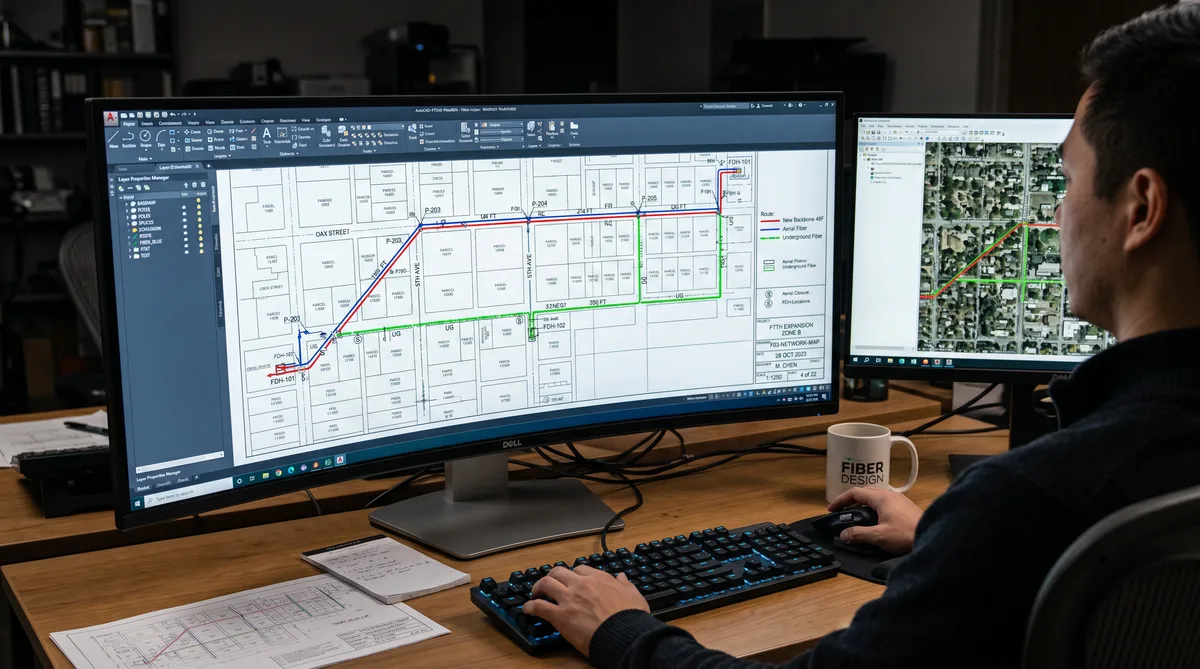
Middle-mile fiber is the part of the network nobody talks about until it's the reason a last-mile project falls apart. You can design the most efficient FTTH distribution in the world — splitter ratios dialed in, FDH cabinets sized perfectly, drop distances accounted for — and none of it matters if the backbone feeding it can't handle the traffic or doesn't reach where you need it.
I've watched three BEAD-funded ISPs in the last year hit the same wall: they won subgrant awards, completed last-mile HLD, and then realized there was no middle-mile fiber connecting their service territory to the nearest internet exchange. One of them in western Kansas had to add 67 miles of backbone fiber to their scope. That wasn't in the original budget.
Middle-Mile vs Last-Mile: Where the Confusion Starts
The terms get thrown around loosely. Here's the distinction that matters for design. Middle-mile is everything between the internet backbone — a data center, an internet exchange point, a carrier hotel — and the local distribution point where last-mile begins. It's the trunk line. The highway before the exit ramps.
Last-mile is the exit ramp to the house. Distribution cable, drop cable, the ONT on the side of the building. Most engineering firms spend 90% of their design energy here because that's where the customer count lives. But middle-mile capacity sets the ceiling for everything downstream.
A 288-fiber middle-mile backbone can support roughly 18,000 to 25,000 GPON subscribers depending on your split ratios and wavelength plan. Run 144 fibers instead and you've cut your long-term capacity in half — for a cable cost difference of maybe $0.35/foot during construction. The Fiber Broadband Association's middle-mile framework released in March 2026 makes this point directly: states should adopt fiber-first infrastructure planning and stop treating middle-mile as an afterthought.
Fiber Count Planning: Don't Be the One Who Runs Out
The single most expensive middle-mile mistake is under-sizing fiber count. Not because the cable itself costs much more at higher counts, but because going back to add capacity later means re-trenching, re-permitting, and re-splicing. On a 40-mile rural backbone, that re-build can run $1.8 million or more. The incremental cost of installing 288F instead of 144F during initial construction? Roughly $14,000 over that same 40-mile route.
Rule of thumb: Middle-mile backbones serving multiple communities should carry a minimum of 288 fibers. If the route will serve as the sole path to 3 or more distribution areas, consider 432F. The material cost difference between 144F and 432F is around $0.70/foot — a fraction of your overall per-mile construction cost.
Fiber assignment on a middle-mile route isn't the same as last-mile distribution. You're allocating strands for specific purposes — dark fiber leases, lit service to anchor institutions, DWDM transport wavelengths, dedicated management and monitoring channels, and spare capacity. We typically break it out like this for a 288F backbone:
- 48 fibers for DWDM transport (primary + protect paths)
- 24 fibers for anchor institution lit connections (schools, hospitals, government)
- 48 fibers for dark fiber lease inventory
- 24 fibers for small cell / wireless backhaul
- 48 fibers for last-mile FTTH feeder distribution
- 96 fibers reserved for future growth and replacement
That 96-fiber reserve sounds excessive. It isn't. We've worked on networks built in 2018 that exhausted their spare fibers by 2023 — two years ahead of the original capacity plan — because nobody anticipated the 5G backhaul demand or the second ISP that wanted to lease dark fiber along the same route.
Hut Spacing and Regeneration Sites
Middle-mile routes need physical locations for signal regeneration, cross-connections, and equipment hosting. In the industry we call them huts, shelters, or regen sites. How far apart they sit depends on your optical transport technology.
For unamplified DWDM systems running coherent 100G or 200G optics, you can push 50 to 60 miles between regeneration points on standard G.652D single-mode fiber. Beyond that, signal-to-noise ratio degrades and you start dropping wavelengths. California's state middle-mile network — the one currently being built under their $3.9 billion initiative — spaces huts at roughly 50 network miles, with amplification every 50 miles to maintain signal quality.
Amplified systems with in-line EDFAs can extend reach to 80-100 miles between regen sites. But every amplifier site needs power, a controlled environment, and physical security. In rural areas, that can mean running utility power to a roadside cabinet in the middle of a county highway easement. Not always straightforward.
Hut site selection matters more than most engineers realize. You need:
- Commercial power access (or a realistic path to get it)
- Vehicle access for maintenance — year-round, not just dry-weather
- Physical security (fencing, locks, sometimes cameras)
- Enough land for the shelter footprint plus cable slack storage
- Environmental clearance (no wetlands, no historic sites, no endangered species habitat)
A project in central Montana taught us that last point the hard way. The ideal optical location for a hut fell inside a sage grouse habitat buffer zone. The NEPA review added 4 months. We moved the site 3.2 miles east and added amplification to compensate — which was faster than waiting for the environmental process.
Route Diversity: When One Path Isn't Enough
Single-path middle-mile networks are a liability. One backhoe hit, one bridge washout, one vehicle collision with a pole — and every customer downstream goes dark. For middle-mile routes serving more than 5,000 subscribers or connecting critical infrastructure, route diversity isn't optional. It's baseline design.
True route diversity means physically separate paths. Not two conduits in the same trench — that's redundancy against cable cuts but not against a trench collapse or a highway construction project that tears up both. The diverse path should follow a different road, a different utility corridor, or a different geography entirely.
The cost calculus is straightforward. If your middle-mile serves 8,000 subscribers paying $65/month, one hour of downtime costs $35,100 in revenue at risk. A 24-hour outage — which is realistic for a rural fiber cut requiring a splice crew to mobilize — puts $843,000 at risk. The diverse route might cost $400,000 to $1.2 million to build. The math usually works out by year two.
We've designed diverse middle-mile rings for electric cooperatives entering the broadband market where the co-op's existing power distribution lines provided one path and a state highway ROW provided the second. The co-op already had easements for the power route, which cut permitting time significantly. That kind of infrastructure reuse is exactly what the BEAD engineering requirements encourage.
Dig-Once Coordination: The Cheapest Fiber You'll Ever Install
Sixty to eighty percent of underground fiber construction cost is civil work — trenching, boring, restoration. The fiber cable itself is a fraction of the total. Dig-once policies exist to capture that economic reality: if a road is already open for water line replacement, sewer work, or highway widening, dropping conduit in at the same time costs a fraction of a standalone build.
The Fiber Broadband Association's 2026 framework specifically recommends that states implement dig-once requirements. Several states — including Utah, Colorado, Minnesota, and North Carolina — already have policies on the books. But policy and execution aren't the same thing. The coordination between DOT road projects and telecom conduit placement requires someone tracking the construction calendar, submitting applications early, and getting conduit specs approved before the contractor mobilizes.
On a practical level, dig-once conduit installations typically involve placing one or two 2-inch HDPE innerducts in the same trench as the primary utility being installed. The incremental cost runs $3 to $8 per foot — compared to $22 to $45 per foot for a standalone underground fiber build. That's an 85% cost reduction for the same conduit capacity.
The catch? Timing. If you find out about a road project after construction has started, you've missed the window. We've started tracking DOT construction calendars for clients in states where we're doing ROW permitting work specifically to flag dig-once opportunities before they close.
How Middle-Mile Gaps Stall BEAD Last-Mile Builds
BEAD is a last-mile program. The $42.5 billion is designed to connect unserved and underserved locations. But some of those unserved locations don't have middle-mile infrastructure anywhere close — and a last-mile network without a backbone connection is a network that can't light up.
The NTIA allows BEAD funding for middle-mile segments when they're necessary to enable last-mile connectivity. But the subgrantee has to prove that no existing middle-mile option exists within a reasonable distance and cost. That proof requires engineering documentation — route analysis, cost comparison, and a demonstration that the middle-mile segment isn't commercially available from another provider.
This is where BEAD-compliant HLD documentation matters. The high-level design has to show the entire signal path from the nearest internet exchange to the subscriber ONT. If there's a 40-mile gap in the middle, the HLD has to address it. Some subgrantees try to hand-wave this section and end up with incomplete submissions that the state broadband office sends back for revision. That revision cycle can burn 6-8 weeks.
For ISPs planning BEAD-funded builds in areas without existing backbone, our recommendation is blunt: start the middle-mile design in parallel with the last-mile application, not after the award. By the time the subgrant is executed, you should already have the backbone route engineered, permitted, and ready for construction. Waiting until after execution to start middle-mile planning is how ISPs miss their first milestone deadline.
Middle-Mile Design Checklist
Every middle-mile design we produce goes through this sequence. It's not glamorous, but skipping steps is how you end up re-building a backbone that should have been right the first time.
- Identify the origination point (data center, IXP, carrier PoP) and all termination points (distribution hubs, last-mile aggregation sites)
- Run a route analysis with at least two candidate paths — evaluate based on distance, terrain, ROW availability, existing conduit, and permit complexity
- Size fiber count based on day-one demand plus 10-year growth projection — minimum 288F for multi-community routes
- Select hut sites based on optical reach, power access, and environmental constraints — get NEPA screening done early
- Design route diversity where subscriber count or service criticality justifies it
- Coordinate with DOT and utility dig-once calendars to capture civil work savings
- Validate the GIS route data against field conditions — desktop routes always have surprises
- Produce a BOM with splice points, access points, and regen equipment — the BOM planning process is the same whether it's middle-mile or last-mile
FAQ: Middle-Mile Fiber Network Design
What is the difference between middle-mile and last-mile fiber?
Middle-mile connects the internet backbone to a local distribution point, covering 10-100+ miles. Last-mile runs from that point to homes and businesses, typically under 5 miles. Middle-mile capacity determines the ceiling for everything downstream.
How far apart should fiber huts be on a middle-mile route?
Typically 40-60 miles for amplified DWDM systems. Unamplified links max out around 50 miles before signal quality degrades. Exact spacing depends on fiber type, wavelength plan, and whether you're running coherent optics.
What fiber count should a middle-mile route carry?
Minimum 144F for single-community routes. 288F or 432F for routes serving multiple distribution areas. The incremental cable cost is trivial — re-trenching later is not.
What is a dig-once policy for fiber conduit?
A requirement or incentive to install conduit whenever a road or utility corridor is already excavated. Incremental cost is $3-8/foot vs $22-45/foot for standalone construction. States including Utah, Colorado, and Minnesota have active dig-once policies.
How does middle-mile design affect BEAD projects?
BEAD subgrantees in areas without existing backbone must include middle-mile engineering in their HLD submissions. The NTIA allows BEAD funding for middle-mile when it's necessary to enable last-mile service. Starting middle-mile design early avoids milestone delays.
If you're planning a middle-mile backbone — whether it's a standalone build, a BEAD-funded segment, or a dig-once opportunity — our team has designed routes across 22 states covering every terrain from coastal plains to mountain passes. Reach out at info@draftech.com and we'll walk through the route options with you.