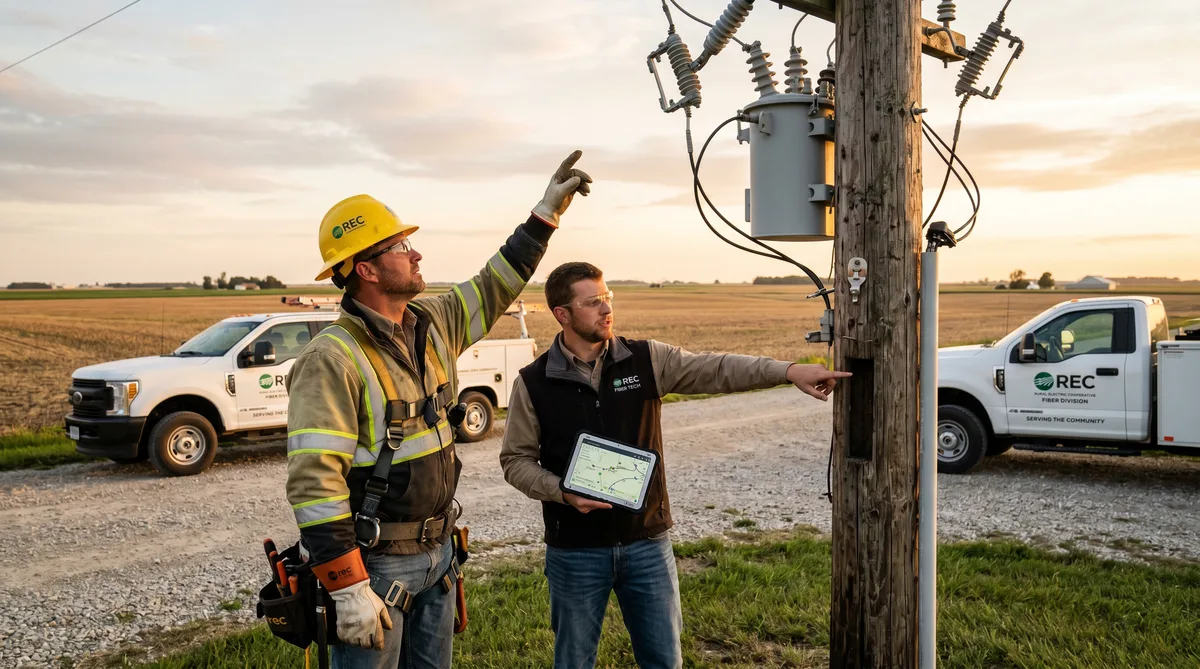
A rural electric co-op in central Alabama came to us with a problem that's become pretty common: they had $14M in BEAD funding committed, 1,100 addresses to serve across 340 route miles, and a preliminary design their internal team had built using a template pulled from a suburban FTTH project. The splitter architecture was all wrong. Drop distances were nowhere near reality. And the cost-per-location estimate was off by a factor of almost two.
We see this regularly. Fiber network design for electric cooperatives doesn't follow the same playbook as commercial ISP builds — not even close. The density numbers are different, the infrastructure assumptions are different, and the funding compliance requirements have their own quirks. This article covers what actually matters when you're designing fiber for a co-op or small rural ISP, from splitter math to drop geometry to BEAD documentation.
Why Electric Co-ops Are Building Broadband Networks Now
The short answer: they're the only ones who will. Private carriers have largely written off low-density rural areas as economically unviable without subsidy. Electric cooperatives, on the other hand, already serve those areas. They have poles in the ground, easements on the books, crews that know every road in the territory, and a membership base that's been asking for broadband for a decade.
BEAD and USDA ReConnect changed the math. With $42.5 billion flowing through BEAD and another round of ReConnect funding available, co-ops can now build fiber networks that would have been impossible to justify on subscriber revenue alone. Member demand is real — in the co-ops we've worked with, pre-registration rates have hit 60–80% before a single foot of cable is in the ground. That's not a number you see in suburban greenfield builds.
The infrastructure advantage is significant too. An electric cooperative that owns its distribution poles can overlash fiber on existing aerial strand, share easements, and start construction without the 14–22 week joint-use application process that kills timelines for commercial ISPs. We've seen co-ops shave 4 to 6 months off project schedules purely because they don't have to wait for the incumbent utility to approve their own pole attachments.
Key co-op advantage: Member-owned poles eliminate third-party make-ready delays and pole attachment fees. But you still need a full NESC-compliant pole loading analysis before attaching. Don't skip it — the liability exposure isn't worth it, and BEAD grant auditors will ask for the calculations.
The Density Problem: Why Suburban FTTH Design Templates Don't Transfer
Suburban FTTH networks are typically designed around 25–60 addresses per route mile. That density changes everything — how you size splitters, how you route feeder cable, how many homes a single FDH location can serve before drop lengths become untenable.
Rural co-op territory runs 2 to 8 addresses per route mile. Some of the most challenging service areas we've designed — a project in eastern Kentucky, for example, and another in the Mississippi Delta region — hit as low as 1.3 addresses per route mile across large portions of the footprint. At that density, the economics of centralized architecture collapse completely.
Here's the math that matters: if you build a centralized FDH serving a 2-mile radius with a 1:32 splitter configuration, you might have 8 homes within reach — but drops averaging 1,400 feet each. Your drop cable cost per subscriber goes through the roof, and you've burned fiber count capacity you'll never use. The design has to follow the address distribution, not the other way around.
We covered the general principles of FDH sizing for FTTH in an earlier piece, but co-op deployments push those principles hard. The right answer for most rural networks is a distributed architecture — smaller cabinets, closer to subscriber clusters, with shorter average drop distances even if you need more cabinet locations overall.
Splitter Architecture for Rural GPON Networks
The temptation when designing for a rural co-op is to drop to a 1:32 split ratio across the board and call it done. That's not wrong, exactly, but it's incomplete thinking. Split ratio selection in low-density rural networks needs to account for three things: actual take rate projections, drop length constraints, and optical budget.
In most co-op FTTH designs, we use 96F feeder cable for the trunk routes feeding out from the OLT location. That gives you enough fiber count to serve multiple distribution zones without running out of headroom as the network grows. For distribution — the cable running from FDH locations toward subscriber clusters — 12F or 24F is almost always adequate in low-density areas. There's no reason to run 48F distribution in a zone where your peak connected homes per cabinet is 24.
Split ratios typically land at 1:16 or 1:32 for rural deployments. We generally lean toward 1:16 when average drop distances exceed 900 feet, because the optical power budget math gets tight at 1:32 with long drops — especially if the co-op is using existing strand that hasn't been PMD-tested recently. A 1:32 split eats roughly 15 dB of your budget before you've run a foot of drop cable. Add 2.1 dB per mile on the drop, plus splice losses, and you're getting close to the edge on 2,000-foot drops.
Optical budget rule of thumb for rural drops: If your 95th-percentile drop distance exceeds 1,600 feet, model the link budget at 1:16 before committing to 1:32 splitters. The cost difference in splitter hardware is small compared to a truck roll to investigate subscriber signal issues six months after launch.
The Drop Distance Problem
This is where rural co-op FTTH design gets genuinely hard. Urban drops average 150–300 feet. Suburban drops run 300–600 feet. Rural co-op drops? We regularly see 800 to 2,000-foot drops, and in truly remote areas, 3,500-foot drops aren't unusual.
That distance creates a decision tree that doesn't exist in denser deployments: aerial or buried, and who pays for it?
Aerial drops on co-op poles are almost always the right answer when the pole line runs near the home. Costs run roughly $3.10–$4.80 per foot installed for lashed aerial drop cable in rural areas — call it $5,600–$8,600 for a 1,400-foot aerial drop with hardware. Buried drops in rural areas are more expensive per foot — typically $6.40–$11.20 depending on soil conditions and whether you're boring under a driveway — but sometimes necessary when the service point is set back significantly from the road with no pole line running to it. We explored the full cost breakdown of these options in our analysis of aerial vs underground cost for fiber deployments.
One thing co-ops consistently underestimate: the number of properties where the driveway is the problem. A farmhouse 200 feet off the road sounds trivial until you realize there's a concrete apron, a drainage ditch, and a county ROW requirement for a bored crossing. Budget $1,800–$3,200 per bore crossing for rural driveways and you'll be closer to reality than the flat per-foot rates most firms use.
For aerial drops on rural properties, forestry clearance is a separate cost category that gets ignored until it's a problem. A 900-foot drop through a wooded property boundary might need 6–8 hours of right-of-way clearing before the installation crew can even stage the job. Build that into your drop cost model early — not as a contingency, as a line item.
Using Existing Electric Infrastructure
This is the co-op's real competitive advantage, and most don't fully exploit it in their design phase.
Overlashing fiber on existing aerial strand is by far the fastest and cheapest construction method for a co-op — provided the strand is in acceptable condition and the poles can carry the added load. The overlash guide we published earlier covers the mechanics, but for co-op applications specifically, there are a few things that change the calculus.
First: pole loading on distribution poles with existing electric equipment. A typical 40-foot Class 4 wood pole carrying 7.2/12.47 kV phase conductors, neutral, and secondary service drops is already loaded. Adding a fiber lashing wire and ADSS or figure-8 drop cable requires a NESC-compliant pole loading analysis for each pole — not sampling, every pole in areas where loading is marginal. We use O-Calc Pro for most co-op loading work, though the tool requires careful attention when you have mixed attachment heights and overlapping equipment from different utilities on the same pole.
Second: shared easements. Co-op distribution easements typically cover facilities "for electric purposes" — and in most states, broadband infrastructure appended to the electric system falls within that easement scope. But this varies by state law and the specific easement language in older land records. We've seen projects stall 90 days in rural Georgia because a landowner contested whether the existing easement covered fiber. Have your legal team verify easement scope before assuming you can build on existing ROW.
Third: existing pole attachment agreements with other utilities on co-op poles. Many co-op distribution lines already have cable TV or telephone attachments under joint-use agreements. Adding fiber to those poles may require notifying the other attaching parties, and some agreements require load analysis sign-off from all parties. This isn't a showstopper — but it adds 3–6 weeks to the pre-construction process if you don't identify it during design.
Fiber Network Design for BEAD-Funded Co-op Deployments
BEAD has specific engineering documentation requirements that go beyond what most co-ops expect. The NTIA model rules require that the high-level design document the entire funded service area — every Broadband Serviceable Location (BSL) — with a credible construction approach and a substantiated cost-per-location estimate. If you want to understand the full documentation stack, our breakdown of BEAD engineering requirements covers it in detail, and our guide on BEAD HLD requirements walks through the specific design deliverables subgrantees must produce.
For co-ops specifically, a few BEAD constraints create design challenges that suburban ISPs don't face:
- 100% BSL coverage requirement: You can't cherry-pick the easy addresses and leave the long drops for later. Every BSL in the funded area must be designed and costed in the HLD. That 3,200-foot drop to the farmhouse at the end of the road is part of the project, and the grant auditor will check.
- Cost-per-location thresholds: NTIA and state agencies set cost-per-location caps to screen for reasonable projects. If your design methodology inflates drop costs — by using suburban per-foot rates in a rural terrain, for example — your cost-per-location estimate may exceed the state threshold and trigger additional review or disqualification. Use terrain-appropriate unit costs.
- USDA ReConnect documentation: ReConnect has its own engineering deliverable requirements, slightly different from BEAD. If a co-op is layering ReConnect and BEAD funding, the design documentation has to satisfy both agencies. We've done this successfully on several projects, but it requires careful coordination of deliverable formats from day one.
BEAD design tip: Build your HLD in GIS from the start — not CAD. NTIA reviewers and state broadband offices increasingly expect GIS-native deliverables with BSL attribute data attached to the design geometry. A CAD drawing exported to PDF won't cut it for BEAD compliance in most states.
Common Mistakes Co-ops Make in Fiber Network Design
After designing co-op FTTH networks in a dozen states, a few failure patterns come up again and again.
Applying urban or suburban design standards to rural density
The most common. I've seen preliminary designs for co-op networks — sometimes from firms that should know better — that specify centralized splitter vaults sized for 300 homes within a 0.5-mile radius. In a service area with 4 addresses per route mile, that vault serves 6 homes. It's a $38,000 structure doing the work of a $2,400 pedestal cabinet. These are the kinds of mistakes worth catching early — which is exactly why we've written about common HLD mistakes that haunt fiber projects before construction even starts.
Ignoring seasonal flooding on underground design segments
Rural service territories often include low-lying agricultural land, floodplains, and areas with high water tables. A buried fiber route that's fine in August may be underwater by January. We've had projects in the Mississippi Delta and in low-lying areas of coastal Georgia where the contractor discovered, mid-construction, that the design called for direct-buried cable in an area that floods to 3 feet annually. HDPE conduit with pull-through cable is the correct spec for flood-prone areas. It costs more upfront and it saves a cable replacement within two years.
Underestimating make-ready on older rural pole lines
Co-op distribution poles in some rural areas were last systematically inspected in the 1980s or 1990s. Rotten butts, leaning poles, undersized poles — all of it shows up during fielding and adds unanticipated make-ready cost. A thorough field survey that includes visual pole condition assessment before finalizing the design is not optional. It's the difference between a project that builds on budget and one that hits a $600,000 change order six months in.
Not planning for forestry clearance on rural aerial routes
Rural pole lines run through trees. Sometimes a lot of trees. NESC minimum clearances from vegetation have to be maintained after construction, which means a clearing crew often precedes the construction crew on rural aerial routes. Some co-ops factor this in; most don't. Budget $800–$2,200 per pole for clearance in heavily wooded sections and your project manager will thank you later.
What Fiber Network Design Should Actually Cost a Rural Co-op
Cost-per-passing in rural cooperative FTTH deployments typically runs $3,200 to $6,800 — and that's a wide range for a reason. Aerial construction on cooperative-owned poles in moderate terrain comes in at the low end, often $3,200–$4,100 per passing. Buried construction in clay soils with significant boring requirements, or aerial construction on poles requiring extensive make-ready and clearing, pushes toward the high end. Some projects we've worked on in extreme terrain — a co-op in the Appalachian foothills of western North Carolina — exceeded $7,400 per passing due to steep grades, limited road access for equipment, and extensive pole replacements.
For context: suburban FTTH runs $1,500–$2,800 per passing. The gap exists because rural construction costs are driven by route miles, not home counts. You're paying to build the same miles of feeder and distribution infrastructure while spreading that cost across far fewer subscribers. That's not a design failure — it's physics and geography. The job of good fiber network design for electric cooperatives is to minimize the cost-per-passing within the constraints of the terrain, not to pretend the constraints don't exist.
Engineering and design — separate from construction — typically runs 8–12% of total project cost. On a $12M rural co-op build, that's $960,000 to $1.44M for the full design, make-ready engineering, and construction documentation package. Co-ops that try to cut engineering costs to 4–5% usually spend the difference twice over in field change orders and rework. Our fiber design services for co-ops include the full stack: HLD, LLD, BEAD-compliant documentation, and field support through construction.
Frequently Asked Questions
How much does fiber design cost for an electric cooperative?
Fiber design costs for electric cooperatives typically range from $180 to $380 per route mile for high-level design, depending on terrain complexity, GIS data availability, and whether existing pole records are usable. Full engineering packages including LLD, make-ready, and permitting support run higher. Most co-ops budget 8–12% of total construction cost for engineering.
Can electric cooperatives use their existing poles for fiber?
Yes. Electric cooperatives that own their distribution poles can overlash fiber on existing aerial strand or attach directly to poles without paying third-party pole attachment fees. They still need a pole loading analysis to confirm NESC compliance under the added fiber weight and wind/ice loads, but they can skip the lengthy joint-use application process that slows commercial ISP deployments by months.
What splitter architecture works best for rural FTTH?
Low-density rural deployments — typically 2 to 8 addresses per route mile — perform best with a distributed splitter architecture using 1:16 or 1:32 split ratios placed in field cabinets or pedestal enclosures close to subscriber clusters. Centralized splitter vaults designed for suburban density waste fiber capacity and increase drop lengths in rural areas. Most co-op FTTH networks use 96F feeder cable for trunk routes with 12F or 24F distribution drops feeding distributed splitter points.
Do electric cooperatives qualify for BEAD funding?
Yes. Electric cooperatives are eligible BEAD subgrantees in most states and are frequently prioritized because they serve unserved rural areas that align directly with BEAD's coverage mandate. Co-ops must meet the same subgrantee technical requirements as any ISP — 100% BSL coverage of the funded service area, speed commitments of 100/20 Mbps minimum, NTIA-compliant network design documentation, and an approved cost-per-location threshold.
What is the typical fiber cost per passing in rural areas?
Rural fiber cost per passing generally runs $3,200 to $6,800 depending on construction method, terrain, and pole conditions. Aerial construction on cooperative-owned poles sits at the lower end of that range. Buried construction in rocky or flood-prone terrain can push well past $6,800. For comparison, suburban FTTH deployment costs $1,500 to $2,800 per passing due to higher address density spreading fixed construction costs across more homes per mile.
If your cooperative is working through a BEAD application, a USDA ReConnect grant, or just trying to figure out whether the design you've been given actually holds up — reach out. Our team has done this work across hundreds of rural service territories in 22 states, from Appalachian mountain terrain to flat Delta farmland to high desert. We know where the standard assumptions break down. Email us at info@draftech.com and we'll take a look at what you're working with.