# Underground Utility Contractors: What to Require for Fiber and Power Builds
**Title tag:** Underground Utility Contractors: Hiring Guide 2026
**Meta description:** Underground utility contractors: compare fiber and power scopes, 811 locates, trench safety, permits, inspection records, restoration and as-built requirements.
**Author:** Devin Martinez
**Published:** November 15, 2026
**Last updated:** November 15, 2026
**Category:** Construction Management
**URL:** https://draftech.com/blog/underground-utility-contractors
**Primary keyword:** underground utility contractors
**Plan reference:** plan-2026-10-18
**Word count:** 2895
**Read time:** 12 minutes
## In this article
- [What underground utility contractors should include](#scope)
- [Qualify underground utility contractors before award](#qualification)
- [Make the construction controls enforceable](#controls)
- [Require restoration and usable as-builts](#closeout)
- [Where integrated engineering and construction help](#delivery)
- [Choose the contract around your acceptance needs](#decision)
A contractor proposal can describe a complete underground build while leaving the owner to resolve every crossing conflict. The gap usually sits between scope lines. Someone installs conduit, someone else places cable, and the acceptance requirements surface after the trench has closed.
We recommend selecting for the finished asset and its records before comparing construction methods. This guide covers fiber and electric distribution work for ISPs, utilities, co-ops, developers and municipalities. It explains what to require before award and where a company with in-house engineering and managed construction crews can remove a handoff.
## What underground utility contractors should include
Underground utility contractors install buried infrastructure for fiber and power, from excavation and conduit placement through cable installation and surface restoration. For a hiring decision, we separate the work into 2 contractual boundaries: the physical installation and the evidence the owner needs to accept and maintain it.
Start with the endpoint. An empty conduit route and an accepted cable system are different deliverables, even when both proposals use the phrase turnkey construction. We ask owners to define the asset they expect to receive before a bidder chooses equipment or assigns crews.
### Trenching and directional boring
**Open-cut trenching** exposes a continuous path for installation and inspection. It can suit accessible corridors where excavation and restoration are permitted. The available work area must also accommodate the excavation safety system, spoil handling and public access without assuming that the drawing's narrow route line represents the full construction footprint.
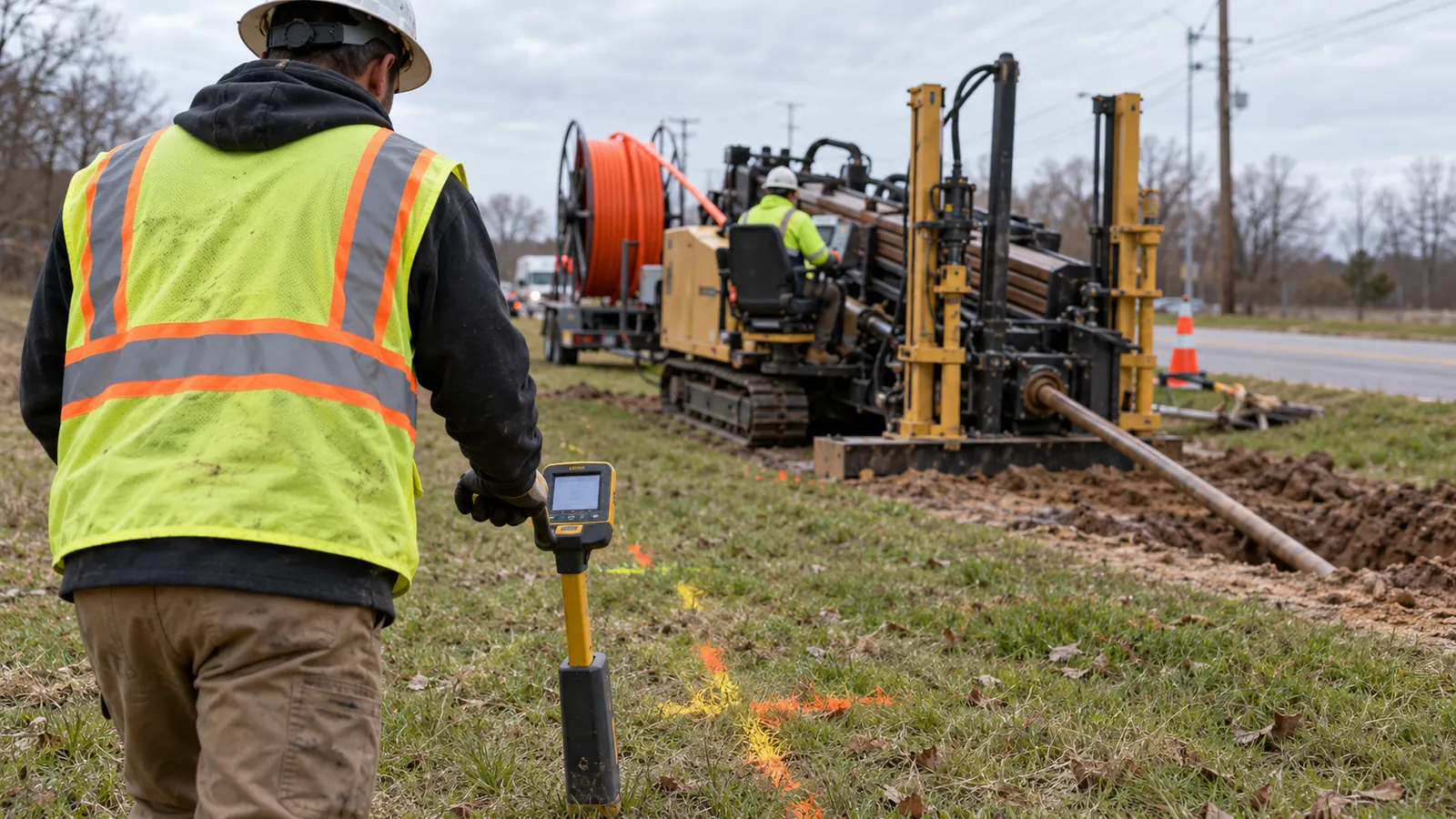
Directional boring, also called horizontal directional drilling or HDD, creates a steered path between access points. Surface disruption can be reduced. Ground conditions still matter. We require bidders to explain how they will verify crossing utilities and respond when the planned path cannot be followed within the approved corridor.
The method should follow the route constraints. A drill on the equipment list proves little about a difficult crossing unless the proposed setup and product limits fit the actual site. Our [guide to HDD bore planning and conduit acceptance](/blog/hdd-boring-fiber-installation) develops that method-specific review.
### Conduit, structures and cable placement
A conduit scope should identify the duct configuration and whether concrete encasement forms part of a duct bank. We want the drawings to distinguish installed capacity from reserved capacity so that a future cable crew can identify the intended path without opening unrelated structures.
Vaults and handholes create access points for pulling or splicing. Their placement must work with finished grade and the applicable loading conditions. A structure that fits the cable layout can still be unsuitable where vehicles will travel over its cover. Match the enclosure to its location.
Cable placement needs its own scope boundary. Ask whether the package includes splicing and acceptance testing, and who supplies the cable-specific installation limits. For power work, the utility's operating authority controls electrical access and energization. We keep those permissions explicit rather than treating installed cable as permission to place a circuit in service.
## Qualify underground utility contractors before award
References should answer how the proposed team handles an imperfect drawing. Ask for permission to discuss a comparable underground scope with a previous owner, then focus the conversation on how an unexpected utility conflict was resolved and recorded. Keep project identities within the authorized procurement conversation.
Equipment experience matters, but the proposed personnel matter more. We ask who will supervise the work and who can stop it. Get names. If a bidder will use subcontract crews, the proposal should identify the prime's control over their qualifications and explain how replacement crews enter the same safety and inspection process.
### 811 locates and crossing verification
The Common Ground Alliance's *Before You Dig* guidance describes 811 markings as approximate utility locations and directs excavators to confirm responses before digging. Require a procedure that follows the applicable state's notice and ticket rules. We do not substitute a national waiting period for those requirements.
Assign ticket responsibility in the contract. The excavation footprint must match the notified work area, including pits and other ground disturbance beyond the main alignment. Ask how missing responses or disturbed markings will be handled before the affected work resumes. Paint alone cannot establish crossing depth.
**Potholing at crossings** should produce usable measurements tied to the route. Require the contractor to explain the safe exposure method and how observed elevations will reach the engineer before a bore proceeds near an existing facility. The owner should also identify private facilities that may need separate locating arrangements.
### Permits, access and traffic control
Review permit responsibility against the proposed method. A permit may constrain where a pit can be placed or how a road surface must be restored, so a change from trenching to boring needs a check against the approved work rather than an informal field substitution.
Public access remains part of construction. We ask for the approved traffic-control basis and the person responsible for maintaining it as work moves. Pedestrians need a usable route. The bidder must also explain how access to properties will be maintained where the excavation affects entrances.
The table below separates the evidence to request before award from the records that should arrive during delivery. We use these distinctions to keep a promising method statement from becoming the only acceptance document. A sample record is useful; a commitment to use it on the awarded scope is stronger.
| Control | Require before award | Require during delivery |
| --- | --- | --- |
| Damage prevention | 811 and crossing-exposure procedure | Locate responses and measured crossing records |
| Permits and access | Responsibility for approvals and traffic control | Approved revisions and access checks |
| Excavation safety | Competent-person assignment and protective-system approach | Inspections and corrective actions |
| Installation QA/QC | Inspection plan with hold points | Material checks and concealed-work evidence |
| Restoration and closeout | Acceptance criteria and drawing format | Restoration acceptance and reconciled as-builts |
## Make the construction controls enforceable
The strongest qualification package still needs field authority. We want the contract to say who receives a conflict report and who authorizes a change to the issued design. The foreman should know where to take a problem before it becomes an undocumented deviation underground.
### Damage prevention and permit changes
Suppose an exposed crossing sits where the proposed bore would pass. This is a planning example, not a reported project. The affected installation stops while the measured condition reaches the designer, who evaluates a revised path and determines whether the authority must approve a permit change.
That sequence needs an owner. We require the approved revision to reach the field set before work resumes on the changed alignment. The crew should not be expected to choose a new depth simply because the planned depth conflicts with an existing utility.
A revised path can affect access beyond the conflict itself. Moving a bore entry may move the work into a different traffic-control setup or outside the permitted limits, which is why we review the construction footprint together with the underground alignment.
**Ask for a conflict walkthrough.** Give each bidder an anonymized crossing sketch and ask them to explain their stop-and-review process. The answer reveals whether the field supervisor can reach someone authorized to resolve the design.
### OSHA trench safety
OSHA's Safety and Health Regulations for Construction, 29 CFR 1926 Subpart P, sets excavation requirements. Section 1926.651, *Specific Excavation Requirements*, requires competent-person inspections and addresses access and utility protection. Ask how the contractor will document inspections and remove exposed employees when hazardous conditions are identified.
Section 1926.652, *Requirements for protective systems*, generally requires cave-in protection, with exceptions for excavations entirely in stable rock or less than 5 feet deep when a competent person's examination finds no indication of a potential cave-in. A shallow trench still needs assessment.
We evaluate the proposed protective approach against the actual work area. A trench box must fit the installation sequence, and a sloped excavation needs room that may extend beyond the conduit alignment shown on a plan. The contractor remains responsible for safe means and methods.
Inspect changing conditions. Water or nearby loading can alter the excavation risk after the initial briefing. Owners should require evidence that the responsible employer has a functioning field safety process, rather than accepting a generic manual as proof that the excavation has been assessed.
### QA/QC before the work disappears
**Hold points** should occur while the inspector can still see the work. We specify the inspections needed before concealment and name who can release them. For a duct bank, that may mean checking the installed arrangement before concrete placement; a completed surface cannot show that arrangement afterward.
Use the approved design and project specifications to establish acceptance criteria. Conduit proofing requirements should be agreed before cable installation, with the method and results tied to the correct segment. A pass recorded against the wrong duct leaves the cable crew with an unresolved risk.
Our [underground construction oversight guide](/blog/underground-osp-construction-oversight) explains how field records support release decisions. The owner should be able to connect the accepted installation to the drawing revision that governed it. Photographs need locations. Otherwise, a folder full of trench images can still fail to establish what was accepted.
## Require restoration and usable as-builts
Restoration begins with a record of existing conditions. Capture the affected surface before disturbance and agree on the restoration limits with the responsible authority. We want the contractor to understand the acceptance standard before excavation, particularly where the required repair extends beyond the width of the trench.
### Surface acceptance and cable records
Separate temporary reinstatement from final acceptance. A surface that allows access during construction may still require additional work before the authority accepts it. Define how settlement or other defects will be handled under the contract, and retain the inspection record that closes the restoration item.
Cable testing also needs a defined recipient. For fiber, specify the required test method and how results map to the installed fiber identifiers. For electric distribution, use the owner's required acceptance procedures and authorized personnel. We do not treat a generic test certificate as evidence that the installed system meets its particular acceptance requirements.
Ask for a sample closeout submission before award. It exposes mismatched expectations early. An owner expecting editable GIS data needs a different delivery specification from an owner accepting marked drawings, even when the underground installation is physically identical.
**Review a sample before production spreads.** Have the owner check the first completed segment's documentation against the agreed format. Correcting an identifier problem there is easier than reconciling it across the entire route at closeout.
### Redlines must become a maintenance record
Redlines capture field changes; as-builts incorporate the accepted installation into the final record. We require each change to retain its location and its approval reference. A displaced handhole can affect pulling geometry and future access, so moving its symbol without explaining the change loses useful engineering context.
The final drawing should distinguish measured information from information carried forward from design. Do not imply survey precision that the collection method cannot support. Where an observation remains unresolved, identify it for disposition instead of smoothing it into a clean line.
Agree on asset identifiers before crews start recording them. A duct label in a vault should match the closeout record used by the maintenance team, and a later cable installation should be able to follow that same identity without reconstructing the original foreman's intent.
We recommend acceptance by completed segment when the contract permits it. That approach gives the owner a chance to test whether the records are usable while the people who collected them are still assigned. Final acceptance still follows the owner's contractual requirements.
## Where integrated engineering and construction help
Draftech International is one option for turnkey telecom and power infrastructure. We connect field survey and planning to construction drawings, permits and agency coordination, then carry the work through construction, as-builts and closeout. Engineering is 100% in-house. Full turnkey construction is delivered by Draftech-managed subcontract crews under Draftech's QA/QC and safety program.
The practical benefit appears when a field condition changes the design. Our engineering team can evaluate the observation while our construction management team coordinates the affected work, keeping the revision connected to the installation that will appear in the final record.
That arrangement removes a separate commercial handoff between design and construction when both are within our scope. It still needs discipline. We keep design approval distinct from a crew's request to proceed, and the owner's acceptance authority remains with the owner.
**A limitation of integrated delivery** is that keeping design and construction under one firm can reduce independent challenge unless the owner specifies separate review and acceptance responsibilities. We recommend retaining those checks, especially where the owner requires an independent inspector or a utility must witness the work.
A construction-only contractor can be the right choice when the owner already has a complete design and an engineering team ready to answer field questions. We favor integrated delivery where unresolved interfaces would otherwise require the owner to coordinate separate design and construction contracts throughout the build.
Our [utility construction delivery scope](/services/utility-construction/) explains that broader responsibility. Power work includes electric distribution and make-ready. Distribution substations are design only; the owner's crews or contractor build them. Transmission-line engineering is outside our scope.
Active in 24 states. Available across all 50 U.S. states. Owners can review our [service-area information](/states/) when defining the route and approval authorities, then use our [partner and company background](/about) to evaluate who is accountable for delivery. Coverage does not replace project-specific qualification.
## Choose the contract around your acceptance needs
**ISPs:** Award a fiber package that defines where conduit acceptance ends and cable acceptance begins. We recommend requiring route identifiers that connect installation records to fiber tests so that an apparently finished civil scope does not conceal an incomplete network handoff.
**Utilities and co-ops:** Put operating authority and electrical acceptance requirements into the scope before construction procurement. Require the bidder to show how its field supervision will work with your authorized personnel, especially where a new underground installation interfaces with an existing distribution system.
**Developers:** Reconcile utility installation with final grades before selecting the excavation method. We recommend settling who accepts each structure and surface because a physically complete route can still leave unresolved obligations between the developer and the future utility owner.
**Municipalities:** Require restoration acceptance and maintenance-ready records as deliverables. Assign responsibility for public access. The contract should identify who closes an outstanding surface defect after the underground installation team has moved away from that work area.
Before award, put exclusions beside the scope drawing and resolve them with the proposed supervisor. We would not recommend an award that leaves crossing verification or concealed-work inspection unassigned. A bidder should explain who owns each unresolved interface before mobilization is authorized.
If your route needs that coordination, our [underground construction service](/services/utility-construction/underground-construction/) connects engineering decisions with managed installation and closeout. We address the crossing changes and missing acceptance records that otherwise fall between contracts. Send the route context to [info@draftech.com](mailto:info@draftech.com) so we can discuss the required scope.
For a qualifying route, Draftech engineers the first 20,000 linear feet at no cost, from feasibility and field survey through permit approval. Our owner reviews each request before Draftech commits the package. Use the [free route engineering request](/free-design) to put the proposed alignment forward for that review.
## Frequently Asked Questions
### What work should an underground utility contractor include?
We recommend defining the finished asset before requesting proposals, with 2 clear boundaries: installation and acceptance documentation. A fiber scope may stop at accepted conduit or continue through cable placement and testing, depending on the contract. Restoration responsibilities and the final drawing format should be explicit so the owner can compare proposals that deliver the same usable result.
### Does an 811 ticket verify the depth of existing utilities?
An 811 ticket initiates the locate process; markings indicate approximate locations and do not establish a verified crossing depth. We require the contractor to follow the applicable response rules and explain how crossing utilities will be safely exposed where needed. The resulting measurements must reach the designer before affected installation proceeds, with unresolved conflicts handled through the agreed review process.
### What should owners require for trench safety?
Ask how the contractor assigns a competent person and applies OSHA excavation requirements to the actual work area. Section 1926.652 addresses cave-in protection, including the conditional exception for excavations less than 5 feet deep. We recommend reviewing the proposed protective approach and inspection process before award, while keeping responsibility for safe execution with the employer performing the work.
### Can Draftech engineer and build an underground route?
Draftech International provides 100% in-house engineering and full turnkey construction delivered by Draftech-managed subcontract crews under our QA/QC and safety program. We connect route decisions with field execution and final records within the agreed scope. Electric distribution and make-ready are included capabilities; distribution substations are design only, with construction performed by the owner or the owner's contractor.
### What does the free route engineering offer cover?
For a qualifying route, Draftech engineers the first 20,000 linear feet at no cost, from feasibility and field survey through permit approval. The owner reviews each request before Draftech commits the package. We use that review to establish whether the proposed route qualifies, so submitting a request starts an evaluation rather than automatically securing an engineering commitment for the applicant.