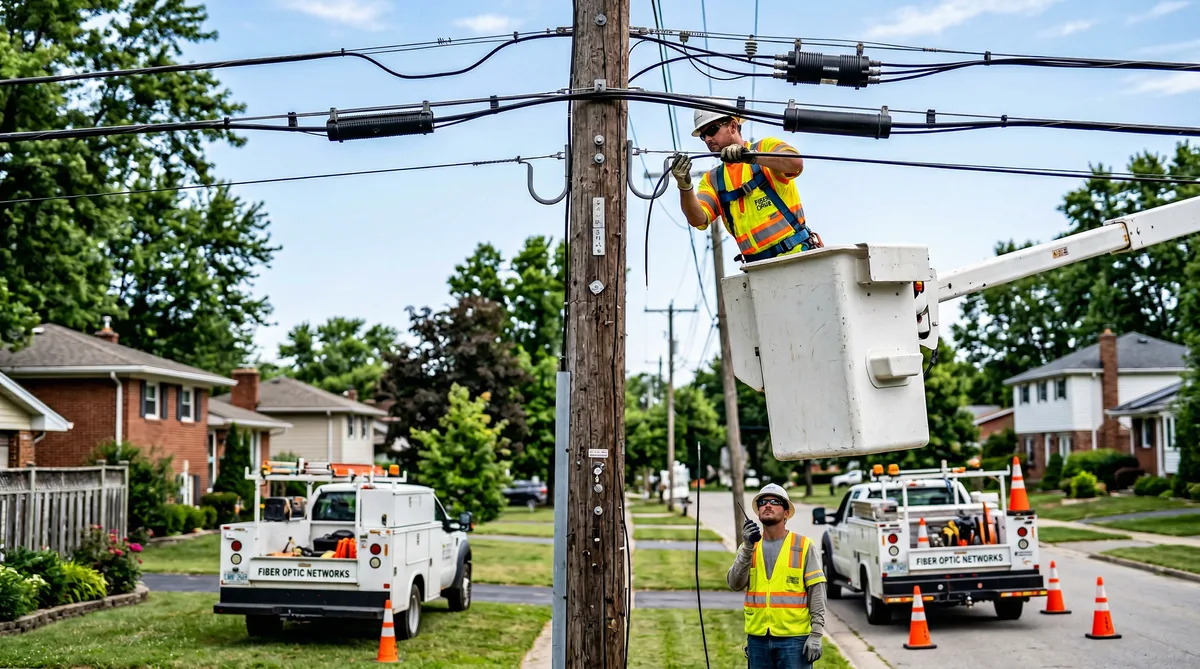
OTMR looks simple on paper. One contractor, one trip, all the make-ready done at once — and you're attached in 30-some days instead of five months. What's not to love? But the one touch make ready OTMR rules for fiber have real teeth, and misreading even a single condition on a single pole can blow up your entire application. We've watched ISPs lose weeks — sometimes months — because they assumed a pole qualified when it didn't, or because they sent their contractor out without clearing the 15-day notice window.
This is our attempt to lay out how OTMR actually works in the field, where the trap doors are, and what distinguishes a clean OTMR route from one that's going to cause problems.
The FCC Order That Made OTMR Possible
The FCC's 2018 Accelerating Wireless Broadband Deployment Order — formally FCC 18-30 — is where OTMR comes from. Before that order, the make-ready process worked like this: every existing attacher got to send their own crews to move their own wires, on their own schedule, before the new attacher could go up. With 8 or 10 existing attachers on a congested urban pole, you were coordinating 8 or 10 separate field visits, each with their own lead time, each with their own billing cycle. The process was effectively controlled by the slowest mover — and some utilities had no incentive to move fast.
The 2018 order changed that for communications-space work by allowing a new attacher to hire a single qualified contractor to complete all communications make-ready in one shot. The pole owner and existing attachers got advance notice and specific windows to object or do the work themselves. If they didn't act within those windows, the new attacher's contractor could proceed.
The FCC updated related broadband infrastructure rules in 2024 and early 2025, tightening enforcement timelines and clarifying what constitutes a valid objection — but the core OTMR framework from 2018 is still what governs field work. Specifically, Section 1.1411 of the Commission's rules is the one your team needs to know.
The Critical Distinction: Simple vs. Complex Make-Ready
This is where most OTMR eligibility questions actually live. The FCC draws a hard line between simple make-ready and complex make-ready, and the distinction is spatial — literally about which vertical zone of the pole you're working in.
Simple Make-Ready (OTMR Eligible)
Simple make-ready covers work in the communications space — the lower portion of the pole below the supply space — that can be done without the involvement of the pole owner or existing attachers' crews. The work is "simple" in the regulatory sense, not necessarily in the field sense. Rearranging messenger wire, adjusting coax or fiber strand heights, moving communication cables within the communications space, adjusting pole risers, changing down-guy configurations — these all potentially qualify as simple make-ready under OTMR. The new attacher's single qualified contractor handles it all.
Complex Make-Ready — and Why It Disqualifies a Pole from OTMR
Complex make-ready involves the power space. Anything that requires moving or rearranging primary conductors, neutral conductors, streetlight wiring, transformer connections, or any other facilities controlled by the electric utility — that's complex. And complex make-ready cannot be done by the new attacher's contractor under OTMR.
Full stop. No workaround.
If even one pole in your route requires complex make-ready, that pole drops out of your OTMR application and has to go through the traditional make-ready process. The rest of the route can still proceed as OTMR — but you need to bifurcate the application cleanly. More on that in a minute.
A solid pole loading analysis done before you file will usually surface which poles need complex work. If the current configuration already has attachments at the wrong heights and the only path to compliance requires moving the neutral — you're in complex territory before you even file.
What Actually Disqualifies a Pole from OTMR
Pole replacement is the most common disqualifier we see. If a NESC compliance check shows the existing pole is already over capacity and the attachment can't be accommodated without replacing the structure — that's not OTMR work. That's a utility-coordinated project, and the timeline is completely different. We had a route in central Mississippi last year, 83 poles, where 11 came back needing replacement. Those 11 went through the utility's standard process, which ran about 14 weeks. The other 72 cleared through OTMR in 38 days. The bifurcated approach let construction start on the OTMR poles while the utility handled replacements in parallel — but that only works if you've planned for it from the start.
Other common disqualifiers:
- Power space work required: If any existing attacher has equipment in the power space that must move to accommodate your attachment or meet clearance requirements, OTMR doesn't apply to that pole.
- Pole owner facilities that need rearranging: Electric utilities typically own the pole, and if the utility's own facilities need to shift — even in the communications space — many utilities claim this as work only they can perform, which effectively kicks it out of OTMR.
- Existing attacher with a legitimate objection: Under FCC rules, an existing attacher can object to the OTMR contractor performing work on their facilities. The bar for a valid objection is supposed to be narrow — safety concerns, technical incompatibility — but some utilities have used objections creatively. Know ahead of time which attachers on your route have a history of this.
- Poles without formal attachment agreements in place: OTMR requires that the new attacher has already submitted a complete pole attachment application through the normal process — typically the NJUNS pole attachment process. If you haven't done that, you have no OTMR rights yet.
- Non-IOU poles: Cooperatives and municipal utilities are often outside FCC jurisdiction. Their make-ready rules may not recognize OTMR at all.
The 15-Day Notice Requirement — and What Happens If You Miss It
Under 47 CFR § 1.1411(i), before the new attacher's contractor can perform any OTMR work, the new attacher must provide at least 15 business days advance written notice to the pole owner and all existing attachers. That notice has to include the specific poles and the specific work planned at each pole.
During that 15-day window, existing attachers have three options: do the work themselves on their own facilities, consent to the new attacher's contractor doing it, or raise a legitimate objection. If they don't respond at all within 15 days, they lose their right to object to the contractor performing the work on their facilities.
Miss the notice window — even by a day — and any work performed before it expires is unauthorized. We've seen utilities use this to invalidate OTMR work that was otherwise perfectly executed, forcing the attacher to redo the notification process from scratch. It's an expensive mistake. Calendar the notice dates and confirm receipt in writing.
Practical note: "15 business days" excludes weekends and federal holidays. On a route that spans two states with different holiday calendars, this can create different effective dates for different poles. Track them individually, not by route.
Contractor Qualification — More Stringent Than People Expect
The FCC requires that OTMR contractors meet the pole owner's published qualification standards. Every major utility has these — Duke Energy's Qualified Electrical Contractor program, Dominion Energy's contractor prequalification requirements, Georgia Power's joint use contractor list — and getting on these lists isn't a quick process. Some utilities have quarterly qualification cycles. Others process applications on a rolling basis but require a 60-day review window.
If your contractor isn't already on the utility's qualified list when you file your OTMR application, you're either going to wait for them to qualify or find a different contractor. We've seen ISPs assume their construction partner would be on the list, only to discover mid-project that the utility didn't recognize that contractor's credentials. That particular project outside Chattanooga lost about six weeks to this exact problem.
Check contractor qualifications before you submit the application. It takes about 20 minutes to verify, and it can save months.
Bifurcated Applications: Running OTMR and Traditional Make-Ready in Parallel
A mixed route — some poles OTMR-eligible, some not — doesn't mean you abandon OTMR entirely. But it does mean your application needs to be explicitly structured as bifurcated from the start. Don't submit a single application and expect the utility to sort it out. They won't. They'll process everything under the more conservative timeline if it's ambiguous.
The right approach: run the make-ready engineering timelines for each pole first. Categorize every pole as OTMR-eligible (simple make-ready only, communications space, no pole replacement) or traditional (complex work, power space involvement, replacement required, or co-op/muni ownership). Submit separate formal applications — or at minimum, clearly separate attachments within a single application — with distinct contractor designations and notice timelines for each category.
On the construction scheduling side, you can start OTMR poles as soon as the notice period clears and the utility approves. Traditional poles run on their own schedule. Design your construction sequencing around the assumption that traditional poles will take 3-4 times longer — because they almost always do.
Common Mistakes That Void OTMR Eligibility Mid-Process
The application isn't the only place things go wrong. Field work itself can invalidate OTMR status after the fact.
Contractor performing work outside the approved scope: If the contractor moves a cable into the power space or touches utility-controlled equipment — even accidentally — the utility can claim the work was unauthorized and require a full re-inspection at the new attacher's cost. Document the approved scope in writing. Pre-work photos at every pole. No exceptions.
Changing contractor mid-project: If your original OTMR contractor drops off and you substitute a different company, that new company needs to independently meet the utility's qualification requirements. You may need to re-issue the 15-day notice with the new contractor identified. Don't assume the approval transfers automatically.
Failing to notify of discovered conditions: Sometimes the field crew gets to a pole and finds something that wasn't in the make-ready study — a third-party attachment that wasn't reflected in utility records, a guy wire that's in the wrong location, a pole that's actually a different class than listed. If the discovered condition changes the scope from simple to complex, stop. Notify the utility. Don't improvise in the field and hope nobody notices.
This is one area where Katapult's Virtual Ride Out (VRO) genuinely helps. Running a VRO before you finalize the OTMR application means you're catching those undocumented conditions at the planning stage rather than on the day of construction. VRO won't catch everything — there are still field conditions it can't see — but it dramatically reduces the number of surprises that derail OTMR eligibility after you've already sent the contractor.
Timeline Comparison: What OTMR Actually Buys You
When OTMR works, it works well. Here's a realistic comparison based on projects we've run across different utility territories:
- OTMR timeline: Application submission → utility review (~15-30 days) → 15-day contractor notice → field work (1-3 days per mile depending on congestion) → attachment. Total: typically 30-45 days for straightforward routes.
- Traditional make-ready timeline: Application submission → utility review (30-60 days) → make-ready survey (14-30 days) → each attacher schedules their own crew → attachment. Total: 90-150 days in most markets, longer in congested metro areas.
- Worst-case traditional: In urban markets with 7-10 existing attachers, each with their own scheduling constraints, we've seen make-ready timelines stretch to 9-11 months. One project in the Philadelphia metro took 13 months to complete make-ready on a 4-mile route. OTMR simply wasn't available because power space work was needed at most poles.
The cost difference is real too. Traditional make-ready, where each attacher bills separately for their crew time, typically runs $1,200-$2,800 per pole depending on the amount of work. OTMR consolidated billing under a single contractor frequently runs $800-$1,500 per pole for equivalent work — though the range varies significantly by region and contractor. These aren't our numbers alone; they track with what the Fiber Broadband Association has documented in their make-ready cost analyses.
State-Certified Programs: When FCC Rules Don't Apply
One detail that catches ISPs off guard when they expand into new states: the FCC's OTMR rules only cover poles owned by investor-owned utilities in states where the FCC has jurisdiction. About 20 states have certified their own pole attachment programs, which means the FCC's rules — including OTMR — don't govern those states. The state's own rules do.
Some state-certified programs have OTMR-equivalent procedures. Florida and California, for example, have adopted streamlined single-contractor make-ready frameworks that function similarly to OTMR. Others haven't touched it. Virginia has a certified program that moved relatively slowly on OTMR-equivalent rules. New York's PSC has its own process that diverges from FCC rules in some meaningful ways.
And cooperatives are almost universally exempt from FCC pole attachment jurisdiction regardless of state. If your route touches co-op territory — and in rural BEAD-funded builds, it often will — you're negotiating separately under whatever pole use agreement or joint use rules that co-op has in place. OTMR simply doesn't exist as a concept in that context.
Know your jurisdiction before you design your application strategy. Our team tracks the current status of each state's certified program, and it's worth a quick check before you commit to OTMR-based timelines in a new territory. For a broader view of how permitting timelines interact with project scheduling, our breakdown of ROW permitting delays in fiber deployment covers the full picture across permit types.
Quick jurisdiction check: If the pole owner is an investor-owned utility and the project is in a non-certified state, FCC OTMR rules apply. If it's a co-op, municipal utility, or a state with a certified program, research the specific framework before assuming OTMR is available.
Where Katapult VRO Fits Into the OTMR Workflow
We mentioned Virtual Ride Out earlier. It's worth being specific about what it actually does and doesn't do in the OTMR context.
Katapult's VRO function lets engineers review poles using field-collected photographic data — essentially a windshield survey that's been turned into a structured dataset. For OTMR eligibility screening, it lets you identify poles with power space conflicts, probable replacement candidates, and unusual attachment configurations before you send anyone back out for a formal make-ready survey. On a 400-pole route, VRO can cut the time spent on eligibility determination from three weeks to under one week.
What VRO doesn't replace: the formal make-ready survey that produces the engineering data needed for your application, the pole loading analysis required to confirm structural compliance, and the on-site verification for poles where field conditions are ambiguous in photos. It's a screening tool, not a substitute for field engineering. Used correctly, it speeds up the front end of the OTMR process substantially. Used as a shortcut to skip field verification, it creates problems downstream.
If You're Filing OTMR Applications Right Now
A few things that have saved us time and grief on recent projects:
- Get contractor qualifications confirmed before submitting — not after. Call the utility's joint use department directly. Their websites are often out of date.
- Pull the utility's published make-ready specifications. Every major utility publishes minimum clearance requirements and approved equipment lists. Build your design to those specs from day one.
- Run your pole loading analysis on every pole before categorizing it as OTMR-eligible. A pole that's at 94% capacity with existing attachments may clear at 101% with yours added — and that means replacement, not rearrangement.
- Document the 15-day notice with delivery confirmation. Email with read receipts, certified mail, or both. If it ever becomes a dispute, you need proof.
- Build a separate construction schedule for traditional poles. Don't let the optimistic OTMR timeline drive your overall project schedule if you have a meaningful number of traditional-track poles.
Our team handles make-ready engineering services across 22 states, including OTMR applications, bifurcated filings, contractor coordination, and post-construction as-builts. If you're working through a complex route or need a second set of eyes on your OTMR eligibility determination, reach out to us at info@draftech.com. We've filed enough of these to know where the landmines are.