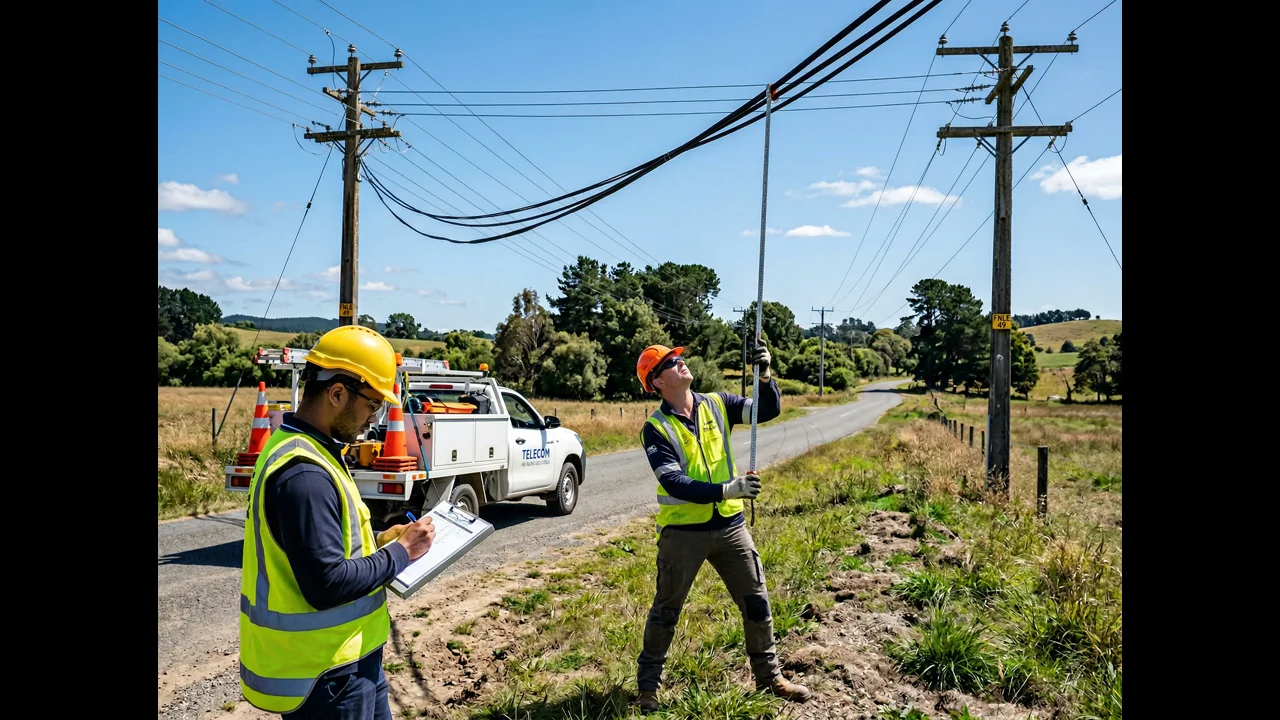
- NESC Rule 235: The Pole Loading Standard That Controls Most Rejections
- Grade B vs. Grade C: Where the Distinction Actually Matters
- Clearance Violations: The Rejection Category That Surprises Engineers Most
- Overloaded Poles: The Structural Rejection You Should Have Seen Coming
- The Most Common Rejection Reasons, Ranked by Frequency
- Utility-Specific Requirements That Go Beyond NESC Minimums
- Connecting Loading Compliance to Field Survey Quality
Every fiber attachment to a utility pole has to pass a pole loading analysis. That's understood. What's less understood — especially by new ISPs and providers who are doing their first significant aerial deployment — is which specific NESC requirements cause applications to get rejected, what the actual compliance thresholds are, and why a pole that looks structurally sound from the street can fail a loading calculation by a comfortable margin. This isn't a theoretical walkthrough of the NESC. It's a practical guide to the specific rules that trip up fiber attachments most consistently, based on rejection patterns we've tracked across hundreds of pole attachment applications.
The National Electrical Safety Code, published by the IEEE, provides the baseline structural and clearance requirements for overhead utility lines and equipment. Most utilities incorporate NESC requirements into their joint-use tariffs, sometimes with additional requirements beyond the NESC minimums — and those utility-specific additions are where applications frequently get rejected for reasons that aren't obvious from reading the code alone.
NESC Rule 235: The Pole Loading Standard That Controls Most Fiber Attachment Rejections
NESC Rule 235 governs structural loading requirements for wood utility poles and is the primary standard cited in fiber attachment rejections. It defines load combinations, overload capacity factors, and construction grade requirements that determine whether a pole can support a new fiber attachment. Most attachment application rejections trace to a Rule 235 violation — either overloaded structure, insufficient clearance, or wrong construction grade applied.
NESC Rule 235 governs the structural loading requirements for wood poles — the calculation method, load combinations, and grade of construction requirements. Most pole loading rejections trace back to a Rule 235 violation, even if the rejection notice phrases it differently.
The Rule 235 calculation takes three load types and applies them simultaneously to determine whether the pole can withstand the combined stress: transverse load (wind force on the pole body and all attached cables and equipment), vertical load (the weight of all attachments, cable, hardware, and the pole itself), and longitudinal load (the tension differential across the pole, significant at dead-ends, corners, and span length changes). The pole must resist the sum of these loads with specified safety factors — 4.0 for Grade B construction, 2.0 for Grade C.
That factor-of-two difference between Grade B and Grade C is consequential. A pole that passes at Grade C loading requirements may fail at Grade B by a significant margin — and many utilities require Grade B construction in certain environments regardless of what the NESC minimum would allow.
Grade B vs. Grade C: Where the Distinction Actually Matters
NESC Section 26 defines the grades of construction, and the Grade B vs. Grade C distinction is one of the most misunderstood aspects of pole loading compliance for new attachers.
Grade B construction is required for:
- Crossings over supply (electric) lines
- Crossings over railroad tracks
- Lines in urban districts where the pole is adjacent to buildings with continuous occupation
- Crossings over limited-access highways
- Lines over navigable waterways
Grade C construction applies to the general case — rural and suburban lines not covered by the Grade B triggers above.
The problem: a route that runs primarily through Grade C territory may have individual poles that qualify as Grade B due to their proximity to specific features. A pole 30 feet from a railroad crossing. A span that passes over a county road that was later upgraded to a state limited-access designation. A pole in a downtown district that was previously classified as rural for purposes of an old joint-use tariff.
On a recent project in western Tennessee involving 1,143 poles, our loading analysis identified 89 poles that required Grade B construction loads due to proximity to crossing features — 7.8% of the total. The ISP's preliminary cost model had assumed 100% Grade C throughout the route. The Grade B poles required significantly stronger equipment specifications, in some cases triggering pole replacement because the existing structures didn't meet Grade B requirements with the proposed fiber attachment. That's a material project cost impact that shows up only when the loading analysis is done at a pole-specific level, not at an average or route-level estimate.
Clearance Violations: The Rejection Category That Surprises Engineers Most
Clearance violations — where the proposed fiber attachment doesn't maintain required minimum distances from electric supply conductors, from the ground, or from structures — are the second most common rejection category. They surprise engineers because the clearance rules are geometry, not load calculation. You can pass every structural loading requirement and still get rejected because your proposed attachment height puts the fiber cable 38 inches from a 7.2kV distribution primary when the NESC requires 40 inches.
Vertical Clearance from Supply Conductors
NESC Rule 235C2 and Table 235-5 govern the minimum vertical separation between supply conductors and communication conductors on the same pole. The base requirement varies by voltage of the supply conductor:
- 0–750V supply (including secondary and service drops): 40 inches minimum vertical separation
- 750V–22kV supply (typical distribution primary): 40 inches minimum
- 22kV–50kV: 60 inches minimum
- Above 50kV: additional clearance required per Rule 235 tables
On most distribution lines, the 40-inch rule controls. That seems straightforward — put your fiber attachment at least 40 inches below the lowest supply conductor and you're clear. But "lowest supply conductor" under storm loading conditions is not the same as the surveyed height on a calm day. NESC clearances must be maintained under Rule 250B loading conditions: 6 pounds per square foot ice load plus wind, or wind only depending on geographic loading district. A supply conductor that surveys at 28 feet 4 inches above ground on a clear day may sag to 25 feet 9 inches under NESC loading conditions. Your fiber attachment height calculation must account for that sag, not just the static survey measurement.
This is an area where quick-and-dirty field surveys create compliance problems. An attachment height measured without sag calculations gets submitted with an application, the utility's engineering department runs the numbers, and the application comes back rejected because the dynamic clearance calculation falls 4.5 inches short. The fix is straightforward — lower the fiber attachment by 6 inches — but the rejection adds weeks to the timeline and requires resubmission with corrected calculations.
Ground Clearance Requirements
NESC Rule 232 sets minimum ground clearance for communication cables by location type:
- Along roads in urban areas: 18 feet above the road surface
- Rural roads and driveways: 15.5 feet minimum
- Other areas accessible to pedestrians only: 10 feet
- Water crossings (navigable): 17–20 feet depending on vessel traffic classification
The 15.5-foot rural road requirement catches agricultural equipment. Farm equipment clearance requirements are why rural fiber deployments in corn and soybean belt states — Iowa, Illinois, Indiana — regularly require poles to be set at heights that put the fiber cable well above standard attachment heights. A standard 40-foot pole with existing communication attachments at 22 feet may need to go to a 45-foot pole just to get the fiber cable to 16 feet above a gravel farm access road with seasonal combine traffic. That's a pole replacement, which is make-ready cost, which is schedule impact.
The sag calculation matters more than the static measurement: Always calculate attachment clearances using the NESC loading district tables for the specific geographic location. A fiber cable attached at 23 feet above ground with 300-foot span lengths in an NESC Heavy Loading district (Northern states) can sag to 20.5 feet under design load — below the minimum clearance for a rural road. Your attachment height has to account for this. O-Calc Pro and SPIDA Calc both handle this automatically if you've correctly set the loading district, but the loading district input needs to match the actual project location.
Overloaded Poles: The Structural Rejection You Should Have Seen Coming
A pole loading rejection on structural grounds — where the pole's calculated stress exceeds its permitted capacity after the proposed fiber attachment is added — is the rejection category that should be most predictable. Yet it consistently surprises providers who haven't done an independent loading analysis before submitting their application.
Poles fail loading calculations for fiber attachments for several specific reasons, and they're not always about the fiber attachment itself.
Existing Pre-Violations
A pole that already fails NESC loading requirements before any new attachment is proposed — because of degraded wood condition, accumulated attachments from previous joint-use agreements, or span length changes after the original installation — will fail worse after the new attachment is added. The utility's review will identify the pre-violation, and the make-ready to address it becomes the new attacher's responsibility if the attacher is the proximate cause of the deficiency being identified. In many joint-use tariffs, any violation found during the application review — pre-existing or not — must be corrected before the application can be approved, and the cost of correction may be charged to the applicant.
We routinely find pre-violations on pole inspection. On a 400-pole application we processed in rural Alabama last year, 23 poles had pre-existing loading violations that predated any fiber attachment proposal — degraded cross-arm hardware, unaccounted added equipment from the utility's own distribution system upgrades, and two poles that had been raked (leaning) by ground settlement to the point where their effective cross-section was reduced. Every one of those violations had to be resolved before the application could proceed.
Span Length vs. Cable Weight
Fiber optic cable is lighter than copper — significantly lighter. A 144-fiber loose-tube cable typically weighs 0.087–0.142 lbs/foot depending on armor specification and sheath type. That's much lighter than the ADSS equivalent of a copper pair cable. But cable weight still matters in long spans. A 600-foot span in a mountainous rural area with a cable weight of 0.12 lbs/foot accumulates 72 lbs of vertical cable weight across that span, concentrated at mid-span sag and distributed to the pole heads at each end. Add the messenger wire tension components and the transverse wind load on the cable surface, and marginal poles in long-span rural deployments can fail the loading calculation on fiber cable weight alone.
The mitigation is usually to add an intermediate pole rather than fight the loading math. One additional pole at mid-span on a 600-foot crossing cuts the cable tension components roughly in half and reduces transverse loading by reducing effective span length. The cost of the additional pole — typically $1,800–$3,400 installed — is almost always less than the cost of upgrading or replacing an overloaded pole at the span end.
The Rule 261 Factor: Anchor and Guy Wire Requirements
NESC Rule 261 governs line guards, anchor guys, and dead-end construction. A fiber attachment at a line angle — where the pole sits at a bend in the route — adds longitudinal loading components that can require additional guying even when the direct attachment weight and transverse loads are within limits. Many applications fail not on the attachment itself but on the anchor/guy system requirements that the attachment triggers at angular poles.
The specific trigger: any new attachment at a pole with a line angle greater than 5 degrees requires a check of the existing guying against the updated combined loading. If the existing anchor and guy system doesn't support the combined load, a new anchor and guy is required — which is complex make-ready, which is a specialized contractor, which is 6–12 additional weeks in the make-ready schedule on top of the structural work already required.
The Most Common NESC Pole Loading Rejection Reasons for Fiber Attachments
Based on our project tracking data across four years of pole attachment applications, the most common NESC rejection reasons for fiber attachments are: overloaded pole structure (40%), insufficient electrical clearance from supply conductors (28%), clearance-to-ground violations (17%), guy wire or anchor deficiencies (9%), and missing or incorrect construction grade documentation (6%). Structural and clearance rejections together account for over two-thirds of all resubmittals.
From our project tracking data on pole attachment applications submitted over the past four years:
- Clearance violation — insufficient separation from supply conductor: 31% of rejections. Almost always fixable by adjusting attachment height, but requires resubmission with corrected calculations.
- Structural overload — existing violations triggered by new attachment: 24% of rejections. Requires make-ready (pole replacement, guying, cross-arm upgrade) before approval.
- Incomplete application — missing attachment data, missing loading calc: 19% of rejections. Preventable with thorough preparation.
- Grade B construction requirement not met by proposed design: 14% of rejections. Often requires specification upgrade from the proposed cable/hardware to meet Grade B safety factors.
- Ground clearance deficiency under dynamic sag calculation: 7% of rejections. Fixable with attachment height adjustment or intermediate pole.
- Other (incorrect loading district, missing guy analysis, tariff-specific requirements): 5%.
The first two categories alone account for 55% of rejections. Both are preventable with a thorough pre-application loading analysis.
Before you submit any attachment application: Run a complete pole loading analysis on every pole in the proposed route — not just the ones that look marginal. The poles that look fine from the road are frequently the ones with pre-existing loading violations on paper, because nobody has looked at them closely since the original installation. An independent loading analysis before application submission converts rejections from surprises into planned make-ready items.
Utility-Specific Pole Loading Requirements Beyond NESC Minimums for Fiber
The NESC sets a floor, not a ceiling. Every major utility has additional requirements in their joint-use tariff that exceed NESC minimums in specific ways. These are the requirements that trip up applicants who have read the NESC carefully but haven't read the utility's tariff with equal care.
Common utility-specific additions we've encountered:
- Minimum attachment height above ground (utility-specific): Some utilities require communication attachments no lower than 18 feet above grade on all spans, even where NESC allows 15.5 feet. This is independent of the NESC ground clearance calculation — it's a blanket minimum the utility imposes for operational clearance reasons.
- Maximum cable weight per span foot: Some utilities limit the aggregate cable weight per linear foot of span for all communication attachments combined. A crowded existing communication space can push a new fiber cable to a weight limit rejection even when the structural loading calculation passes.
- Strand tension limits: Utilities specify maximum messenger strand tensions for communications attachments. An applicant who uses 6M or 10M high-strength strand in a long span to improve sag performance may exceed the utility's maximum tension specification — even though the pole loading passes — because the higher tension transfers load to the pole in ways the utility's infrastructure isn't designed to handle.
- Power supply attachment restrictions: If you're attaching power supply equipment (BGE, remote power units for active fiber nodes) to the pole, some utilities require separate structural analysis for the additional point load, and some prohibit power supply attachment entirely below the communications space.
Reading the utility tariff before designing your attachment specifications is non-negotiable. The tariff tells you the utility's design standards, not just the NESC. Our pole loading analysis services include tariff review as a standard step — we pull the relevant utility tariff before running loading calculations to ensure the analysis reflects the right standards for that specific owner. It's a small step that prevents a large category of application rejections.
How Field Survey Quality Determines NESC Pole Loading Compliance Results
All of the compliance work described above depends on accurate field data. A loading calculation that runs on incorrect attachment heights, estimated cable sizes, or missing equipment descriptions produces a compliance result that isn't worth the paper it's on — and won't survive the utility's independent review.
The field survey inputs that most often introduce errors into loading analyses:
- Attachment heights measured at the pole face rather than at the attachment point — creates systematic low-biasing of communication heights by 6–14 inches depending on hardware
- Cable identification errors — fiber versus copper, lashed versus self-supporting — affect cable weight calculations and sometimes trigger wrong clearance requirements
- Missing guy wires in the survey record — a guy wire not included in the model understates the existing tension loading and can cause a passing calculation to miss an existing violation
- Pole class estimated from size rather than tag — a Class 2 pole can look exactly like a Class 3 from the ground, but the rated groundline moment is different and the loading result can flip from pass to fail
Our field survey services use Katapult and Fulcrum for data collection with structured attribute capture specifically designed to feed into O-Calc Pro loading models without manual translation. The data schema matches the model input requirements, which eliminates the transcription layer where most field data errors enter the analysis.
For a detailed look at how O-Calc Pro handles the calculation workflow — including loading district inputs, safety factor settings, and the outputs that utilities actually review — our technical guide to pole loading analysis with O-Calc Pro covers the process from field data through the final compliance summary report.
If you're preparing a pole attachment application and want an independent loading analysis before submission — or if you've received a rejection and need to understand what it will take to get to approval — our team has worked through every rejection category described here, many times over. Reach out at info@draftech.com. Getting the compliance analysis right before submission is always faster than negotiating a rejection.