Walk into a project kickoff meeting for a new aerial fiber deployment and ask the PM when construction is expected to start. You'll usually get a date that's 90 to 120 days out. Ask an OSP engineer who's worked with that same utility before and you'll get a different answer — probably with a look that says more than the number. Make-ready engineering timelines for fiber deployment are one of the most consistently underestimated variables in broadband project planning, and they cause more schedule slippage than weather, materials, and permitting delays combined on most aerial builds.
The FCC's pole attachment rules give cable and telecom providers enforceable timelines. In theory. The 148-day rule established in the FCC's 2018 Accelerating Wireline Broadband Order set outer bounds on how long utilities can take to process attachment applications and complete make-ready. In practice, the timeline from application submission to construction authorization regularly runs 9 to 14 months on projects we've been involved with. Here's why — and what you can actually do about it.
What the FCC's 148-Day Make-Ready Framework Actually Says for Fiber Deployment
The FCC's 148-day make-ready framework for fiber attachments establishes three sequential phases: a 45-day survey period, a 14-day survey result period, and an 89-day make-ready completion period for complex work. In practice, most fiber deployments exceed this timeline — not because the rules don't apply, but because pole owner backlogs, multi-attacher coordination, and structural deficiencies extend each phase well beyond the FCC's theoretical minimums.
The FCC's rules break the make-ready process into three sequential phases, each with its own deadline:
- 45 days: Utility must complete its survey of the poles and notify the applicant of make-ready work needed and estimated cost.
- 14 days: Applicant has 14 days to accept or reject the estimate. Once accepted, make-ready work begins.
- 75 days (or 60 days under OTMR): Make-ready work must be completed before the applicant can attach, with limited extensions for complex make-ready or work involving wireless attachments.
Add it up and the FCC framework allows a maximum of 148 days from application submission to make-ready completion and authorization to attach. That's roughly 5 months — still longer than most new providers anticipate, but theoretically enforceable.
The problem is what happens when the utility disputes the completeness of the application, or when the pole loading analysis reveals extensive make-ready that triggers negotiation over costs, or when the make-ready work itself involves other existing attachers who need to move their equipment before the new attacher can come on. None of those scenarios pause the FCC's clock in a way that protects the applicant's schedule. They just create situations where the 148-day rule becomes unenforceable as a practical matter.
One-Touch Make-Ready for Fiber Deployment: The Promise and the Reality
One-Touch Make-Ready (OTMR) allows fiber deployers to hire a single qualified contractor to perform all simple make-ready work in one mobilization, bypassing the sequential wait for each existing attacher to perform its own rearrangements. OTMR can compress the make-ready timeline by 30–60 days on projects where the rules apply. However, not all pole owners have adopted OTMR processes, and complex rearrangements are excluded — limiting OTMR's practical impact on many rural BEAD builds.
One-Touch Make-Ready (OTMR) was the FCC's attempt to break the sequential bottleneck in traditional make-ready processes. Under OTMR, a new attacher can hire a qualified contractor to perform all simple make-ready work in a single mobilization, rather than waiting for each existing attacher to schedule and perform its own rearrangement work.
OTMR has genuinely helped — in certain utility territories and certain project types. In areas where the existing attachers are primarily cable MSOs with cooperative joint-use agreements and where simple make-ready constitutes most of the needed work, OTMR can compress timelines to 90–110 days from application to authorization. That's real progress.
But OTMR doesn't work everywhere, and the exceptions are significant:
First, OTMR only applies to "simple" make-ready work. The FCC defines complex make-ready as work involving wireless attachments, transfer of existing attachments that require specialized knowledge to move, or work that requires pole replacement. In the real world, a large fraction of make-ready falls into the complex category — especially on aging rural pole lines where multiple generations of communication attachments are present. On a project we engineered in northwestern Georgia involving 1,847 poles owned by a rural electric cooperative, 63% of the make-ready work was classified as complex. OTMR didn't apply to any of it.
Second, some utilities have successfully challenged OTMR applicability through state regulatory proceedings. Several southeastern states with their own pole attachment regulatory frameworks (rather than FCC jurisdiction) have utility-specific processes that preempt federal OTMR rules. If you're attaching to a rural electric cooperative in a state that has opted out of FCC jurisdiction over electric utility poles, you're operating under state rules — and some of those state rules have no OTMR equivalent at all.
Check FCC jurisdiction before you plan: Electric utilities in the following states are NOT under FCC pole attachment jurisdiction and have their own state rules: Alabama, Florida, Georgia, Mississippi, North Carolina, South Carolina, Tennessee, and Virginia — among others. In these states, make-ready timelines depend entirely on the individual utility's joint-use tariff and process. Some are reasonable. Some are not.
Make-Ready Engineering Timeline for Fiber Deployment: Phase by Phase
Based on our project records across 22 states, here's what a realistic make-ready timeline looks like on a moderate-complexity aerial project involving 800–2,000 poles with a mix of utility and cooperative ownership.
Phase 1: Application Preparation (4–8 weeks)
Before you can submit a pole attachment application, you need a completed field survey of the poles, a pole loading analysis for each pole that will receive a new attachment, and in most cases, a make-ready estimate that identifies which poles need work and what kind. This engineering work — the field survey and loading analysis — is often the phase that new entrants underestimate most badly.
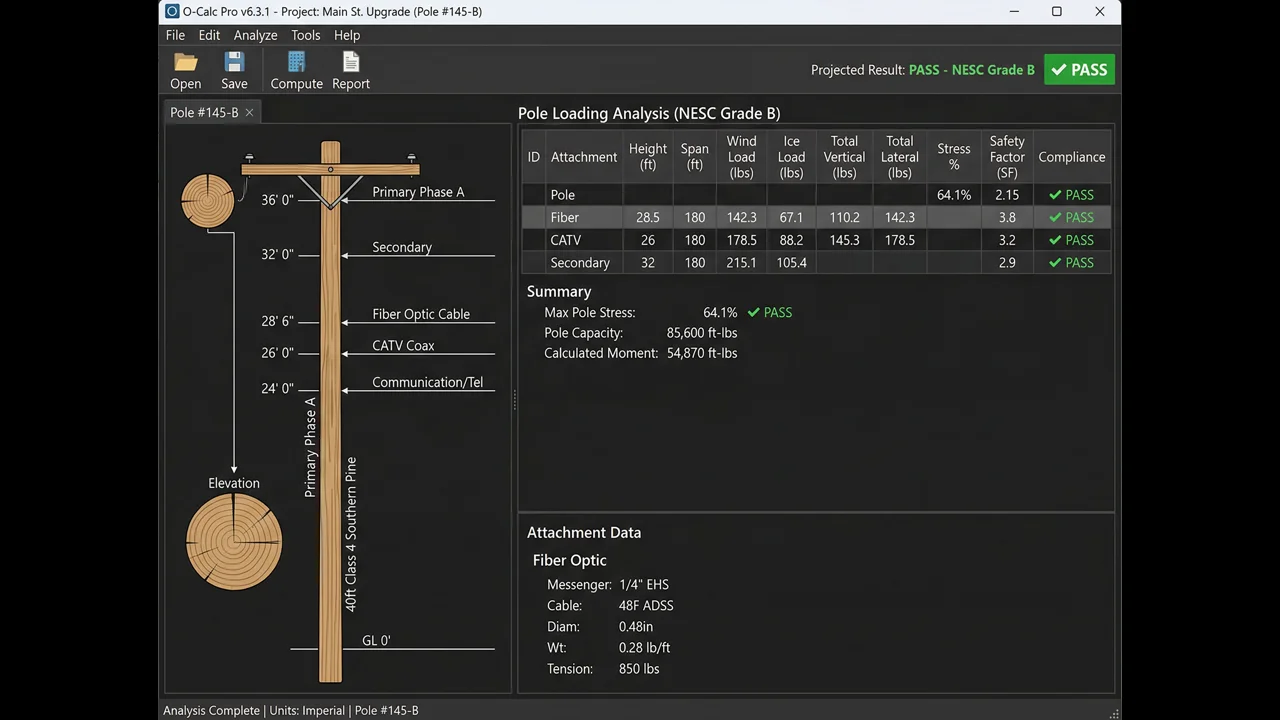
A thorough field survey of 1,000 poles by an experienced crew runs 3–4 weeks in accessible terrain, 5–7 weeks in rural or mountainous conditions. The loading analysis in O-Calc Pro or SPIDA Calc — running each pole's existing attachment data plus proposed attachment through the calculation engine — takes another 2–3 weeks if the survey data is clean. If the field survey data has significant gaps or errors, the loading analysis process doubles in duration as engineers chase down missing attachment heights, cable tensions, and equipment weights.
Our pole loading analysis services include the integrated field survey and loading calculation workflow specifically to compress this phase — collecting standardized field data that feeds directly into the analysis models without manual re-entry. That alone typically saves 1.5–2 weeks compared to field survey and analysis done by separate teams.
Phase 2: Application Submission to Survey Completion (45–90 days)
The FCC allows 45 days for utility survey completion. Most utilities with active joint-use programs hit this target when applications are submitted completely and cleanly. Many don't, for various reasons — staff capacity constraints, competing make-ready requests from multiple applicants, or application deficiencies that the utility uses to restart the clock.
Application deficiencies are a real problem. Utilities have specific application requirements — pole owner, GPS coordinates, pole tag numbers, proposed attachment heights, cable specifications, equipment weight — and missing or incorrect information gives them grounds to request supplemental data, which effectively pauses the review. We've seen utilities request supplemental data three times on a single application, each time restarting the 45-day period. On one project outside Raleigh, NC, a utility's supplemental requests extended the Phase 2 period from 45 days to 127 days. The deficiencies were real — the applicant's field survey had missing attachment data on 23% of poles — but the utility's aggressive use of supplemental requests pushed even legitimate poles past the original timeline.
Phase 3: Make-Ready Cost Negotiation and Authorization (2–8 weeks)
Once the utility completes its survey, it issues a make-ready cost estimate and a list of required work. The applicant then has 14 days to accept or reject. In practice, this phase involves negotiation — especially when the utility's cost estimate is substantially higher than the applicant's estimate based on their own loading analysis.
We've seen make-ready cost estimate disputes add 6–12 weeks to the process. Utilities sometimes include work in make-ready estimates that isn't actually required by the new attachment — existing violations or deferred maintenance they want the new attacher to fund. Challenging these line items requires a detailed review of the loading analysis and often an independent engineering assessment. That's not unreasonable work, but it adds time and requires engineering resources the applicant may not have readily available.
Phase 4: Make-Ready Construction (60–180 days)
Once make-ready is authorized and contractors are mobilized, the actual construction timeline depends on the volume and complexity of work. Simple make-ready — moving a communications cable 6 inches to achieve required vertical clearance — can be done at 40–60 poles per day by an experienced crew. Complex make-ready involving transfer of power supply equipment, pole replacement, or rearrangement of existing communication facilities runs 8–15 poles per day. Heavy pole replacement on routes with steep terrain or poor vehicle access can drop to 3–4 poles per day.
On a project in rural West Virginia involving 312 poles requiring various levels of make-ready — 187 simple, 94 complex, 31 pole replacements — the make-ready construction phase took 23 weeks. The FCC's 75-day target for this phase would have been 11 weeks. The gap was primarily driven by contractor availability during a period when multiple utilities in the same region were processing concurrent make-ready requests from multiple broadband applicants. Labor market constraints in rural West Virginia meant there were exactly two qualified joint-use contractors in the state, and both were committed on other projects for the first 8 weeks of our window.
The contractor availability problem: In rural areas and certain southeastern states, the pool of qualified make-ready contractors is thin. With BEAD funding driving unprecedented levels of simultaneous broadband deployment activity, contractor availability is more constrained than at any point in the last decade. If your make-ready schedule depends on contractor availability, start that conversation before your application is approved — not after.
Make-Ready Timeline Bottlenecks by Utility Type in Fiber Deployment
Not all utilities are created equal in terms of make-ready process speed. The type of utility that owns the poles is often the best predictor of what your timeline will look like.
Investor-Owned Electric Utilities (IOU)
Large IOUs like Duke Energy, Southern Company, and Evergy typically have developed joint-use programs with defined processes, dedicated staff, and established contractor relationships. Timeline compliance varies, but the process is usually predictable — you know what you're getting. Duke's joint-use process in the Carolinas runs about 90–110 days from application to authorization on typical projects, assuming no major disputes. That's above the FCC's 148-day maximum but well within the range we plan for.
Rural Electric Cooperatives (REC)
This is where timelines blow up. Rural electric cooperatives often don't have dedicated joint-use staff. The engineering department handles attachments as a secondary function alongside their primary distribution system work. Backlog can be months. We've submitted complete, clean pole attachment applications to small cooperatives in Alabama and Mississippi and waited 6 months for a survey response — not because they were non-compliant, but because they genuinely didn't have the capacity to process the application faster.
And in states where RECs are exempt from FCC jurisdiction, there's no regulatory mechanism to enforce any timeline. If the cooperative takes 9 months, the applicant's options are to wait, negotiate, or pursue state-level regulatory relief — which, in states with limited broadband-specific regulatory frameworks, may not be a realistic option.
Incumbent LEC Poles (AT&T, Lumen, CenturyLink)
Joint use on incumbent telco poles operates under a different regulatory structure than on electric utility poles. Make-ready timelines on telco poles are generally faster — the incumbents have established processes and the pole counts are typically smaller. The main friction point is dispute over existing attachment data: incumbent telcos don't always maintain accurate records of their own attachments on older poles, which creates loading analysis complications when the field-observed attachment height differs from the utility's records by 14 inches.
Strategies to Compress the Make-Ready Engineering Timeline
Given all of this, what actually works to move make-ready faster?
Submit a perfect application the first time. Supplemental data requests are the most common cause of Phase 2 timeline slippage, and most of them are preventable with thorough field data collection and a complete loading analysis before submission. An application that comes back for missing data once costs 4–6 weeks. One that comes back twice costs 8–12 weeks. Invest in the upfront quality.
Pre-identify complex make-ready poles and start contractor discussions early. If your loading analysis reveals 50 poles requiring complex make-ready, contact qualified contractors before your application is approved. Get them on the schedule in concept. You can't contract for the work until authorization is received — but you can secure a contractor's preliminary schedule commitment, which prevents the 8-week wait for contractor availability after authorization is received.
File applications in batches by utility, not all at once across a large route. A 3,000-pole application submitted to a small cooperative will sit in their queue longer than three 1,000-pole batches filed at staggered 30-day intervals. Counter-intuitive, but the smaller batches often get faster responses because the cooperative's review capacity can actually process them.
Engage the utility's joint-use team before submission. A pre-application meeting to walk through your proposed route, identify poles that are likely problem cases, and introduce your engineering team builds goodwill and often surfaces information about utility-side constraints that affect your timeline — upcoming planned pole work, existing backlog, preference for application format — that you can factor in before you submit.
For more on how pole loading analysis quality affects make-ready timelines, our detailed guide to pole loading analysis with O-Calc Pro covers the data inputs that make the difference between a clean application and a deficiency-riddled one. And if you need permit management support alongside the engineering, our permitting services include the coordination with utility joint-use teams that typically saves 3–5 weeks per project.
Building the Real Make-Ready Timeline Into Your Fiber Project Plan
Here's the planning framework we give clients based on our project data. These are median durations — optimistic projects finish faster, complex ones run longer.
- Field survey and loading analysis: 4–8 weeks
- Application preparation and submission: 1–2 weeks
- Utility survey and response: 7–16 weeks
- Cost negotiation and authorization: 2–8 weeks
- Make-ready construction: 8–24 weeks
- Total median timeline: 22–58 weeks
The median is around 32 weeks — 8 months from decision to begin fieldwork through make-ready authorization. That is the number to put in your project Gantt chart if you have a typical aerial project with a mix of electric and telecom pole ownership. Not 90 days. Not 148 days. Eight months.
If you're planning a fiber deployment and need an honest assessment of the make-ready timeline exposure on your specific pole line — including a utility-by-utility analysis of likely processing time — our team has tracked and documented these timelines across enough utilities to give you real data rather than regulatory theory. Reach out at info@draftech.com. Getting the timeline right before you commit a construction start date is worth the conversation.