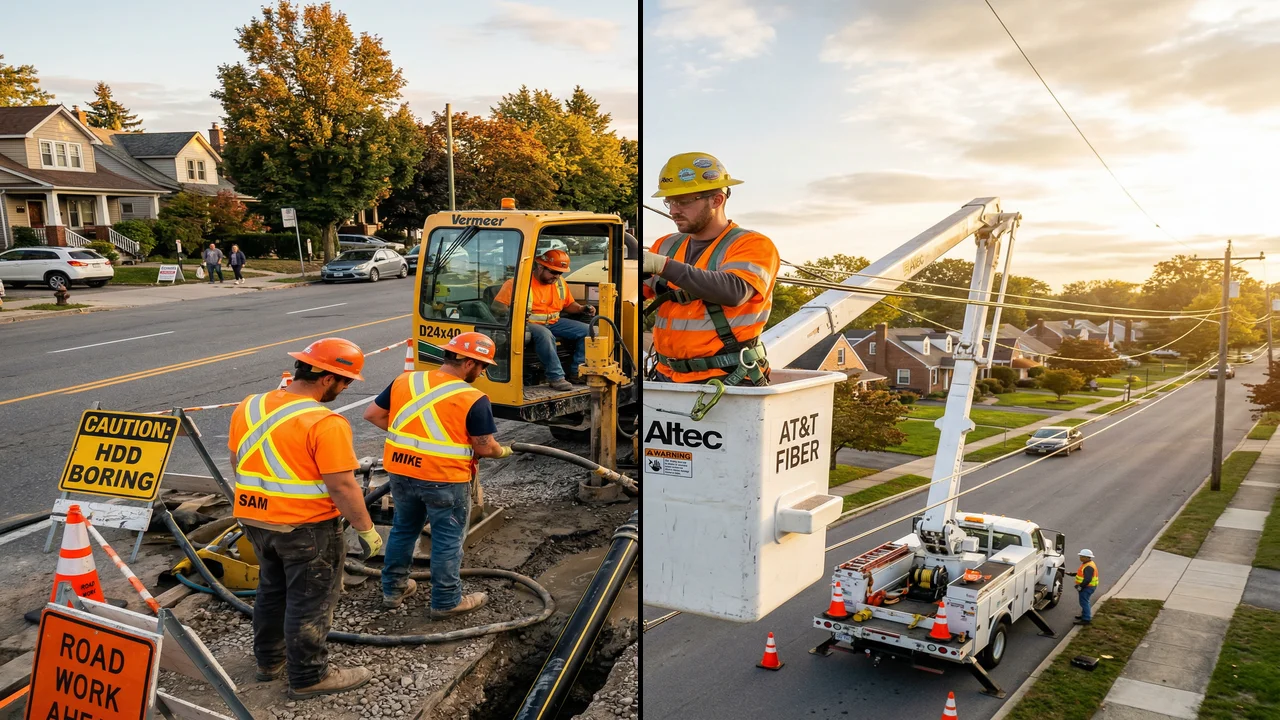
- Aerial Fiber Construction: The Real Cost Range
- Underground Fiber Construction: Where the Numbers Actually Come From
- The Variables That Make or Break Your Budget Assumptions
- When Aerial Wins, When Underground Wins
- Hybrid Construction: Getting It Right Without Getting the Worst of Both
- Cost-Per-Home-Passed: The Number That Actually Matters
Every ISP planning a fiber deployment eventually confronts the same decision: aerial or underground? And every time, someone pulls up an industry report citing averages — $5–8 per foot for aerial, $10–30 for underground — and then tries to build a budget model on those numbers. That approach fails regularly. The ranges are real, but the averages hide the variables that actually determine which side of that range your project lands on. We've engineered and supported construction on over 200 fiber projects across 22 states. This is what aerial vs underground fiber construction cost actually looks like when you break it down from field data.
The short version: aerial is almost always cheaper on a per-foot basis if the pole infrastructure is there and make-ready costs are manageable. Underground wins on long-term maintenance cost, aesthetics-sensitive municipalities, and certain terrain types where aerial isn't viable. Hybrid deployments — the default on most large ISP builds — require careful design to avoid the cost pitfalls of both methods without getting the advantages of either.
Aerial Fiber Construction: The Real Cost Range
Aerial fiber construction costs range from $5 to $14 per foot depending on region, pole density, make-ready requirements, and terrain. The primary cost driver is make-ready scope — poles requiring rearrangements or replacements before fiber attachment add $3,500–$7,000+ per pole in unplanned cost. Rural corridors with clear aerial plant and minimal make-ready run toward the low end; dense suburban routes with aging plant run toward the high end.
The Fiber Broadband Association's most recent cost benchmark data puts aerial construction somewhere between $5 and $14 per foot depending on region and project type. From our project data, that range is accurate — but the spread within it is enormous and driven by four primary variables.
Make-Ready: The Cost That Kills Aerial Budgets
Make-ready is the single largest variable in aerial construction cost. When the utility owns poles and those poles are at or near capacity for attachments, make-ready — the work required to prepare existing poles to accept new attachments — can add $800 to $4,500 per pole to your project cost. And you often don't know what you're facing until the field survey and pole loading analysis are done.
On a project we worked in central Virginia — approximately 340 pole line miles of aerial plant for a rural CLEC — make-ready ran an average of $1,240 per pole across the 2,847 poles that required any work. That's $3.5M in make-ready cost on a project where the initial aerial construction budget assumed $6.80/foot. The actual all-in aerial cost came out to $9.43/foot once make-ready was included. Still competitive with underground — but not the $6.80 the provider had planned.
The make-ready surprise is so common that we now treat it as a budget risk category in every aerial project we design. Without a completed pole loading analysis and make-ready estimate before locking your construction budget, you're guessing.
Aerial Strand Lash vs. Figure-8 Cable
Two dominant aerial methods, meaningfully different costs. Strand lash — where a separate steel messenger wire is first attached to the poles and the fiber cable is then lashed to it — runs approximately $2.10–$3.40 per foot for the lashing work alone, on top of strand and hardware costs. Figure-8 self-supporting cable eliminates the separate strand and lashing labor, but the cable itself is 15–30% more expensive per foot and heavier, which can push marginal poles past NESC loading limits.
On dense pole lines in well-maintained areas where make-ready is minimal and poles are spaced 150–180 feet apart, figure-8 cable often pencils out better despite the cable cost premium. On rural routes with 250–350 foot average span lengths and poles that are already carrying significant NESC wind and ice loading, the additional weight of figure-8 cable can trigger pole replacements that make strand lash the clear cost winner — even accounting for the additional lashing labor.
Aerial cost summary from our project data (all-in, including make-ready where applicable):
— Dense urban/suburban with existing pole infrastructure, light make-ready: $5.20–$7.80/ft
— Suburban/rural mixed terrain, moderate make-ready: $8.40–$11.60/ft
— Rural, aging pole infrastructure, heavy make-ready/replacements: $12.00–$18.70/ft
Underground Fiber Construction: Where the Numbers Actually Come From
Underground fiber construction costs range from $20 to $80+ per foot depending on soil type, construction method (bore vs. trench), depth requirements, and urban congestion. Directional boring through rock or urban utility corridors drives the highest costs. Micro-trenching in stable soils can bring costs below $15/ft in favorable conditions. Subsurface surprises in developed areas are the primary cost risk factor.
Underground costs are more predictable than aerial in one sense — the primary driver is soil type and depth, which you can characterize with a good geotechnical study before you commit to a route. They're less predictable in another sense: subsurface surprises in developed areas can send a project cost through the roof within a single block.
Trenching vs. Directional Boring: Cost by Method
Open-cut trenching is the cheapest underground method where it's allowed. In rural right-of-way with soft or loamy soil, a single 4-inch HDPE conduit trench with fiber installation runs $14–$22 per foot including conduit, fiber, and restoration. In clay soils with significant rock content, that same trench runs $24–$38/foot before you hit any hard rock. At 6 inches or more of continuous rock, you're in blasting or saw-cutting territory and the economics of trenching collapse.
Directional boring (HDD) is the method of choice for road crossings, driveways, paved areas, and environmentally sensitive features. Boring costs vary more than any other underground method — we've seen the same linear footage priced at $18/foot in sandy Gulf Coast soil and $127/foot in granite near Asheville, NC, for the exact same bore diameter and depth. Regional averages are almost meaningless here. Get a geotechnical soil boring before you budget any significant HDD work.
Pneumatic boring (air spade or impact moling) works for short distances — typically under 50 feet — in consistent soil without rocks or significant utility congestion. Cost runs $28–$55/foot depending on soil conditions. It's fast when conditions are right and a disaster when conditions aren't.
Conduit System vs. Direct Buried
A common budget decision: direct-buried armored cable vs. conduit system with non-armored cable. Direct-buried saves on conduit material and installation cost — typically $3–$6/foot less than conduit in comparable conditions. But conduit provides future capacity through additional cable pulls or cable replacement without excavation, and in areas with high rodent damage rates (we've had entire cable runs chewed through in agricultural areas of the Central Valley in California — twice), the conduit protection is non-negotiable.
Our standard recommendation: conduit system on feeder plant always, in any environment with vehicle traffic above the route. Direct-buried is defensible on distribution plant in low-traffic residential areas where the probability of future excavation or cable replacement is low. Don't use direct-buried under paved surfaces. Ever. The cost of excavating asphalt to access or replace a failed direct-buried cable in year 7 is not in any initial budget model, and it's brutal.
Underground cost summary from our project data:
— Soft soil trench, rural ROW, single 4" conduit with fiber: $14–$22/ft
— Mixed soil/urban trenching with paved surface restoration: $28–$48/ft
— HDD in average conditions (no significant rock): $22–$45/ft
— HDD in hard rock: $85–$135/ft
— Urban duct bank (4+ conduits, concrete encased): $65–$120/ft
The Variables That Make or Break Your Budget Assumptions
Beyond the base construction method, five variables consistently push projects to the high end of their cost range — or over it.
Traffic Control
Any underground work in a state highway ROW requires a traffic control plan and often a lane closure permit. In states with active construction seasons and high permit volume — Ohio, Michigan, Pennsylvania — permit approval can take 6–8 weeks and cost $1,800–$4,200 per permit depending on roadway classification. Traffic control labor and equipment for a single lane closure on a 4-lane state highway runs $2,800–$4,500 per day. That's before any construction work is done. Projects that don't budget traffic control separately from construction often get hit hard in this category.
Our permitting services include traffic control plan preparation and permit management specifically because this is where so many construction projects encounter avoidable delays and costs. A properly prepared MOT plan submitted 10 weeks before construction start is worth far more than the fee to produce it.
Rock and Subsurface Surprises
The midwest and southeast have a split personality on soil conditions. The Mississippi River corridor and coastal plain areas have deep, workable soil. The Appalachian range, the Ozarks, and the limestone karst zones of Tennessee and Kentucky can hit continuous rock at 18 inches of depth with no warning from surface indicators. On a project outside Knoxville, TN, we transitioned from $21/foot trenching to $94/foot saw-cutting within a single cable mile because the limestone shelf was shallower on the eastern side of the ridge than the geotechnical study had predicted. That project's underground cost was $31/foot overall — reasonable — but 0.8 miles of it was $94/foot, which burned through the contingency budget entirely.
Permit and Restoration Requirements by Jurisdiction
Pavement restoration requirements vary wildly by municipality. Some counties accept cold-patch temporary restoration followed by permanent hot-mix within 90 days. Some require full-depth pavement replacement for any excavation in the travel lane within 5 years of the last pavement overlay — which can mean milling and replacing an entire lane width even if your trench is 10 inches wide. One municipality outside Atlanta required a concrete cap over any trench in a state-maintained road — adding $7.40/foot to every underground segment that crossed a state highway. We didn't know about that requirement until the permit review comments came back, because it was a local ordinance, not a state standard.
Utility Conflict and Relocation
Underground fiber routes in developed areas frequently conflict with existing utilities. Most conflicts are manageable — adjust the bore angle, lower the conduit depth, hand-excavate around a water main. Some aren't. A gas main relocation that blocks a planned route can cost $25,000–$80,000 and add 8–16 weeks to the schedule. These situations are almost always visible in a thorough utility conflict study before construction. They're almost never included in the original budget if the conflict study wasn't done.
When Aerial Fiber Construction Wins vs. Underground Fiber Construction
Aerial fiber construction wins on cost in rural and suburban corridors where utility poles already exist along the route — typically $5–$10/ft versus $20–$60/ft for underground bore. Underground wins when road crossings, aesthetics, local ordinances, or long-term reliability requirements outweigh the higher upfront cost. Most builds use a hybrid approach determined by segment-by-segment analysis.
Aerial wins when: Pole infrastructure exists and is in good condition, make-ready is light or manageable, the service area doesn't have aerial ban restrictions, the terrain is workable for bucket truck access, and the timeline is a priority (aerial construction moves significantly faster than underground in most conditions).
Underground wins when: There are no existing poles or poles are in poor condition requiring mass replacement, the municipality requires underground plant, the terrain has features that make aerial maintenance difficult (dense forest canopy, high wind/ice loading zones), long-term maintenance cost is a primary consideration, or the project is in an area with high storm or hurricane risk where aerial damage is a near-certainty during the network's life.
Coastal Mississippi, for example, is not an aerial-first region. The storm risk alone drives most providers to underground construction even though the initial cost premium is significant. A provider that builds aerial in Hancock County, MS, will spend more on storm restoration in a 15-year network life than the underground premium would have cost upfront.
Hybrid Construction: Getting It Right Without Getting the Worst of Both
Most large FTTH deployments end up hybrid — aerial feeder plant where poles exist, underground for road crossings and bore points, underground distribution in HOA areas or municipalities that prohibit aerial, aerial drops where lot conditions allow. Hybrid design done well produces efficient, cost-effective builds. Hybrid design done carelessly produces construction packages where the method transitions aren't properly engineered and the crew spends half their time problem-solving transitions that should have been resolved in design.
The critical engineering document in a hybrid design is the aerial-to-underground (A/U) transition detail. Every A/U point needs a specified riser conduit, conduit support method, vault or handhole location, and cable handling specification. A transition that's labeled "per standard detail" on the construction drawing but actually doesn't have a standard detail in the package will be built differently by every crew that encounters it. We've seen six different interpretations of an undocumented A/U transition on a single project — every one of them technically functional, none of them consistent, all of them creating maintenance documentation headaches.
For a full picture of how FTTH design decisions at the HLD phase set the conditions for these construction cost outcomes, our breakdown of common FTTH HLD design mistakes covers the upstream decisions that determine aerial vs. underground cost exposure before a single permit is filed.
Cost-Per-Home-Passed: The Number That Actually Matters
Per-foot construction cost is a useful engineering metric. It's not the number your CFO or your BEAD grant manager is going to care about. They care about cost per home passed and cost per connected subscriber.
From our project data across 22 states, all-in cost per home passed — including design, permitting, make-ready, construction, and drop installation but excluding CPE — runs:
- Dense suburban aerial: $680–$1,100 per passing
- Suburban mixed aerial/underground: $1,050–$1,750 per passing
- Rural aerial with moderate make-ready: $1,400–$2,600 per passing
- Rural underground, soft soil: $2,100–$3,800 per passing
- Rural underground, hard rock terrain: $4,200–$7,500+ per passing
Those ranges have widened over the past three years with labor and material cost inflation. The Fiber Broadband Association's most recent data confirms the upward trend, particularly for underground construction in competitive labor markets. Projects that were budgeted at $1,800/passing two years ago are coming in at $2,200–$2,400 today with the same physical plant design.
The implication for BEAD-funded projects specifically: construction budgets that were built on 2023 cost data and submitted with 2024 grant applications may be materially underfunded. We're seeing this across multiple state programs. If you're approaching your construction window with a 12–18 month old budget model, a cost reconciliation against current contractor pricing in your specific geography is not optional — it's necessary before you can commit a construction schedule.
Our FTTH design team can provide construction cost modeling as part of the design process, grounded in current contractor pricing data and terrain-specific assumptions for your actual service area. If you're planning a deployment or reviewing a budget that was built on older cost data, reach out at info@draftech.com. Getting the cost assumptions right before you commit to a construction schedule is worth every hour it takes.